

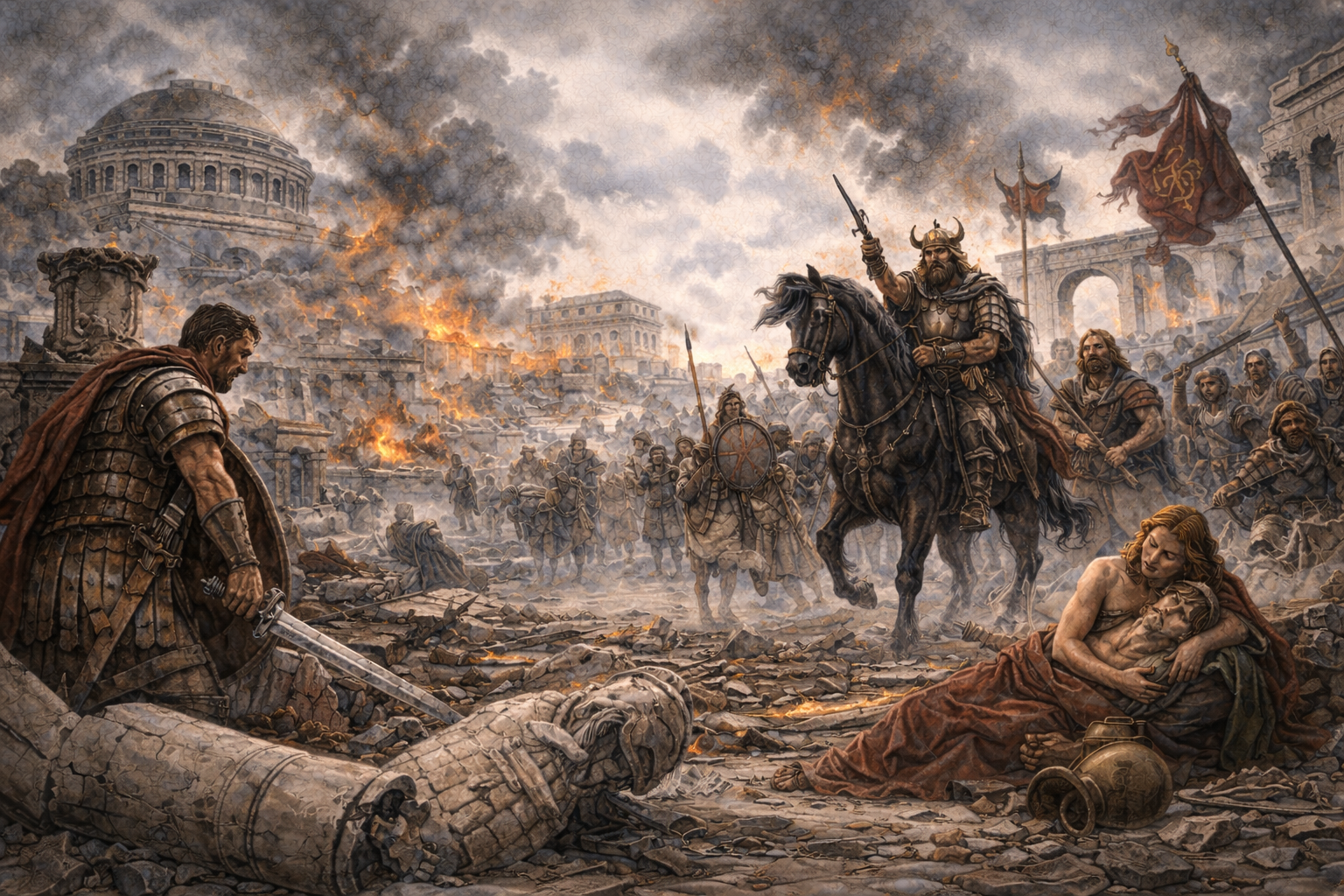
5th Century: Rome’s Twilight
p3≈ 400 à 476 ap. J.-C.
The 5th century marked the end of the Roman world in the West.
For two centuries, the Empire had been weakened by economic crises, civil wars, and growing pressure from Germanic peoples.
At the start of the 5th century, Gaul became a strategic territory where Romans, migrating peoples, and new barbarian kingdoms collided.
This century saw imperial authority disappear and the first medieval kingdoms emerge.
⚖️ A divided Empire (395–410)
In 395, after the death of Emperor Theodosius I, the Roman Empire was permanently divided into two parts:
- Western Roman Empire
- Eastern Roman Empire (Byzantium)
The West, ruled by Honorius, was far more fragile.
The economy was weakened and the army depended increasingly on soldiers of barbarian origin.
The Empire’s true defender was General Stilicho, of Vandal origin.
 Depiction of General Stilicho, the last great defender of the Western Roman Empire — Source: Wikimedia Commons
But in 408, Stilicho was accused of treason and executed.
Without him, the Empire lost its main military strategist.
Soon after, the Visigothic leader Alaric marched on Rome.
In 410, the city was sacked for the first time in nearly 800 years.
 The sack of Rome by the Visigoths in 410 — Source: Wikimedia Commons
The event sent shockwaves through the Roman world.
🔍 Zoom — A torn Empire: Alaric, Stilicho, and the usurpers
❄️ The winter of 406: the Rhine is crossed
On the night of 31 December 406, a decisive event changed the history of Gaul.
The Rhine froze, allowing several peoples to cross the Roman frontier.
 Map of the major Germanic migrations in the 5th century — Source: Wikimedia Commons
Three main peoples crossed the border:
- Vandals
- Suebi
- Alans
These peoples did not only seek plunder.
They were themselves fleeing the pressure of the Huns, coming from the Asian steppes.
They crossed Gaul, devastating regions before eventually settling in Spain.
Rome was unable to react effectively.
🔍 Zoom — The frozen Rhine: the great breakthrough of 406
🏹 Attila and the threat of the Huns
In the middle of the 5th century, a new danger appeared: the Huns.
This people of nomadic horsemen from Central Asia terrorised Europe.
Their leader, Attila, became one of the most feared enemies of the Roman Empire.
 Attila, king of the Huns, nicknamed “the Scourge of God” — Source: Wikimedia Commons
🔍 Zoom — Attila and the Huns: terror from the steppes
In 451, Attila invaded Gaul.
To resist him, an unprecedented coalition formed:
- Roman armies
- Visigoths
- Franks
- Burgundians
This coalition was led by the Roman general Aetius.
The decisive battle took place on the Catalaunian Plains.
 The Battle of the Catalaunian Plains (451) — Source: Wikimedia Commons
Attila was driven back, but the Western Empire was now deeply weakened.
🏰 Barbarian kingdoms appear
During the 5th century, several Germanic peoples settled permanently within Roman provinces.
In Gaul, new kingdoms emerged:
- Visigoths in the southwest
- Burgundians in the Rhône valley
- Franks in the north
These kingdoms often preserved part of Roman institutions:
- administration
- taxation
- Roman law
Gallo-Roman elites therefore continued to play an important role in these new states.
🛡️ 476: the official end of the Empire
In 476, the Germanic military leader Odoacer deposed the last Western Roman emperor:
Romulus Augustulus.
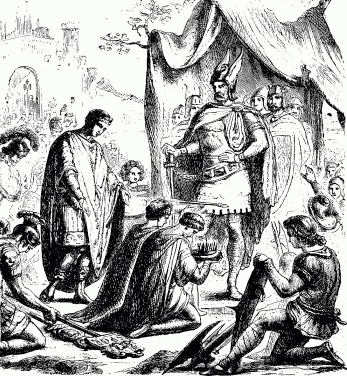 Illustration: Romulus Augustulus, last Western emperor, removes his crown before Odoacer — Source: Wikimedia Commons
Odoacer did not appoint a new emperor.
He simply recognised the authority of the Eastern emperor.
For historians, this date marks the end of the Western Roman Empire and the transition to the Middle Ages.
🔍 Zoom — 476: the end of a world and the rise of Clovis
✝️ The Church: the only stable institution
As Roman administration disappeared, one institution remained strong:
the Christian Church.
Bishops became central figures in cities.
They organised:
- aid for the poor
- protection for inhabitants
- political mediation
In many regions, the Church became the main link between the Roman world and the new barbarian kingdoms.
🔍 Zoom — Why the Roman state collapses (and the Church survives)
👑 Clovis and Gaul’s future
At the end of the 5th century, a young Frankish king gradually rose to dominance.
Clovis, king of the Salian Franks, took the throne in 481.
He would conquer much of Gaul and lay the foundations of the future Kingdom of the Franks.
His reign opened a new era: that of medieval kingdoms.
🔍 Zoom — Clovis: founder of the Kingdom of the Franks
🧠 Key takeaways
- The 5th century marks the end of the Western Roman Empire.
- The great migrations reshaped Gaul.
- Attila and the Huns threatened Europe in 451.
- Several barbarian kingdoms settled in Gaul.
- The Church became the most stable institution in society.
📸 Image credits
- Map of Germanic invasions — William Robert Shepherd, Public domain, via Wikimedia Commons
- Stilicho — User:O.Mustafin, CC0, via Wikimedia Commons
- Sack of Rome (410) — RaGoix, CC BY-SA 4.0 https://creativecommons.org/licenses/by-sa/4.0, via Wikimedia Commons
- Attila — Vincze József, Czinege István, CC BY-SA 4.0 https://creativecommons.org/licenses/by-sa/4.0, via Wikimedia Commons
- Battle of the Catalaunian Plains — No machine-readable author provided. MapMaster assumed (based on copyright claims)., CC BY-SA 3.0 http://creativecommons.org/licenses/by-sa/3.0/, via Wikimedia Commons
- Romulus Augustulus — Yonge, Charlotte Mary, (1823-1901), Public domain, via Wikimedia Commons