

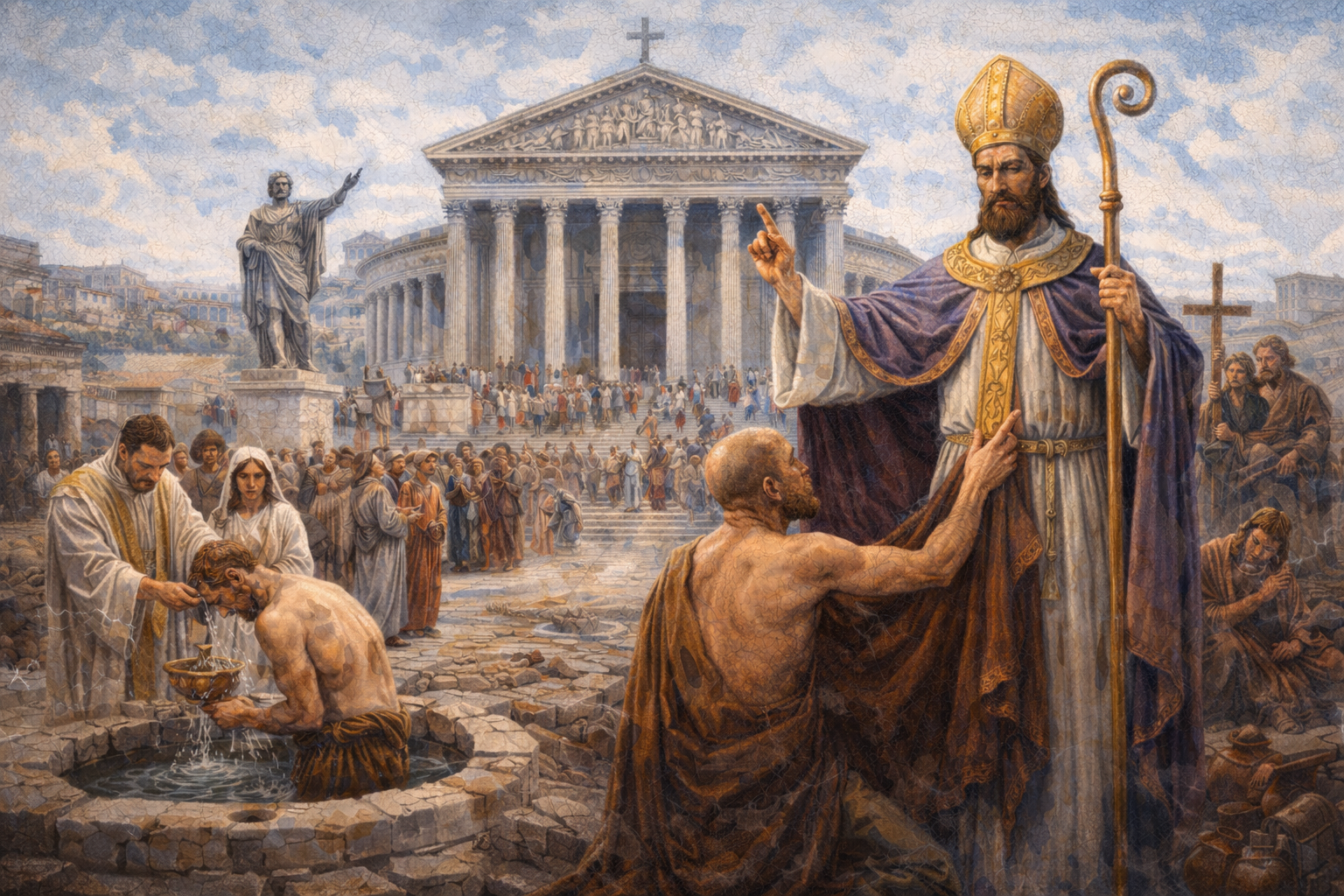
4th Century: The Christian Empire
p3≈ 300 à 400 ap. J.-C.
The 4th century brought a profound transformation to the Roman world.
After the Crisis of the 3rd century, the Empire stabilised thanks to the reforms of Diocletian and Constantine. But this reconstruction came with an even deeper revolution: the rise of Christianity.
In less than a hundred years, a religion once persecuted became the dominant religion of the Empire.
In Gaul, this religious transformation is embodied by a major figure: Saint Martin of Tours.
🏛️ Reforms that saved the Empire
At the end of the 3rd century, Emperor Diocletian set out to rescue the Roman Empire from chaos.
He introduced a new political system: the Tetrarchy.
The Empire was now ruled by four emperors:
- two Augusti
- two Caesars
This system made it easier to defend the frontiers and stabilise administration.
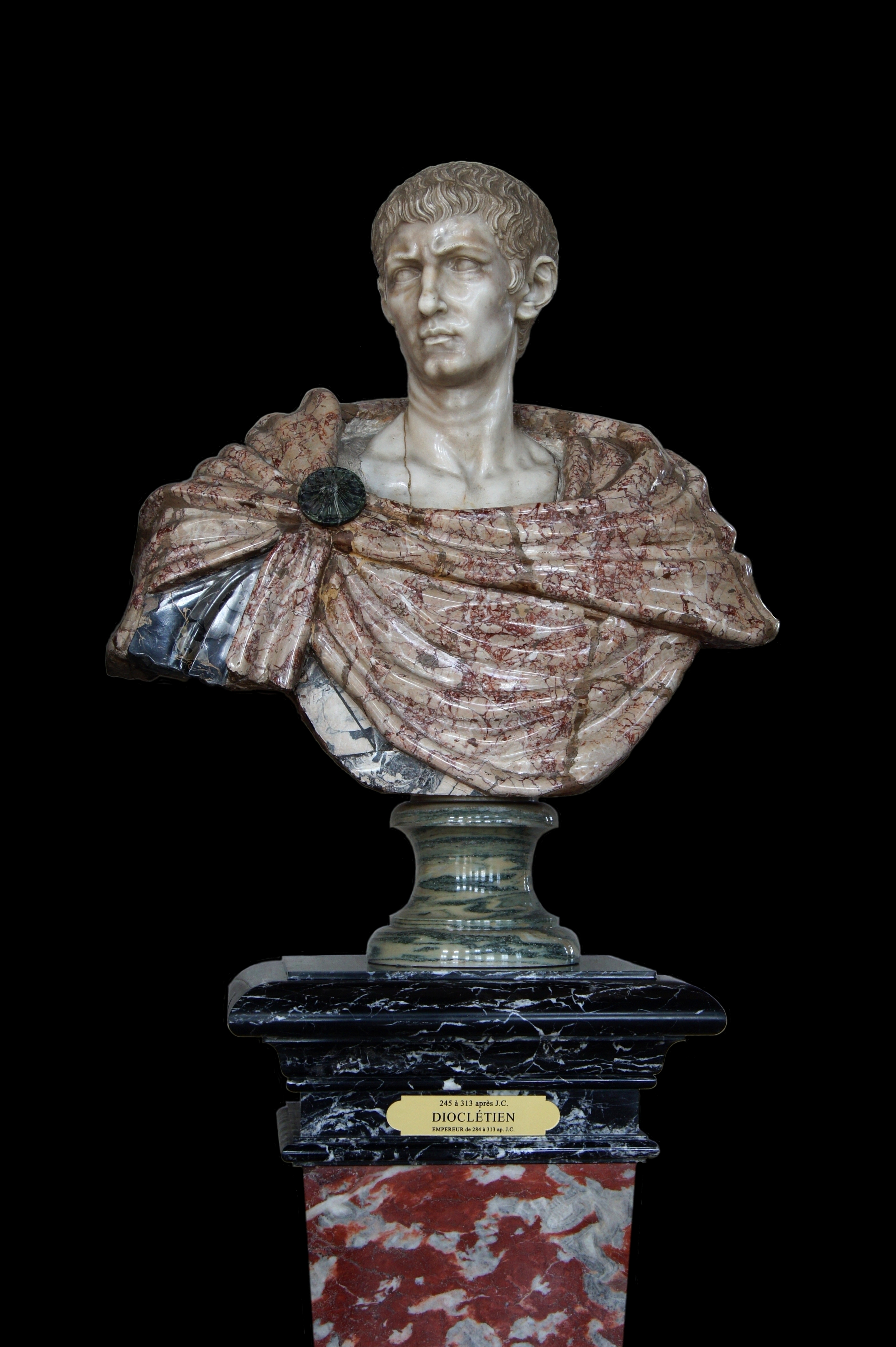 Bust of Emperor Diocletian, founder of the Tetrarchy — Source: Wikimedia Commons
🏛️ Constantine and the Edict of Milan (313)
Emperor Constantine radically changed the Empire’s religious policy.
In 313, together with Licinius, he issued the Edict of Milan, which guaranteed religious freedom across the Empire.
Christianity became a religion that was legal and protected.
 Solidus of Constantine II, son of Constantine the Great — Source: Wikimedia Commons
Constantine also favoured Christians:
- funding basilicas
- privileges for the clergy
- support for bishops
🏙️ Trier: an imperial capital in Gaul
In the 4th century, Trier (Augusta Treverorum) became one of the capitals of the Western Roman Empire.
Several emperors resided there, including:
- Constantine
- Valentinian
- Gratian
The city was equipped with monumental buildings:
- an imperial palace
- baths
- an amphitheatre
- the famous Porta Nigra
 The Porta Nigra of Trier, a Roman monument from the 4th century — Source: Wikimedia Commons
Trier also became an important Christian centre.
📈 The Empire’s conversion
During the 4th century, Christianity progressed rapidly.
Gallo-Roman elites gradually adopted the new religion.
Cities began to see:
- the first Christian basilicas
- powerful bishoprics
- ecclesiastical institutions
The decisive turning point came in 380.
Through the Edict of Thessalonica, Emperor Theodosius I made Christianity the official religion of the Empire.
Pagan cults were progressively banned.
⛪ The Church takes shape
The Church adopted an organisation inspired by Roman administration.
Each major city had a bishop.
Bishops gradually became central figures in society:
- religious leaders
- arbiters of conflicts
- protectors of the poor
To settle religious debates, emperors convened councils.
The most famous is the Council of Nicaea (325).
 Depiction of the Council of Nicaea — Source: Wikimedia Commons
🔍 Zoom — Organisation of the Church: hierarchy and power
🏰 Fortified cities
Despite the Empire’s recovery, threats remained strong.
Gallo-Roman towns changed.
They abandoned their open urban layout and withdrew behind powerful walls.
These fortified cities were called castra.
 Illustration: the Gallo-Roman walls of Senlis — Source: Wikimedia Commons
🔍 Zoom — From forum to castrum: the birth of fortified towns
🧣 Saint Martin: apostle of the countryside
While cities converted quickly, the countryside remained attached to older beliefs for a long time.
A former Roman soldier played a decisive role: Martin of Tours.
 Statue of Saint Martin — Source: Wikimedia Commons
Born around 316, Martin became bishop of Tours.
He founded:
- the monastery of Ligugé, the first monastery in Gaul
- the monastery of Marmoutier
He travelled through rural areas to destroy old pagan temples and convert countryside populations.
His famous gesture of sharing his cloak at Amiens symbolises the Christian ideal of charity.
🔍 Zoom — Saint Martin: apostle of the countryside
🌪️ Resistance and tensions
Christianisation did not happen without opposition.
Some elites remained attached to pagan traditions.
In rural areas, older cults persisted for a long time.
The word “pagan” comes from the Latin paganus, meaning “villager” or “peasant”.
At the same time, social revolts broke out in some regions:
the Bagaudae, groups of peasants rising up against taxation and Roman authority.
🔍 Zoom — Opposition and Bagaudae: resisting the new order
🧠 Key takeaways
- The 4th century saw the gradual conversion of the Roman Empire.
- Constantine legalised Christianity in 313.
- Theodosius made it the official religion in 380.
- Bishops became central figures in society.
- Saint Martin played a major role in Christianising the countryside.
📸 Image credits
- Bust of Diocletian — Jebulon, Public domain, via Wikimedia Commons
- Coin of Constantine II — Münzkabinett Berlin, Public domain, via Wikimedia Commons
- Porta Nigra of Trier — Thomas Wolf, www.foto-tw.de, CC BY-SA 3.0 DE https://creativecommons.org/licenses/by-sa/3.0/de/deed.en, via Wikimedia Commons
- Council of Nicaea — Cesare Nebbia, Public domain, via Wikimedia Commons
- Walls of Senlis — Naudet, Public domain, via Wikimedia Commons
- Statue of Saint Martin — Chabe01, CC BY-SA 4.0 https://creativecommons.org/licenses/by-sa/4.0, via Wikimedia Commons