

Gaul in the Christian Empire
p3300 à 400
In the 4th century, Gaul is part of a Roman Empire that has been profoundly transformed. After the crises of the previous century, imperial power strengthens and reorganises, while a major shift takes place: Christianity gradually becomes the dominant religion.
This period is marked by a fragile balance. Gaul remains a strategic and relatively stable region, but it faces growing threats on the frontiers and internal political tensions. It thus becomes a key space within an Empire in transition.
🏛️ A reorganised and recentred Empire
At the start of the 4th century, the Roman Empire builds on the reforms launched at the end of the previous century under Diocletian. Imperial power is now more authoritarian and centralised, surrounded by a hierarchised and more efficient administration. Provinces are subdivided, governors are more tightly supervised, and fiscal control is strengthened. This organisation helps the Empire manage a vast territory more effectively, but it also makes its functioning heavier.
 The Roman Empire in AD 330 — Source: Wikimedia Commons
The army also undergoes a deep reorganisation. Forces are divided between frontier troops responsible for defending the Empire’s limits and mobile units able to intervene rapidly in times of crisis. This system aims to respond more effectively to invasions and internal unrest, which have become frequent since the 3rd century.
In this new balance, Gaul holds an essential strategic position. Located near the Rhine, the main frontier facing Germanic peoples, it becomes a major centre of imperial power in the West. The city of Trier asserts itself as a true political and military capital. It hosts the imperial court, important administrations, and serves as a base for military campaigns toward the north.
This proximity to the frontier explains the strong military presence in the region. Roads, fortifications, and camps are maintained or reinforced, making Gaul a key space in the defence of the Empire.
From the beginning of the century, tensions remain acute. In 306, Germanic peoples such as the Franks cross the Rhine. Constantine intervenes quickly, repels the invaders, and conducts operations beyond the river. These campaigns show that the Empire still retains offensive capacity—able not only to defend its borders, but also to project power into enemy territory.
Thus, the beginning of the 4th century corresponds to a phase of reorganisation and consolidation. The Empire appears strengthened, better structured, and able to maintain its authority, even if border tensions remain permanent.
✝️ The Christian transformation of the Empire
The 4th century marks a decisive religious turning point in the history of the Roman Empire. In the span of a few decades, Christianity moves from being a marginal and sometimes persecuted religion to becoming the dominant faith, closely linked to imperial power.
 Religious distribution in the Roman Empire in AD 330 — Source: Wikimedia Commons
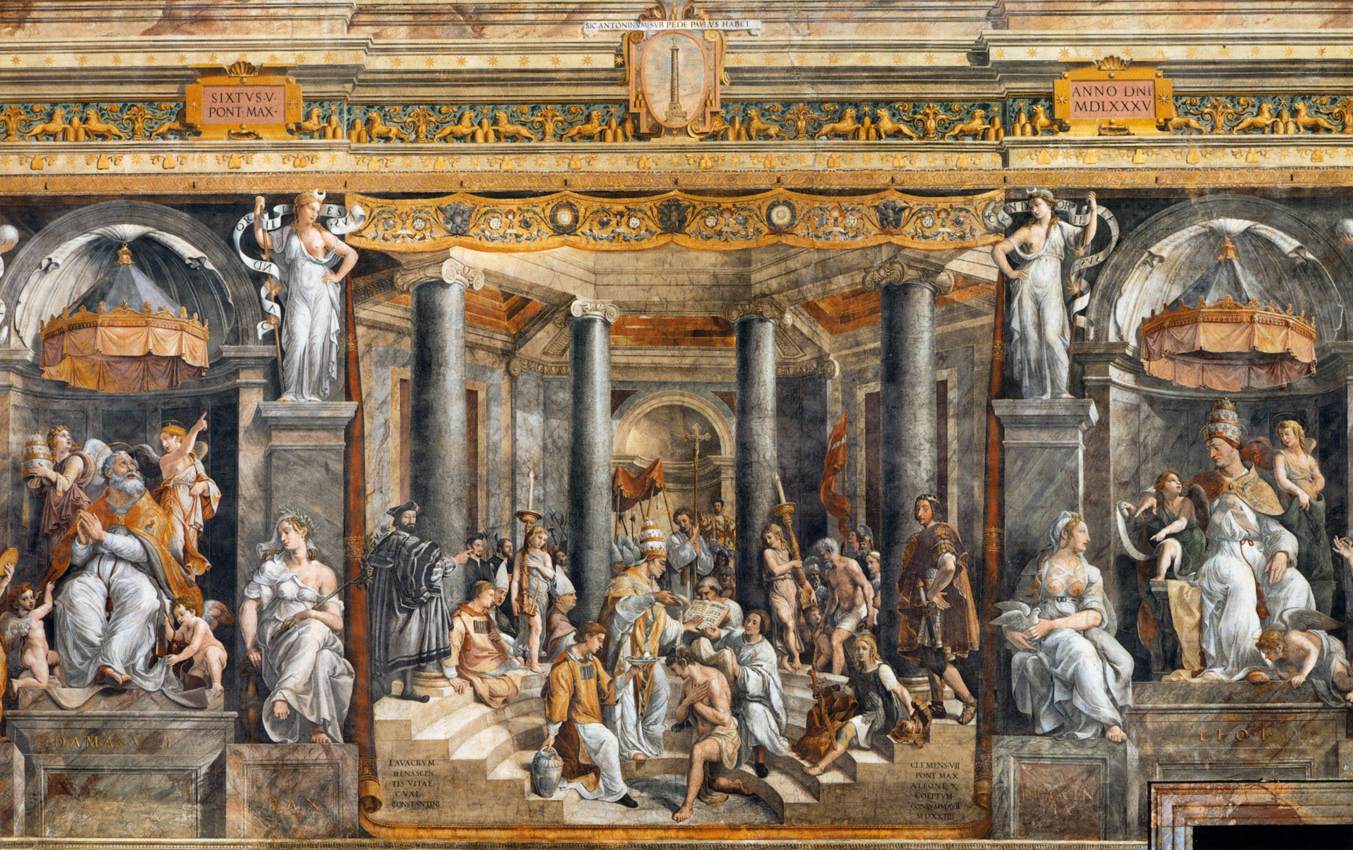
This evolution begins with the end of the great persecutions. In 311, an edict of toleration brings repressive measures against Christians to an end. Two years later, in 313, Emperor Constantine officially guarantees freedom of worship. Christianity becomes an authorised religion, on the same footing as traditional cults.
However, this equality proves short‑lived. After his victory in 312, Constantine grants increasing support to the Christian religion. He favours the Church, grants it privileges, finances the construction of basilicas, and intervenes in religious organisation. At the same time, some pagan temples lose resources or importance, signalling a gradual shift.
Imperial power now plays a direct role in religious affairs. Emperors convene councils to define doctrine and resolve internal divisions within Christianity. This intervention helps structure a more organised and unified religion at the scale of the Empire.
 The baptism of Constantine I — Source: Wikimedia Commons
Over the course of the century, Christianity gradually asserts itself within society. Elites convert, religious institutions develop, and the Christian presence becomes visible in cities as well as in the administration.
The decisive turning point comes in 380, when Emperor Theodosius makes Christianity the official religion of the Empire. Traditional cults, previously tolerated, are progressively marginalised. This decision does not immediately erase older practices, but it profoundly reshapes the religious balance.
Thus, the 4th century witnesses the birth of a Christian Empire. This transformation is not limited to religion: it influences institutions, mentalities, and social life, and durably shapes the evolution of the Roman world, including in Gaul.
⛪ Christianity in Gaul
In the 4th century, Christianity experiences rapid and lasting growth in Gaul. First rooted in major cities, the new religion is organised around a network of bishoprics that structure religious and social life. Centres such as Lyon, Arles, Tours, and Poitiers become important hubs for the spread of Christianity.
Bishops take on an increasingly central role. They do not limit themselves to spiritual leadership: they also intervene in public life, participate in managing communities, and sometimes act as intermediaries between populations and imperial power. Their authority strengthens the Church’s influence within Gallo‑Roman society.
Certain figures particularly mark this period. Martin of Tours, for example, plays a major role in evangelising the countryside. Unlike earlier centuries, Christianity is no longer confined to urban environments: it gradually extends into rural areas, where it seeks to replace or integrate older religious practices.
This diffusion goes hand in hand with a transformation of the religious landscape. Churches are built, places of worship multiply, and Christian communities organise in a more structured way. Christianity becomes a visible and central element of collective life.
However, this progress is not without resistance. Pagan traditions remain strong, especially in the countryside, where they continue to be practised for several generations. Christianisation is therefore a gradual process, combining continuity and transformation.
Thus, in the 4th century, Gaul fully joins the Empire’s wider movement of Christianisation. The Christian religion progressively establishes itself as a structuring framework of society, preparing the developments of the following century.
⚔️ Gaul at the heart of imperial conflicts
In the 4th century, Gaul remains a major strategic space in the power struggles that run through the Roman Empire. Because of its wealth, its important cities, and the presence of many legions, it is a key territory for any claimant to imperial power.
 Constantius II’s campaign against Magnentius — Source: Wikimedia Commons
In the middle of the century, the region is directly involved in a civil war. In 353, the usurper Magnentius, who had proclaimed himself emperor in the West, is pursued by the legitimate emperor Constantius II. After several clashes, he is ultimately defeated and commits suicide at Lugdunum (Lyon). This episode illustrates the violence of internal conflicts and their direct impact on Gaul, which becomes a battlefield between rival armies.
In the years that follow, the region remains unstable. Military campaigns against Germanic peoples are accompanied by internal tensions, sometimes aggravated by supply difficulties or mutinies, revealing the fragility of imperial control.
At the end of the century, new struggles break out. In 392, the general Arbogast, master of the army in Gaul, imposes one of his close associates, Eugenius, as emperor of the West. This decision triggers a conflict with Emperor Theodosius, who refuses to recognise this regime.
These events show that imperial power remains contested and depends heavily on the support of the armies. Gaul, because of its strategic position and military forces, plays a central role in these rivalries.
Thus, despite the century’s reforms, the Empire remains politically fragile. Internal struggles weaken its unity and contribute to the tensions that will mark the end of the 4th century.
🛡️ A frontier under pressure
Throughout the 4th century, the Rhine frontier remains one of the Empire’s most sensitive points. Although fortified and watched by garrisons, it remains a zone of constant contact with Germanic peoples.
The situation worsens especially in the middle of the century. In 355, a series of invasions strikes Gaul hard: the Franks and the Alamanni cross the Rhine at several points and advance deep into the interior. Many cities—including Trier, Cologne, and Mainz—are attacked and sometimes sacked. Some regions are devastated, and Roman authority is temporarily weakened.
In response to this crisis, imperial power sends substantial reinforcements. In 357, Julian, then Caesar in Gaul, leads a decisive campaign. He confronts the Alamanni near Strasbourg and wins a major victory, which restores the situation and provisionally secures the frontier.
However, these successes remain fragile. Incursions do not stop and resume regularly over the following decades. Some Germanic groups do not merely plunder: they settle durably near, and even within, Roman territories, sometimes with the authorities’ agreement as “federated” peoples.
Thus, the Rhine frontier is no longer a stable barrier, but an unstable and shifting zone. This constant pressure weakens Gaul and foreshadows the great invasions of the next century.
🛡️ A frontier under pressure
Throughout the 4th century, the Rhine frontier remains one of the Empire’s most sensitive points. Although fortified and watched by garrisons, it remains a zone of constant contact with Germanic peoples.
The situation worsens especially in the middle of the century. In 355, a series of invasions strikes Gaul hard: the Franks and the Alamanni cross the Rhine at several points and advance deep into the interior. Many cities—including Trier, Cologne, and Mainz—are attacked and sometimes sacked. Some regions are devastated, and Roman authority is temporarily weakened.
In response to this crisis, imperial power sends substantial reinforcements. In 357, Julian, then Caesar in Gaul, leads a decisive campaign. He confronts the Alamanni near Strasbourg and wins a major victory, which restores the situation and provisionally secures the frontier.
However, these successes remain fragile. Incursions do not stop and resume regularly over the following decades. Some Germanic groups do not merely plunder: they settle durably near, and even within, Roman territories, sometimes with the authorities’ agreement as “federated” peoples.

Barbarian invasions — Source: Wikimedia Commons
Thus, the Rhine frontier is no longer a stable barrier, but an unstable and shifting zone. This constant pressure weakens Gaul and foreshadows the great invasions of the next century.
⚖️ The division of the Empire (395)
At the end of the 4th century, a major turning point occurs. In 395, upon the death of Emperor Theodosius, the Roman Empire is definitively divided between his two sons.
The western part, which includes Gaul, goes to Honorius, while the East is governed from Constantinople. Unlike earlier divisions, this separation is no longer temporary: it becomes lasting.
This development has major consequences. The Western Empire, less wealthy and more exposed to invasions, proves more fragile. The East, by contrast, remains more stable and better protected.
For Gaul, this situation is decisive. Now attached to a weakened Western Empire, it will be on the front line when the crises of the following century unfold.
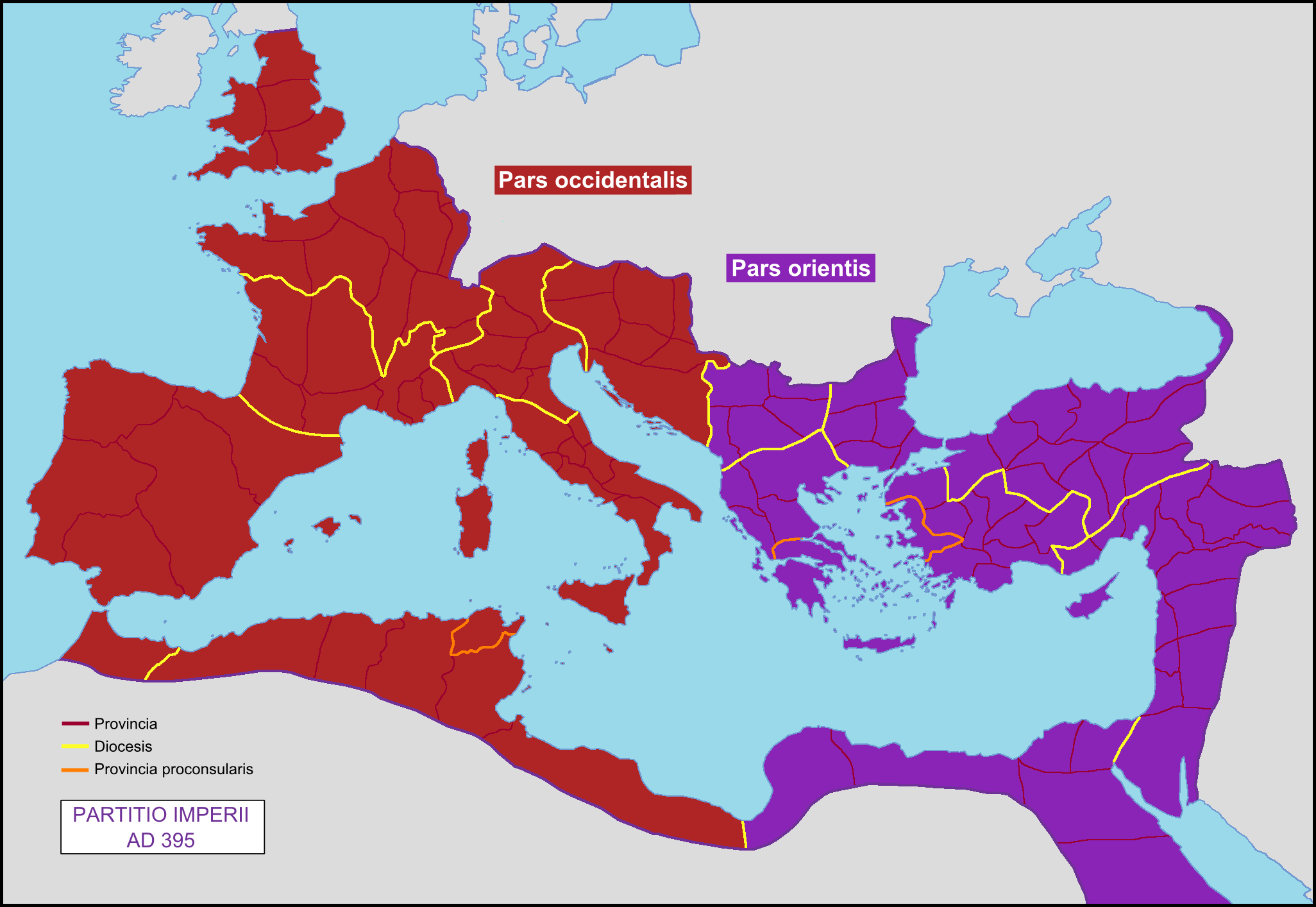
Division of the Empire — Source: Wikimedia Commons
Thus, the division of 395 does not immediately cause the Empire’s fall, but it deepens its vulnerabilities and prepares the upheavals of the 5th century.
Conclusion
Between 300 and 400, Gaul is part of an Empire undergoing major transformation. Imperial power strengthens, administration is restructured, and Christianity gradually asserts itself as the dominant religion.
However, this stability remains fragile. Political tensions, invasions, and population movements foreshadow major upheavals.
Thus, the 4th century appears as a pivotal period: it does not yet mark the fall of the Empire, but it prepares the profound transformations of the 5th century, when the balance of the Roman world will be definitively called into question.
Image credits
- The Roman Empire in AD 330: Doll91939, CC BY-SA 4.0 https://creativecommons.org/licenses/by-sa/4.0, via Wikimedia Commons
- Religious distribution in the Roman Empire in AD 330: Claude Zygiel, Public domain, via Wikimedia Commons
- The baptism of Constantine I: Raphael, Public domain, via Wikimedia Commons
- Constantius II’s campaign against Magnentius: Panairjdde, CC BY-SA 2.5 https://creativecommons.org/licenses/by-sa/2.5, via Wikimedia Commons
- Barbarian invasions: User:MapMaster, CC BY-SA 2.5 https://creativecommons.org/licenses/by-sa/2.5, via Wikimedia Commons
- Division of the Empire: Mandrak, Public domain, via Wikimedia Commons