


Charlemagne: Inherit, Conquer, Scale Up (768–814)
p4768 à 814
In 768, Pepin the Short dies. For the Frankish world, it is a turning point: the Carolingian dynasty is established, but it still must prove it can endure, unify, and govern on a larger scale. The next true holder of power who will give the West a new direction is Charles, soon called Charlemagne.
At first, Charles is not alone: he shares kingship with his brother Carloman. This fragile co‑rule quickly reveals a reality: the kingdom’s future depends on whether one man can gather forces and impose authority beyond regions.
Before dying, Pepin planned a division of the kingdom. The territories granted to the two brothers do not form two simple blocs: they interlock. Charles’s lands form a western arc (from the Garonne to the Rhine), while Carloman’s are more centred to the east (around Alamannia). Several major sets — Austrasia, Neustria, Aquitaine — are thus split.
On 9 October 768, each is proclaimed king by his own followers:
- Charles at Noyon
- Carloman at Soissons
Very quickly, Charles is absorbed by the affairs of Aquitaine, which he settles without his brother’s help. The “Lombard question” and diplomatic balances then weigh on the years 769–771.
In 771, Carloman dies suddenly at the Carolingian palace of Samoussy, near Laon. Charles seizes his brother’s lands and sets aside the rights of his nephews. Carloman’s widow, Gerberga, takes refuge in Italy with the Lombard king, along with her sons and a few supporters.
From then on, Charles becomes the de facto sovereign of the entire Frankish kingdom.
🔍 Zoom – 768–771: co‑rule and the fracture between brothers
🧱 Unify the kingdom, impose a method
Charlemagne governs by combining several levers:
- war, to secure and expand political space
- alliance with the Church, to frame populations and legitimise power
- a more rigorous administration (capitularies, counts, control of elites)
Capitularies (royal legislative texts) organise justice, the army, religion, and administration.
To control territories, Charlemagne relies on counts and on royal envoys called missi dominici (“the lord’s envoys”), tasked with checking the application of royal decisions in the provinces.
The goal is no longer only to reign: it is to transform the Frankish kingdom into a durable and organised political order.
🗺️ Consolidation and territorial expansion (772–814)
Charlemagne is a warrior king. During the first three decades of his reign, Frankish territory expands dramatically.
Some regions are integrated directly into the kingdom, while others become marches: military border territories meant to protect the empire.
Among the main movements of expansion:
- fuller integration of Aquitaine and Bavaria
- conquest of the Lombard kingdom (774)
- the long war in Saxony (772–804)
- campaigns against the Avars on the Danube
- interventions on the frontier of Spain
- military pressure on Brittany
🔍 Zoom – Conquests, marches, and tributes: Carolingian expansion (772–814)
⚔️ Major military fronts
⚔️ The Saxon wars (772–804)
Among all Charlemagne’s campaigns, the Saxon wars are among the longest and most difficult. For more than thirty years, from 772 to 804, the Frankish king fights Saxon peoples living northeast of the kingdom, between the Rhine, the Weser, and the Elbe.
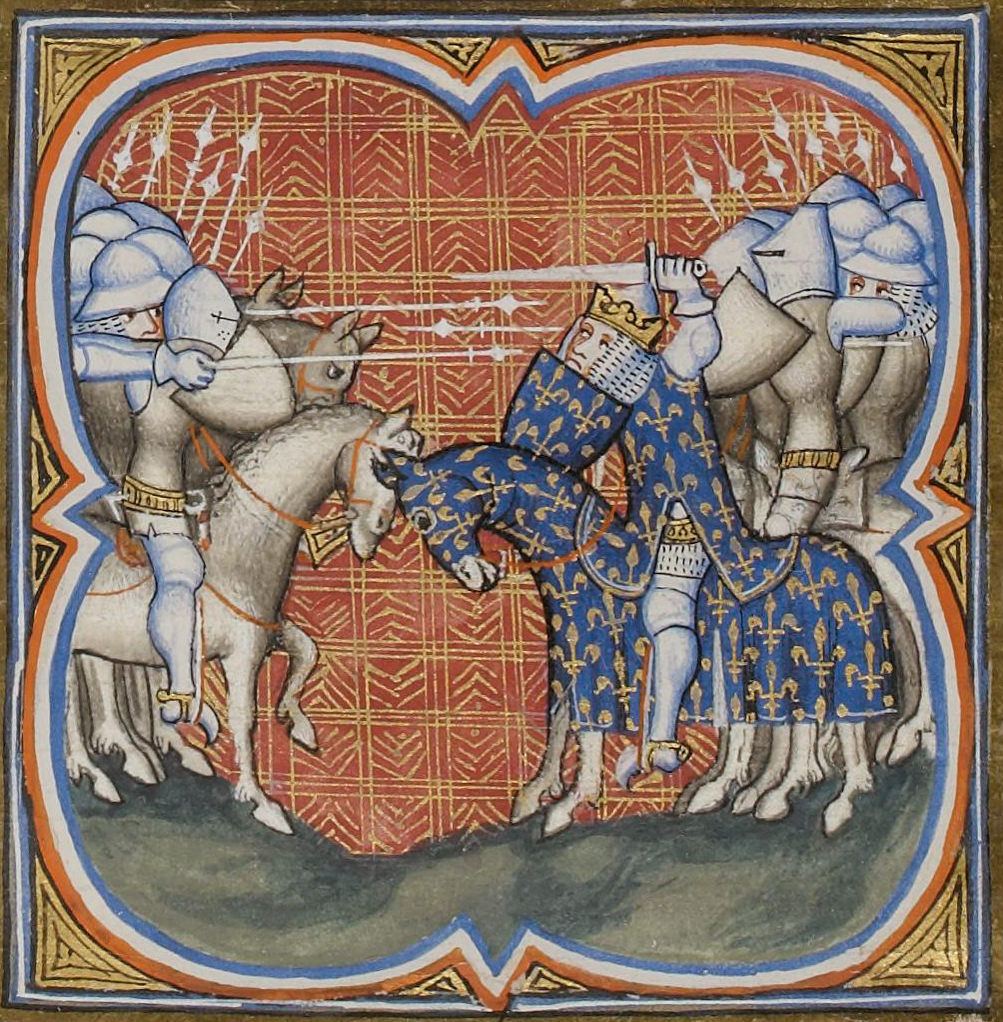 Battle between Franks and Saxons — Source: Wikimedia Commons
Unlike other Carolingian conquests, this is not only territorial expansion. It pits two very different worlds against each other. Saxons live in a tribal society of relatively independent communities and still practise a Germanic pagan religion. For Charlemagne, conquering Saxony has several goals: secure the kingdom’s northeast frontier, stop Saxon raids against Frankish lands, and expand Christian influence eastward.
The conflict begins in 772, when Charlemagne launches an expedition into Saxon territory and destroys a major religious sanctuary, the Irminsul, a sacred symbol of Saxon religion.
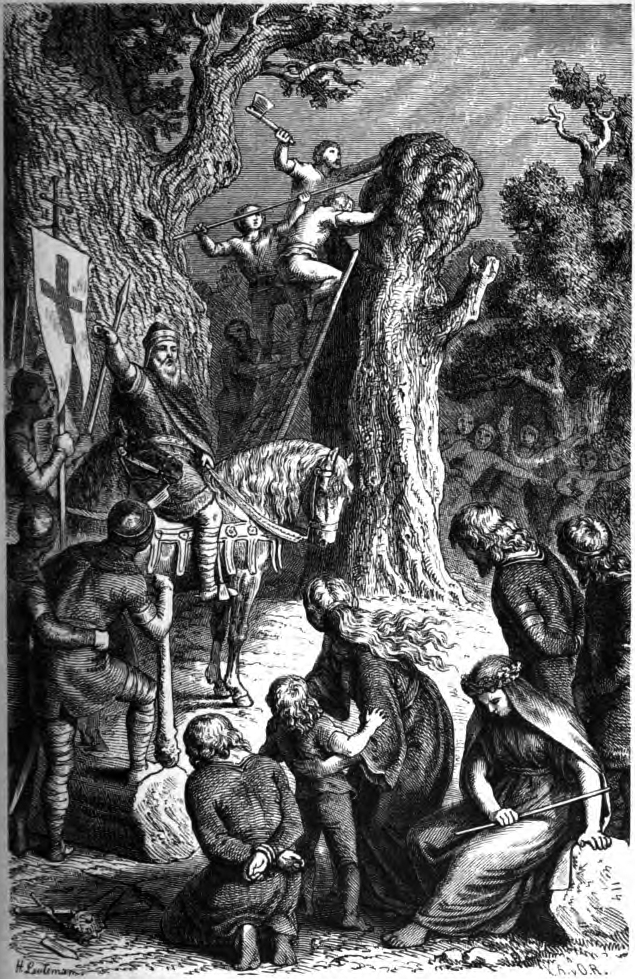 Charlemagne destroys the Irminsul — Source: Wikimedia Commons
Saxon resistance is embodied by the charismatic leader Widukind, who organises uprisings for years. In 782, Saxons inflict a heavy defeat on a Frankish army. Charlemagne’s reaction is harsh: chronicles report thousands of Saxon prisoners executed at Verden.
Little by little, Charlemagne imposes authority by combining military pressure and religious organisation. Conquered lands are divided into counties, and bishoprics and monasteries are founded to frame the population and spread Christianity.
A turning point comes in 785, when Widukind submits and receives baptism in Charlemagne’s presence. Sporadic revolts continue, but Frankish domination grows stronger.
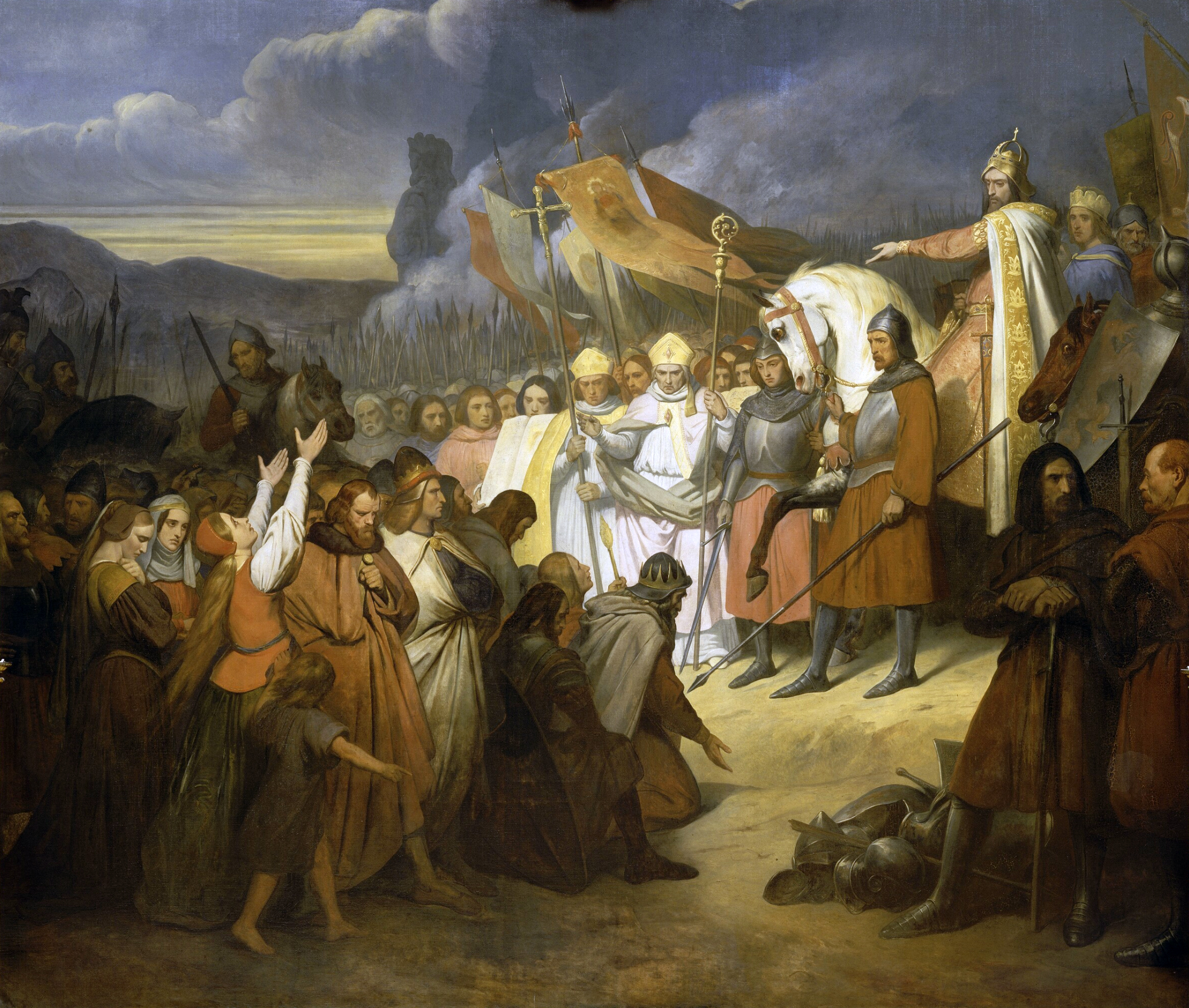 Widukind submits (785) — Source: Wikimedia Commons
Only in 804 is Saxony considered definitively subdued. Some Saxon populations are displaced to prevent further uprisings and the region is integrated into the Carolingian political and religious system.
🔍 Zoom – Saxon wars (772–804): conquest, conversion, resistance
🏹 Spain: the expedition of 778 and the Spanish March
Iberia is another important frontier. Since the Muslim conquest of 711, most of Spain is controlled by al‑Andalus. North of the Pyrenees, the Franks seek to secure their frontier and exploit internal divisions within Andalusi power.
In 778, some Muslim governors opposed to Cordoba ask Charlemagne for help. The Frankish army crosses the Pyrenees and advances to Zaragoza, but the city refuses to open its gates. With insufficient local support, Charlemagne retreats.
During the return, the Frankish rearguard is attacked at Roncevaux Pass by mountain fighters, likely Basques hostile to Frankish authority. Several nobles die, including Roland, count of the Breton March.
 Roncevaux ambush — Source: Wikimedia Commons
Later, the Song of Roland turns this limited event into a heroic battle against Muslim armies.
Despite the failure of 778, Frankish influence south of the Pyrenees grows in the following decades. In 801, the capture of Barcelona is a turning point. Border territories are organised into the Spanish March, a set of counties defending the frontier against al‑Andalus.
 Iberian Peninsula in 814 — Source: Wikimedia Commons
🔍 Zoom – Spain (777–810): expedition of 778 and the Spanish March
🏔️ Bavaria: the end of Duke Tassilo’s autonomy (788)
Before the great campaigns against the Avars, Charlemagne addresses a crucial eastern issue: the Duchy of Bavaria.
For generations, Bavaria has been ruled by the Agilolfing family, theoretically recognising Frankish authority but keeping broad autonomy. Duke Tassilo III, Charlemagne’s cousin, rules this strategic region between the Alps, the Danube, and routes toward central Europe.
Tassilo gradually seeks greater independence and cultivates alliances, notably with the Lombards and the Avars. In 787, a Frankish expedition forces him to submit. In 788, he is tried for treason, deposed, and sent to a monastery.
Bavaria is then integrated directly into the Carolingian realm and administered by royal representatives, notably Frankish counts.
🔍 Zoom – Bavaria (787–788): the end of ducal autonomy
🐎 The Avars: the Danube and the eastern marches
To the east, the Avars dominate the Danube basin. Their power rests on a warrior aristocracy and a system of tributes.
The conflict erupts in the 790s. In 791, Charlemagne launches a major campaign along the Danube. Decisive operations occur in 795–796, when Frankish forces seize the Avar power centre known as the Avar Ring and capture an immense treasure of gold and silver.
After these defeats, Avar power collapses. Danubian territories fall under Carolingian influence and several Slavic peoples enter the empire’s orbit.
To defend these new borders, the Carolingians create eastern marches, military frontier territories led by counts or margraves.
🔍 Zoom – Avars (791–805): treasure, Danube, and eastern marches
🌊 Brittany: expeditions, tribute, and the western frontier
At the western edge, Brittany is difficult to control. Breton chiefs sometimes recognise Frankish superiority, but loyalties remain unstable.
Charlemagne leads expeditions to assert authority and prevent raids. Some Breton leaders accept paying tribute, but integration remains limited.
To manage the frontier, the Carolingians develop the Breton March, a military buffer zone.
 Fortresses of the Breton Marches — Source: Wikimedia Commons
🏹 Aquitaine and Vasconia: a fragile integration
In the southwest, Aquitaine and Vasconia are hard to control. Pepin’s conquest in the 760s ended Duke Waïfre, but the region remains unstable.
In 769, Charlemagne campaigns against Aquitanian rebels who take refuge in Vasconia. After military operations and negotiations, he restores order.
To stabilise the south, Charlemagne installs a subordinate kingship: in 781, at an assembly in Rome, he entrusts Aquitaine to his young son Louis (future Louis the Pious), crowned king of Aquitaine under his father’s authority.
🔍 Zoom – Aquitaine & Vasconia: submissions, revolts, the Kingdom of Aquitaine (768–814)
🔍 Zoom – 774: defeat the Lombards, protect Rome
✍️ Reform, govern, “civilise”
Charlemagne does not build only by the sword. He also strengthens:
- religious and educational supervision
- the production of texts and norms
- the idea of a power that corrects and organises society
This movement, known as the Carolingian Renaissance, accompanies the scaling up of power.
📚 Carolingian Renaissance: renovatio
Carolingian scholars speak of renovatio, an intellectual and religious renewal. Influences converge from:
- Italy
- the Byzantine world
- the monasticism of the British Isles
At Charlemagne’s court, scholars such as Alcuin of York reform teaching and promote a new script: Carolingian minuscule.
🔍 Zoom – Carolingian Renaissance: schools, manuscripts, and Carolingian minuscule
🏛️ 800: a new status
At the end of the century, Carolingian power changes scale.
On 25 December 800, in Rome, Pope Leo III crowns Charlemagne emperor in Saint Peter’s Basilica.
The gesture marks the return in the West of the idea of a Christian empire, heir to both Rome and the barbarian kingdoms.
According to Charlemagne’s biographer Einhard, Charlemagne did not want to appear as receiving empire from the pope’s hands: the crown would have been placed on his head while he prayed.
The gesture is heavy with meaning: it suggests the pope can confer imperial dignity, opening a lasting question about the origin of political authority.
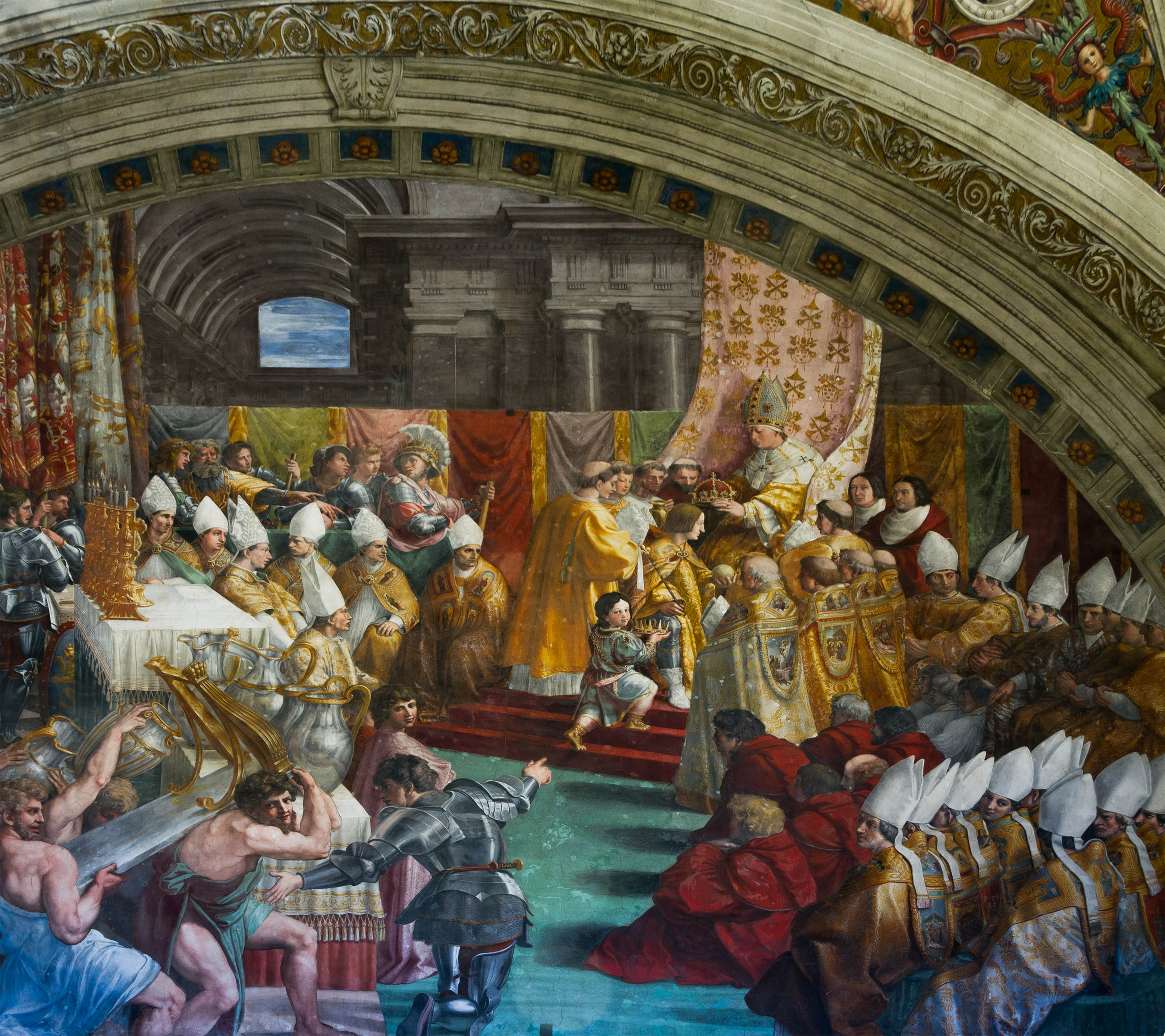 Coronation of Charlemagne — Source: Wikimedia Commons
In 813, Charlemagne changes the ritual for his son Louis the Pious: Louis crowns himself, without direct papal intervention.
🧭 Byzantine reaction: competing legitimacies
In Constantinople, the eastern emperor initially refuses to recognise the new title. A diplomatic compromise comes with the Peace of Aachen (812), which accepts the existence of the Carolingian empire.
🔍 Zoom – 800: imperial coronation and the idea of empire
🧠 Key takeaways
- Charlemagne inherits a legitimate but still fragile Carolingian kingdom.
- Between 768 and 814, he unifies, conquers, and reorganises a vast political space.
- His power rests on war, the Church, and a more structured administration.
- The imperial coronation of 800 marks a new stage: the West thinks again in terms of empire.
Image credits
- Battle between Franks and Saxons — Public domain, via Wikimedia Commons
- Charlemagne destroys the Irminsul — Heinrich Leutemann (1824–1904), Public domain, via Wikimedia Commons
- Widukind submits — Ary Scheffer, Public domain, via Wikimedia Commons
- Roncevaux ambush — Wolfgang von Bibra, CC BY-SA 4.0 https://creativecommons.org/licenses/by-sa/4.0, via Wikimedia Commons
- Iberian Peninsula in 814 — Elryck, CC BY-SA 4.0 https://creativecommons.org/licenses/by-sa/4.0, via Wikimedia Commons
- Fortresses of the Breton Marches — CC BY-SA 3.0 http://creativecommons.org/licenses/by-sa/3.0/, via Wikimedia Commons
- Coronation of Charlemagne — Raphael, Public domain, via Wikimedia Commons