


Charles the Bald: The Birth of West Francia (840–877)
p4840 à 877
When Louis the Pious died in 840, the Carolingian Empire entered a new phase. Rivalry among his sons turned into open war, and the unity built by Charlemagne began to crumble. Out of this dynastic crisis gradually emerged a political space that matters directly for the history of France: West Francia, ruled by Charles, soon nicknamed “the Bald”.
Charles does not simply inherit a territory: he must build and stabilise a kingdom in an exceptionally unstable context. His reign is marked by wars among Carolingian princes, by the need to negotiate constantly with regional elites, and by steady external pressure, above all the Viking raids that strike the kingdom’s river valleys.
Little by little, under his authority, West Francia takes on a political life of its own and becomes one of the durable heirs of the former Carolingian Empire.
🧑🦲 Nickname: why “the Bald”?
The origin of the nickname “the Bald” remains uncertain, and historians have proposed several explanations.
According to one tradition, Charles became lay abbot of Saint‑Denis from 867. During Pope John VIII’s consecration of the collegiate church of Sainte‑Marie at Compiègne on 5 May 877, Charles would have had his head shaved as a sign of humility and submission to the Church. This would have impressed contemporaries because long hair was, among the Franks, a symbol of royal dignity.
Another explanation, often judged more plausible, refers to his childhood. When Louis the Pious organised imperial succession, Charles’s half‑brothers already held well‑established kingdoms, while Charles long remained without a realm of his own. He may thus have been nicknamed ironically “the Bald”, meaning the prince without a kingdom, without a “crown”.
⚔️ 840–843: from civil war to partition
At the death of Louis the Pious in 840, the fragile balance of the Carolingian Empire quickly collapses. Provisions meant to organise succession are no longer sufficient to contain heirs’ ambitions. Rivalry among the emperor’s sons becomes open war, mainly opposing Lothair, the eldest and associated emperor, to his two brothers Charles and Louis (the future Louis the German).
Lothair believes his imperial dignity gives him a right of supremacy over the whole empire. He therefore tries to impose authority on his brothers and restore political unity inherited from Charlemagne. Facing this ambition, Charles and Louis ally to defend their territories and prevent Lothair from dominating the empire alone.
The situation is further complicated by other dynastic rivalries, notably in Aquitaine. Pepin II, son of Pepin I of Aquitaine, refuses to recognise Charles’s authority and seeks to recover the Aquitanian kingdom his father had ruled. This contest weakens Charles’s position in the southwest and shows that war between heirs also fuels regional conflicts.
The decisive confrontation takes place in 841 at the battle of Fontenoy‑en‑Puisaye, in Burgundy. Charles’s and Louis’s armies fight those of Lothair in extremely violent combat that leaves a deep impression on contemporaries. Victory ultimately goes to the allied brothers, reversing the balance of power and preventing Lothair from imposing domination over the empire.
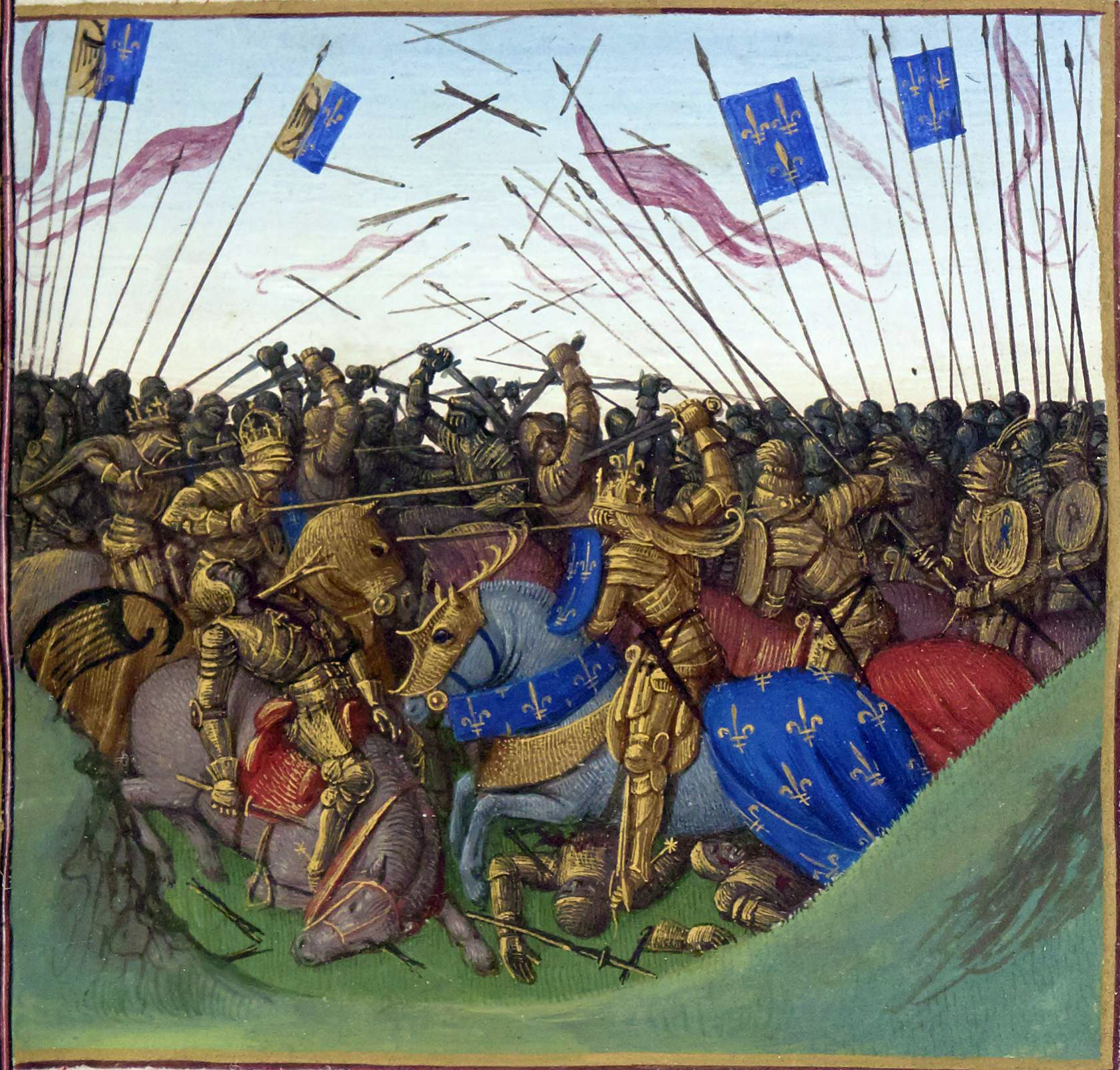 Battle of Fontenoy‑en‑Puisaye — Wikimedia Commons
After this battle, Charles and Louis seek to consolidate their alliance. In 842, they publicly renew their mutual commitment in order to continue the struggle against Lothair and stabilise their political position.
🔍 Zoom – 842: the Oaths of Strasbourg
From 843, Charles becomes king of West Francia, a vast territory covering much of the former Gaul. This political entity is not yet modern France, but it constitutes the territorial core of the future kingdom of France.
 Treaty of Verdun (843) — Wikimedia Commons
🔍 Zoom – 843: Verdun, three Francias
✝️ 848: an anointing at Orléans
A few years after the Treaty of Verdun (843), Charles the Bald seeks to strengthen the legitimacy of his power over West Francia. The civil war among Louis the Pious’s heirs has deeply shaken royal authority, and Charles still must impose himself against regional contests, especially in Aquitaine.
In this context, the king organises a new solemn anointing. On 6 June 848, at Orléans, he is elected and anointed king by the archbishop of Sens Wenilo, in the presence of several bishops and great men of the kingdom. This ceremony is not Charles’s first coronation, but it aims to publicly assert his authority over West Francia as a whole, especially in regions where his power remains contested.
The choice of Orléans is not accidental. Located at the heart of the kingdom, the city has a strong religious and political tradition. The anointing thus helps gather ecclesiastical and aristocratic elites around the king and reassert political order after years of civil war.
This event shows that Carolingian kingship rests on a balance between essential elements:
- military victory, which allows power to be imposed in dynastic conflicts;
- elite support, indispensable for governing the kingdom;
- and the religious ritual of anointing, which confers sacred legitimacy and places royal power within the Christian order.
🔍 Zoom – 848: Charles’s anointing at Orléans
🛡️ Governing West Francia: balances and compromises
Governing West Francia requires Charles the Bald to constantly balance royal authority with negotiation among local elites. The king’s power relies largely on regional relays: counts, bishops, and great aristocrats, who administer territories, dispense justice, and organise defence.
These men are both indispensable supports of power and actors capable of contesting royal authority if their interests are threatened. In a kingdom marked by regional diversity and political traditions, Charles must therefore constantly work with local balances.
Several factors make government particularly delicate:
- regions with strong political traditions, such as Aquitaine, Neustria, or Burgundy, where local elites enjoy wide autonomy;
- powerful aristocratic families able to mobilise loyalty networks and challenge royal decisions;
- a political system based on assemblies, oaths of loyalty, and grants of land or offices, which structure relations between the sovereign and the great men of the realm.
In this context, royal authority rests less on a centralised administration than on a play of alliances and loyalties. The king governs by regularly gathering the realm’s great men in assemblies where major decisions are taken.
Little by little, this situation transforms the nature of monarchy itself. While Charles tries to strengthen central authority and preserve the kingdom’s unity, he must also accept compromises that give growing room to local powers. This evolution gradually foreshadows the political world of the 10th century, when regional princes and lords will play an increasingly decisive role.
⚔️ 843–851: wars against the Bretons
On the western edge of the kingdom, Brittany is a particularly unstable front for Carolingian monarchy. For several generations, Breton leaders have sought to preserve autonomy against Frankish kings. The region is difficult to control: political structures are fragmented, Frankish influence is uneven, and local aristocracies retain strong capacity for resistance.
The revolt is led by Nominoë, a former representative of Carolingian power in Brittany under Louis the Pious. Initially loyal to the empire, Nominoë takes advantage of the troubles following Verdun to assert independence. Conflict truly breaks out when Charles the Bald’s armies try to restore royal authority in the region.
 Nominoë, a 9th‑century Breton leader, returns from hunting (hands still bloodied) when he learns that the son of the old chief of Mount Aré has been killed by Frankish invaders. He swears not to wash his hands until he has driven the Franks out of Brittany — Wikimedia Commons
In 845, Nominoë inflicts an important defeat on Charles at the battle of Ballon, near Redon. This victory greatly boosts Breton prestige and weakens the king’s authority in the kingdom’s west. The following year, an agreement in 846 effectively recognises Nominoë’s dominant position in Brittany, even if the region remains officially linked to West Francia.
Peace remains fragile. Tensions resume quickly, and after Nominoë’s death in 851, fighting continues under his son Erispoë. That same year, Charles the Bald suffers a new defeat against the Bretons at the battle of Jengland.
The conflict ends with the Treaty of Angers (851). By this agreement, Charles recognises broad autonomy for Breton power and cedes several territories, notably Rennes and Nantes, to the Breton kingdom. In exchange, Erispoë formally recognises the Frankish king’s authority.
These events mark an important stage in Brittany’s political history. Without fully breaking with the Frankish world, Brittany acquires durable political autonomy, limiting the direct authority of Carolingian kings in the kingdom’s west.
🔍 Zoom – 843–867: Brittany, Ballon, Jengland, and treaties
⚔️ The Vikings: a permanent threat
From the 840s onward, West Francia faces a new form of war: Viking raids. Coming mainly from Scandinavia (Denmark and Norway), these groups of warriors and sailors exploit internal divisions of the Carolingian world to launch fast expeditions along coasts and rivers.
 Viking expansion in Europe — Wikimedia Commons
The great river valleys — the Loire, Seine, Garonne, as well as the Scheldt and the Somme — become ideal invasion routes. Thanks to shallow‑draft ships, Vikings can sail deep inland, strike by surprise, and then leave quickly with their booty. Monasteries, rich in precious objects and often poorly defended, are prime targets, as are merchant towns and episcopal centres.
One of the most striking episodes occurs in 843, when Vikings sack Nantes. The attack takes place on the feast day of Saint John the Baptist: the city is taken by surprise and Bishop Gohard is killed in his cathedral during the celebration. The raid shocks contemporaries and symbolises the vulnerability of western cities.
 Gohard, martyr of Saint John the Baptist — Wikimedia Commons
Attacks then multiply in several regions. Paris, on the Seine, becomes a strategic target and is threatened repeatedly. The most famous raid takes place in 845, when a Viking fleet sails up to the city. Unable to defeat the invaders directly, Charles the Bald ultimately agrees to pay a large tribute to obtain their departure.
Facing repeated attacks, Carolingian monarchy struggles to organise durable defence. Royal armies are slow to mobilise, while Vikings favour speed and surprise. In many cases, the king chooses to pay ransoms to avoid larger destruction. This sometimes buys time, but also encourages new expeditions.
These Viking raids reshape the kingdom’s organisation. They push local elites to strengthen fortifications, protect bridges and river crossings, and organise defence more directly. The Scandinavian threat becomes one of the major factors of political and military change in West Francia in the 9th century.
🔍 Zoom – 845: the siege of Paris and the tribute
🧨 858: political crisis and Louis the German’s intervention
The kingdom’s difficulties, worsened by Viking raids and tensions among great aristocratic families, favour new opposition to Charles the Bald. In 858, part of the realm’s great men rebel and seek to replace the king. Among them is the powerful aristocrat Robert the Strong, who plays an important role in organising opposition.
The rebels decide to call on Louis the German, Charles’s brother and king of East Francia. Taking advantage of this invitation, Louis crosses the Rhine and invades West Francia. His intervention is supported by part of the aristocracy and even by some bishops, giving the crisis both political and religious dimensions.
Facing this threat, Charles temporarily retreats and seeks new support. The balance shifts thanks to bishops who remain loyal to the king, foremost among them the influential Hincmar, archbishop of Reims. Through his moral authority and political influence, Hincmar rallies part of the elites and defends Charles’s legitimacy.
Lacking sufficient support and confronted with resistance, Louis the German is ultimately forced to withdraw. The crisis of 858 nonetheless shows the fragility of royal power in West Francia: when their interests are threatened, great aristocrats can challenge the sovereign and appeal to foreign princes to arbitrate internal conflicts.
🔍 Zoom – 858: Robert the Strong, Hincmar, and the invasion
🏰 864: organising defence
Facing Viking raids multiplying since the 840s, Charles the Bald understands that ad‑hoc responses — ransoms, improvised military expeditions — are no longer enough. Scandinavian fleets regularly sail up the kingdom’s rivers, strike cities and monasteries, then depart with booty before royal armies can intervene. To better contain these incursions, the king seeks a more structured territorial defence.
In 864, at an assembly held at Pîtres, in Normandy, Charles promulgates an important text known as the Edict of Pîtres. This capitulary aims to strengthen the kingdom’s security and better frame the military obligations of elites.
One of its most famous measures concerns building fortified bridges on major rivers, especially the Seine and the Loire. These bridges are meant to be strongly defended to prevent Viking ships from moving too easily inland. By controlling these crossings, the goal is to turn rivers — until then invasion routes — into defensive lines.
The edict also seeks to organise mobilisation more effectively. Great men must provide troops and help maintain fortifications. The text also aims to limit abuses linked to the use of weapons and to strengthen royal authority over local forces.
While these measures do not end Viking raids, they mark an important stage in how Carolingian power adapts to this new kind of warfare. The Edict of Pîtres shows Charles’s attempt to progressively transform defence into a more stable system, based on permanent fortifications and coordinated mobilisation of local elites.
🔍 Zoom – 864: the Edict of Pîtres
🧭 869–870: Lotharingia, a strategic stake
The death of King Lothair II in 869 opens a new phase of rivalry among Carolingian sovereigns. His kingdom, Lotharingia, occupies a strategic position between West Francia and East Francia, along the Rhine axis and the Meuse valley. This rich and densely populated region includes major cities such as Metz, Verdun, Aachen, and Cologne, heirs of the political heart of the former Carolingian Empire.
Taking advantage of Lothair II’s death and the absence of a recognised heir, Charles the Bald acts quickly. He goes to Metz, where he is crowned king of Lotharingia on 9 September 869, aiming to assert authority over the whole territory. This alarms his brother Louis the German, who also claims part of the inheritance.
Tension between the two rulers leads to negotiation. In 870, the Treaty of Meerssen ends confrontation by organising the partition of Lotharingia between the two Frankish kingdoms. The western part goes to Charles the Bald, while the eastern part is attributed to Louis the German.
 Treaty of Meerssen (870) — Wikimedia Commons
This partition fixes, for a time, the balance between the two Francias and shows how Lotharingia is a true hinge region in the political geography of Carolingian Europe. Situated between the two realms, it will remain for centuries a contested space at the heart of rivalries among western European powers.
🔍 Zoom – 869–870: Metz and Meerssen
👑 875–877: imperial prestige and the end of a reign
In the mid‑870s, Charles the Bald tries to strengthen his prestige and influence beyond West Francia. Italy offers an opportunity. When Emperor Louis II dies in 875, the imperial throne becomes vacant. Pope John VIII, confronted with threats to Rome and Italy, seeks support from a Carolingian ruler able to protect the Church.
Charles crosses the Alps and intervenes in Italy. On 25 December 875, in Rome, he is crowned emperor by Pope John VIII, taking up the prestigious title once worn by Charlemagne and several successors. This imperial dignity considerably increases his prestige and affirms his rank among Carolingian princes.
However, the title remains largely symbolic. It does not deeply alter the political balance of the Carolingian world, now divided among competing kingdoms. Charles still faces the same difficulties: dynastic rivalries, growing autonomy of regional aristocracies, and pressure from external enemies.
In the last years of his reign, the king remains involved in Italian affairs. In 877, he prepares a new expedition south of the Alps to support the pope and defend his imperial interests. But the campaign ends quickly. On the return journey, weakened and ill, Charles the Bald dies on 6 October 877 in the Alps, near Brios (today Avrieux, in Savoy).
His death ends a long and turbulent reign. Under his government, West Francia has asserted itself as a distinct kingdom, but it remains fragile, crossed by aristocratic rivalries and exposed to external threats.
🔍 Zoom – 877: the Capitularies of Quierzy
🧠 Key takeaways
- Charles the Bald’s reign sees the durable birth of West Francia.
- He governs in a difficult context: Carolingian rivalries, regional revolts, and Viking raids.
- His reign marks the transition between the unified Carolingian Empire and the medieval kingdoms of western Europe.
Image credits
- Battle of Fontenoy‑en‑Puisaye — Jean Fouquet, Public domain, via Wikimedia Commons
- Treaty of Verdun 843 — Nicolas Ray, CC BY-SA 3.0 http://creativecommons.org/licenses/by-sa/3.0/, via Wikimedia Commons
- Engraved illustration of Nominoë — John Tenniel, Public domain, via Wikimedia Commons
- Viking expansions — IvanBondarev, CC BY-SA 4.0 https://creativecommons.org/licenses/by-sa/4.0, via Wikimedia Commons
- Gohard, martyr of Saint John the Baptist — Édouard Jolin, CC BY-SA 3.0 https://creativecommons.org/licenses/by-sa/3.0, via Wikimedia Commons
- Treaty of Meerssen, 870 — Trasamundo, Public domain, via Wikimedia Commons