


Louis III and Carloman II: Two Kings Facing the Vikings (879–884)
p4879 à 884
When Louis the Stammerer dies in 879, West Francia is ruled by two young sovereigns: his sons Louis III and Carloman II.
According to Carolingian tradition, the kingdom is not entrusted to a single heir but shared within the dynasty.
The two brothers therefore rule jointly, each controlling part of the territory while asserting a common authority over the kingdom.
 Coronation of Louis III and Carloman II — Wikimedia Commons
But the situation is fragile.
The Carolingian dynasty, once powerful under Charlemagne, has weakened.
Great regional aristocrats now hold considerable power, while borders are threatened by external enemies.
Three main dangers weigh on the kingdom:
- Viking raids, which regularly devastate rivers and towns;
- the ambitions of the great, able to contest royal authority;
- political fragmentation, illustrated by Boso, elected king in Provence.
In this context, stability no longer depends only on kings themselves.
Power also rests on those who control armies, abbeys, and political networks. Among them, one figure plays a central role: Hugh the Abbot, an influential adviser and real organiser of royal power.
🔍 Zoom – Hugh the Abbot: the kingdom’s strongman
⚖️ 879–880: two kings, one kingdom to stabilise
At the start of their reign, Louis III and Carloman II must first consolidate legitimacy.
Their accession comes at a moment of political tension: some great men hesitate to fully recognise their authority, while rival ambitions appear in different regions.
 Boso of Provence — Wikimedia Commons
In the South, Boso of Provence takes advantage of the situation to be proclaimed king in 879, breaking with the Carolingian tradition that only members of the dynasty can wear the crown.
This reveals a deep transformation: royal power now depends more on the support of the great than on dynastic legitimacy alone.
Meanwhile, Lotharingia remains a major strategic stake.
This territory between West and East Francia has been contested for decades.
 Carolingian Empire in 880 — Wikimedia Commons
In 880, an agreement is reached among Carolingian rulers to stabilise borders.
🔍 Zoom – 880: the Treaty of Ribemont
This treaty marks an important step: Lotharingia passes definitively under East Francia’s authority.
In exchange, West Francia gains a form of diplomatic stability that allows it to concentrate forces elsewhere.
Because the most immediate threat comes from the North.
🐉 Vikings: war and prestige
Since the mid‑9th century, Vikings have multiplied expeditions in the Frankish kingdoms.
These warriors from Scandinavia sail along coasts and up great rivers — Seine, Loire, Somme — to attack towns, monasteries, and markets.
Their strategy rests on mobility: they strike quickly, plunder, and depart before royal armies can react.
For Frankish kings, these attacks are both:
- a military danger,
- and a political challenge.
A sovereign unable to defend his realm risks losing support from the great.
Kings therefore seek spectacular victories able to restore prestige.
It is in this context that one of the reign’s most famous clashes takes place.
🔍 Zoom – 881: Saucourt, victory against the Vikings
In 881, Louis III wins an important victory against a Viking army at Saucourt‑en‑Vimeu, near today’s Somme.
 Battle of Saucourt‑en‑Vimeu — Wikimedia Commons
The battle quickly becomes a symbol of Frankish resistance.
It is celebrated in a heroic poem in Old High German, the Ludwigslied, which glorifies the king as defender of the Christian people against pagans.
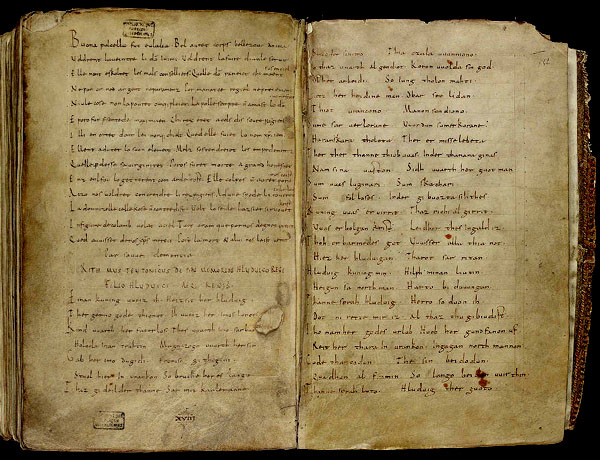 First two pages of the Ludwigslied — Wikimedia Commons
The victory temporarily strengthens royal authority.
But it does not end raids.
Vikings continue to travel rivers and threaten the richest regions of the kingdom.
🧩 882–884: rapid successions, unstable power
Despite Saucourt, the brothers’ reign is very brief.
Events unfold quickly and once again weaken the kingdom.
⚔️ 882: the death of Louis III
In 882, Louis III dies suddenly at about eighteen years old.
Chroniclers report a death as sudden as it is unusual: the king is said to have been the victim of a horse accident during a chase in the streets of a town.
Trying to pursue a young woman fleeing before him, he would have struck a door lintel or obstacle violently and died of his wounds.
His disappearance shocks the kingdom.
Young and victorious at Saucourt, Louis III embodied hope for a renewal of royal authority.
After his death, his brother Carloman II remains the sole king of West Francia.
👑 882–884: Carloman II’s solitary reign
Carloman II becomes the kingdom’s only sovereign.
His solo reign remains brief and relatively poorly known.
He must keep facing the same difficulties as his predecessors:
- continued Viking pressure,
- rivalries among great aristocrats,
- and a royal power dependent on political alliances.
The role of advisers and great men, notably Hugh the Abbot, remains essential to maintain some stability.
🏹 883: Viking offensives under Carloman II
During Carloman II’s solitary reign, Viking attacks continue to threaten Carolingian realms.
In October, a Viking army advances to the ford of Laviers, on the Somme. Carloman tries to block them by positioning his army at Miannay, but the Franks are defeated. Forced to retreat beyond the Oise, the king cannot prevent Vikings from settling at Amiens, strengthening their presence in the region.
At the same time, other Viking bands push further east and sail up the Rhine, threatening religious and political centres. Archbishop Liutbert of Mainz, with Count Henry of Franconia, manages to stop them as they move toward the abbey of Prüm, an important imperial monastery. Vikings then retreat toward Duisburg, where they establish a camp and winter, showing how hard it is for Carolingian rulers to prevent these mobile armies from establishing durable footholds in certain regions.
💰 884: a truce bought from the Vikings
At the beginning of 884, Viking pressure becomes so intense that the kingdom’s great men seek a pragmatic solution.
On 2 February 884, the main lords of West Francia, gathered at Compiègne, decide to negotiate with the Vikings settled at Amiens. They propose a huge sum — 12,000 pounds of silver — in exchange for their departure.
The Northmen accept and grant Carloman II a truce until October, giving him time to raise the promised sum.
But this truce does not mean peace: Vikings continue expeditions and ravage the right bank of the Scheldt, exploiting royal weakness.
🏹 December 884: the death of Carloman II
A few months later, fate strikes the Carolingian dynasty again.
In December 884, Carloman II dies during a hunting party, probably after being mortally wounded by a boar, according to several chronicles.
 Carloman mortally wounded — Wikimedia Commons
Like his brother Louis III, dead two years earlier, he disappears young and without an heir able to succeed him.
This brutal disappearance leaves West Francia without a direct king and opens a new period of political uncertainty, forcing the realm’s great men to look for another Carolingian to ensure continuity.
🌍 Calling Charles the Fat
With no direct heir, the great men take a pragmatic decision:
they call Charles the Fat, another member of the Carolingian dynasty, to rule.
Charles already governs several major territories:
- East Francia,
- Italy,
- and he also holds imperial dignity.
His accession to the throne of West Francia allows, for a time, a large part of Charlemagne’s former empire to be reunited under one sovereign.
But this unity remains fragile.
Charles the Fat will soon face the same difficulties as his predecessors:
aristocratic ambitions, political crises… and above all the persistent Viking threat.
🔍 Zoom – 884: Carloman’s death and the arrival of Charles the Fat
🧠 Key takeaways
- 879: Louis III and Carloman II become kings of West Francia.
- Their authority depends heavily on support from the great, notably Hugh the Abbot.
- 880: the Treaty of Ribemont fixes the border with East Francia.
- 881: Louis III defeats Vikings at Saucourt.
- 882–884: the successive deaths of both kings plunge the realm into a new phase of instability.
Image credits
- Coronation of Louis III and Carloman II — Anonymous, Public domain, via Wikimedia Commons
- Boso of Provence — Odejea, CC BY-SA 3.0, via Wikimedia Commons
- Carolingian Empire in 880 — Gundan, CC BY-SA 4.0 https://creativecommons.org/licenses/by-sa/4.0, via Wikimedia Commons
- Battle of Saucourt‑en‑Vimeu — Palace of Versailles, Public domain, via Wikimedia Commons
- Ludwigslied manuscript — Municipal Library of Valenciennes, Public domain, via Wikimedia Commons
- Carloman mortally wounded — Jean‑Charles‑Joseph Rémond, Public domain, via Wikimedia Commons