

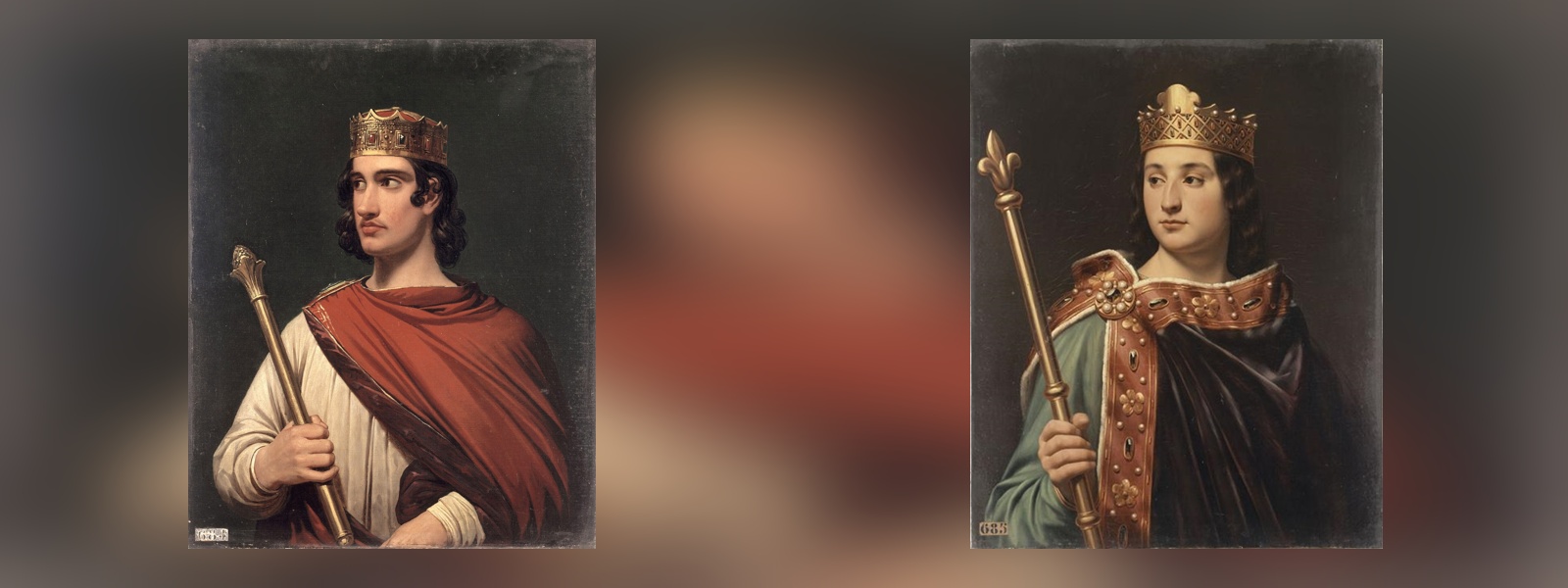
Lothair and Louis V: The End of the Carolingians (954–987)
p4954 à 987
When Louis IV dies in 954, the Carolingian dynasty does not collapse: it continues with his son Lothair, anointed on 12 November 954 at Saint‑Remi of Reims.
 Anointing of Lothair at Saint‑Remi of Reims — Wikimedia Commons
But this continuity is deceptive.
The kingdom has profoundly changed. The king no longer dominates: he arbitrates. Princes — above all the Robertians — control most military and territorial resources. In the East, Ottonian power becomes an unavoidable factor.
The reign opens on a lasting tension:
how to restore an effective kingship in a kingdom dominated by its own vassals and framed by the Empire?
🔍 Zoom – 954: anointing at Reims and a tutelary government
🧭 954–956: kingship under supervision
Lothair comes to the throne young. His power is initially framed by major figures who structure the kingdom’s balance.
On the one hand, his mother Gerberga, heir to Carolingian and Ottonian networks, plays a central role. She embodies dynastic continuity and a cautious diplomatic line oriented toward accommodation with the Empire.
On the other hand, Hugh the Great, duke of the Franks, remains the kingdom’s real arbiter. As under Louis IV, monarchy functions with a “second” indispensable to government yet able to impose his own balances.
This dominance shows concretely in 955. At Easter, Hugh organises great festivities at Paris for the young king. But the ceremony is also alliance policy:
- he betroths his son Otto to Liégarde, daughter of Gilbert of Chalon, consolidating influence in Burgundy;
- he marries his daughter Emma to Richard of Normandy;
- another daughter, Beatrice, is already linked to the count of Bar.
Through these unions, Hugh weaves a princely network that far exceeds the royal court.
Hugh also draws the king into his military projects. In 955, Lothair accompanies Hugh against Duke William “Towhead” of Aquitaine. The expedition reaches Poitiers but fails: William, supported by Auvergne lords, gathers an army and forces a retreat. The king acts, but still within the duke’s initiatives.
A third actor completes this system: Bruno of Cologne, Lothair’s uncle and brother of Otto I. Archbishop and duke of Lotharingia, he embodies Ottonian influence and continues to orient western balances.
The year 956 is a turning point. On 8 April, Otto, Hugh’s son, becomes duke of Burgundy after Gilbert of Chalon dies. Then, on 16 June, Hugh the Great dies at Dourdan.
His death does not instantly free the king. It opens uncertainty. His son Hugh Capet, still young, inherits positions, but Lothair delays recognising him as duke of the Franks. This hesitation temporarily weakens the princely centre.
Others take advantage: the counts Theobald of Blois and Fulk of Anjou strengthen autonomy. In a context worsened by an epidemic, the kingdom’s balance becomes more unstable.
🔍 Zoom – 956–960: Hugh Capet, princely power
🧨 960–977: tensions with the Empire, rise of princely power
After years of tutelage, Lothair gradually seeks to rule more independently. But princes remain powerful on the ground, and the kingdom’s equilibrium is tied to the Ottonian world.
In 960, a compromise stabilises matters. In the presence of Bruno of Cologne, Hugh Capet and his brother Otto pay homage to the king. Hugh becomes duke of the Franks, Otto duke of Burgundy. In theory, royal hierarchy is reaffirmed; in practice, the gap between royal legitimacy and princely power is underlined.
In 961–962, the king nevertheless tries to regain initiative. He draws closer to Theobald of Blois, Geoffrey of Anjou, and Baldwin of Flanders, and intervenes against Richard of Normandy. Évreux is taken, but the Norman response is swift: Richard, aided by Danes, defeats Theobald before Rouen, and Scandinavian bands ravage nearby regions.
Meanwhile, in 962, Otto I is crowned emperor in Rome. This imperial restoration changes the balance: Ottonian power now claims to embody the Western imperial inheritance. For Lothair, a strong emperor in the East narrows ambitions.
The king is not passive. In 965, after the death of Arnulf the Old, he tries to assert rights in Flanders, keeping positions up to the Lys. In 966, the peace of Gisors with the Normans, ratified by Lothair, recognises Richard I’s authority over Normandy, in the vassalage of Hugh Capet. The king still arbitrates, but order increasingly rests on agreements among princes.
The crisis truly breaks out in 976–977. Lotharingia becomes an explosive stake again. In 977, the king’s brother Charles accuses Queen Emma of Italy of adultery with Adalbéron of Laon. A synod clears them; Charles is expelled. Soon after, Otto II grants Charles the duchy of Lower Lotharingia. A family rupture becomes a major political challenge.
🔍 Zoom – 976–977: Charles of Lorraine and the break with Otto II
⚔️ 978: showdown with Otto II
In August 978, Lothair goes on the offensive. He invades toward Aachen, imperial residence and a core symbol of Carolingian memory. Striking Aachen is a bid to reclaim Charlemagne’s legacy and contest Ottonian legitimacy.
Lothair takes the city and surprises the imperial court; Otto II narrowly escapes capture. But the success cannot be converted into durable domination.
The imperial response is rapid. On 1 October 978, Otto II invades West Francia, takes Laon, then marches toward Paris. The capital holds. Unable to take Paris, the emperor retreats on 30 November. During the withdrawal, the Ottonian rear‑guard is badly defeated on the Aisne near Soissons.
The episode can look like an equilibrium regained, but it also shows limits: the king can act spectacularly and resist invasion, yet cannot defeat the Empire nor impose lasting authority on disputed spaces.
🔍 Zoom – 978: Aachen and the siege of Paris
🤝 979–982: secure succession, contain the Robertians
After 978, Lothair adopts a more cautious strategy.
In 979, he has his son Louis anointed to secure succession and prevent dynastic challenge.
In 980, he meets Otto II and accepts détente, effectively renouncing ambitions in Lotharingia to stabilise the frontier.
But the policy has an internal cost. The Robertians, especially Hugh Capet, are sidelined; resentment grows while their territorial power consolidates.
Lothair tries to rebalance by turning south. The marriage of his heir in 982 fits this logic: widen the royal base beyond the Île‑de‑France. Yet room for manoeuvre remains limited.
🔍 Zoom – 979–982: anoint the young Louis and tensions with the Robertians
🏰 983–986: a last attempt in Lotharingia
The death of Otto II in 983 opens a window. The Empire is entrusted to a child, Otto III, and the regency creates instability. Lothair tries to return to Lotharingia.
He gains local supports and even reconciles with his brother Charles. For a time, a Carolingian influence seems possible again.
But the window closes quickly. The Peace of Worms (984) confirms Carolingian retreat and strengthens pro‑imperial networks, notably the House of Ardennes.
Lothair tries direct action: in 985, he takes Verdun and captures major figures. Yet he faces combined opposition: Lotharingian ecclesiastical networks, Ottonian influence, and Hugh Capet’s intervention. When the king tries to judge Adalbéron of Reims at Compiègne (985), Hugh breaks the assembly.
It is a key moment: the king can no longer impose a major political decision against princes.
🔍 Zoom – 983–986: Verdun and the last Lotharingian attempt
⚰️ 986–987: Louis V and dynastic end
In early 986, Lothair still plans actions against the Empire, but he dies suddenly on 2 March 986 at Laon.
His son Louis V, already associated with power, succeeds him. The reign is extremely brief.
Louis attempts to assert authority by convening an assembly at Compiègne to judge Adalbéron of Reims, symbol of pro‑imperial networks. But he does not have time.
On 22 May 987, during a hunt in the forest of Halatte near Senlis, Louis dies in a riding accident. He leaves no heir.
His death opens a major crisis. Two options oppose:
- continue Carolingian dynasty with Charles of Lorraine;
- or choose a new king among the great men.
The princes decide. In 987, they elect Hugh Capet.
This is not only a change of man: it consecrates a deep evolution of royal power. The Carolingian dynasty disappears not in a sudden collapse, but because it can no longer dominate the kingdom it founded.
🔍 Zoom – 987: Louis V’s death and the election of Hugh Capet
🧠 Key takeaways
- 954: Lothair is anointed; kingship framed by princes and the Empire.
- 956: Hugh Capet inherits durable Robertian power.
- 976–978: break with the Empire and confrontation with Otto II.
- 979–982: succession security, tensions with the Robertians.
- 983–986: failed attempt to regain Lotharingia.
- 986–987: short reign of Louis V, death without heir.
- 987: election of Hugh Capet, end of the Carolingians.
Image credits
- Anointing of Lothair — Grandes Chroniques de France, Public domain, via Wikimedia Commons