


Theudebert I: Austrasia’s King Looking Toward Rome (Austrasie)
p4534 à 548
When Theuderic I died in 534, his son Theudebert (more often called Theudebert I / Théodebert I) inherited Austrasia, one of the most powerful kingdoms created by the division of Clovis’s realm.
This kingdom stretched from the Moselle valley to the regions near the Rhine, including major cities inherited from the Roman Empire such as Metz, Reims, and Trier.
Unlike some Merovingian kings more focused on internal warfare between Frankish princes, Theudebert pursued an ambitious policy. He relied on cities, maintained diplomatic relations with the Eastern Roman Empire, and sought to give his kingship a broader dimension.
His reign marks a special moment when the Frankish kingdom began to appear as a European power.
⏳ Quick timeline
- 534: Theudebert succeeds Theuderic I and becomes king of Austrasia.
- 536: Provence comes under Frankish control.
- 537: Submission of the Alamanni and consolidation of Frankish authority in the East.
- c. 539: Embassy from Emperor Justinian to Theudebert.
- 539: Frankish incursion into Italy in the context of the Gothic War.
- 540: Marriage to the Lombard princess Wisigarde.
- c. 541: Attempted military alliance against Chlothar interrupted by a storm.
- 548: Death of Theudebert; his son Theudebald succeeds him.
🏛️ A king “more Roman” than the others
 Gold coin of Theudebert I, c. 534 — Source: Wikimedia Commons
Austrasia was a territory strongly shaped by Roman heritage.
Cities still played an essential role:
- they concentrated wealth
- they served as administrative centres
- they housed bishops and local elites
Theudebert understood the importance of this legacy.
He governed by relying on:
- bishops
- Gallo-Roman elites
- urban centres
This gave his kingdom a more stable structure than in other Frankish regions.
An ambitious royal image
Theudebert also sought to project a strong royal image.
He wanted to appear as:
- a stable sovereign
- a protector of cities
- a king able to negotiate with Mediterranean powers
This contrasted with the traditional image of the Frankish king as a mere war leader.
🔍 Zoom — The king who mints coin: authority through gold
🏺 The Gothic War (535–553): Italy in flames
During Theudebert’s reign, Italy became the theatre of a major war.
The Byzantine emperor Justinian tried to reconquer former territories of the Western Roman Empire.
Italy was then dominated by the Ostrogoths.
 Gothic War (535–553) — Source: Wikimedia Commons
534: a murder that changes everything
The Ostrogothic queen Amalasuntha, favourable to the Eastern Empire, was assassinated after Theodahad came to power.
Justinian used this as a pretext to launch a military campaign.
535: Belisarius enters the stage
The Byzantine general Belisarius landed in Italy.
The Byzantines also looked for allies.
They contacted Frankish kings, hoping to win their support against the Goths.
The Frankish double game
The Franks promised help, but remained cautious.
They preferred to take advantage of both sides’ weakening in order to:
- gain territory
- seize loot
- expand influence
🔍 Zoom — The Gothic War: Justinian, Belisarius, and the Frankish kings
🛡️ 537: Alamanni, Bavarians, and control of the East
War in Italy weakened neighbouring realms.
Theudebert used this opportunity to strengthen his authority in central Europe.
Submission of the Alamanni
The Alamanni, a Germanic people settled along the Upper Rhine, came under Frankish authority.
Rather than occupying their lands directly, Theudebert imposed local leaders loyal to the Frankish king.
Influence over the Bavarians
At the same time, Frankish influence also expanded toward the Bavarians.
These peoples gradually became allies or dependents of the Austrasian kingdom.
This policy greatly strengthened Austrasia’s position along the eastern frontiers.
🌊 536: Provence, gateway to the Mediterranean
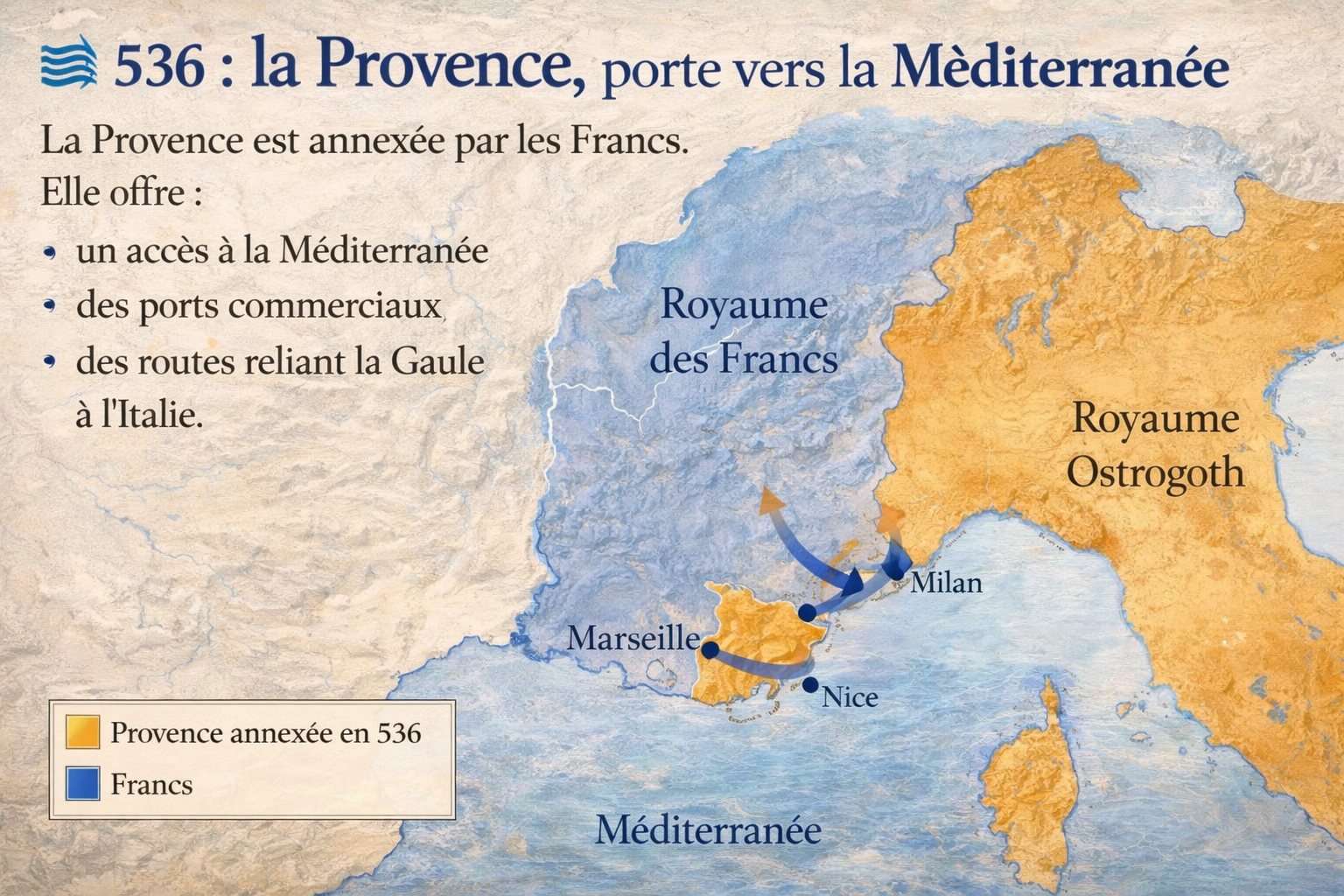
Taking control of Provence was one of the most important events of the reign.
The region had previously belonged to the Ostrogothic kingdom.
Taking advantage of the political situation in Italy, the Franks obtained the region.
Why Provence was strategic
It offered:
- access to the Mediterranean
- commercial ports
- routes linking Gaul to Italy
Arles: a showcase of power
In 537, Theudebert came to take possession of Provence.
In Arles, a former imperial city, he organised public games.
This gesture echoed Roman practices and strengthened the image of a king inheriting imperial order.
🔍 Zoom — Provence 536: Marseille, Arles, and the Franks enter the Mediterranean
⚔️ 539: the Italian expedition
Taking advantage of war between Byzantines and Ostrogoths, Theudebert launched an expedition into Italy.
Frankish armies crossed the Alps.
They advanced into the Po valley and plundered several regions.
Goals
- obtain loot
- assert Frankish power
- influence the balance between Goths and Byzantines
However, the expedition proved difficult.
The armies had to face:
- disease
- famine
- logistical difficulties
Even if the Franks did not hold Italy for long, the operation boosted Theudebert’s prestige.
🔍 Zoom — 539: the Italian expedition, between adventure and strategy
🏰 Speaking to Justinian like to an emperor
Around 539, ambassadors from Emperor Justinian came to question Theudebert about the extent of his power.
 Justinian I — Source: Wikimedia Commons
The Frankish king described his authority not in terms of borders, but in terms of peoples.
He mentioned populations under his influence:
- Thuringians
- Saxons
- Jutes
- northern Germanic peoples
This reflects the Frankish conception of power: a king rules first and foremost people and peoples, not only territories.
👑 540: alliances and diplomacy
Marriage remained an essential tool of Merovingian politics.
Theudebert married the Lombard princess Wisigarde, to whom he had been betrothed for several years.
This alliance strengthened ties between Austrasia and Germanic kingdoms of Italy.
However, Wisigarde died shortly after arriving in Cologne.
As often in royal dynasties, new marriage alliances were quickly sought.
🌩️ c. 541: the storm against Chlothar
Rivalries between Frankish kings never disappeared entirely.
Around 541, Theudebert and his uncle Childebert launched an expedition against Chlothar.
But a violent hailstorm struck the army.
Sources report that:
- horses were scattered
- soldiers were injured
- equipment was destroyed
The kings decided to halt the campaign.
This episode is a reminder of how much nature could disrupt medieval military operations.
🧭 548: end of the reign
Even after the Italian expeditions, conflicts continued in the region.
The Ostrogoths tried to regain the initiative in Italy.
In 548, a new Frankish expedition intervened in the north of the peninsula.
But the situation remained unstable.
That same year, Theudebert died.
Sources hesitate between:
- illness
- a hunting accident
His son Theudebald succeeded him.
🧠 Key takeaways
- 534–548: reign of Theudebert I.
- Austrasia: a kingdom structured around the Rhine and Moselle cities.
- 536: acquisition of Provence, access to the Mediterranean.
- 537: consolidation of power over eastern peoples.
- 539: expedition into Italy during the Gothic War.
- Legacy: a Merovingian king who sought to anchor Frankish power in Roman heritage.
📚 Sources
Primary sources (public domain)
-
Gregory of Tours, History of the Franks
https://fr.wikisource.org/wiki/Histoire_des_Francs -
Chronicle of Fredegar
Free historical resources
-
Theudebert I — Wikipedia
https://fr.wikipedia.org/wiki/Théodebert_Ier -
Gothic War (535–553)
https://fr.wikipedia.org/wiki/Guerre_des_Goths_(535-553) -
Justinian I
https://fr.wikipedia.org/wiki/Justinien_Ier
📸 Image credits
- Gold coin of Theudebert I — The original uploader was DALIBRI at German Wikipedia., Public domain, via Wikimedia Commons
- Gothic War (535–553) — A.Cython, CC BY 4.0 https://creativecommons.org/licenses/by/4.0, via Wikimedia Commons
- Justinian I — Petar Milošević, CC BY-SA 4.0 https://creativecommons.org/licenses/by-sa/4.0, via Wikimedia Commons