


Guntram: Burgundy and Merovingian Arbitration (Bourgogne)
p4561 à 592
After King Chlothar I died in 561, the Frankish kingdom was once again divided among his sons.
Among them, Guntram received Burgundy, a vast territory between the valleys of the Saône, the Rhône, and the Loire.
His reign lasted more than thirty years (561 → 592), making it one of the longest of the Merovingian period.
Unlike his brothers, often engaged in brutal wars, Guntram appears in the sources as a more cautious king, seeking to maintain balance among the Frankish kingdoms.
 The kingdom of the Franks in 561 — Source: Wikimedia Commons
🗺️ Burgundy: a strategic kingdom
Burgundy had several strengths.
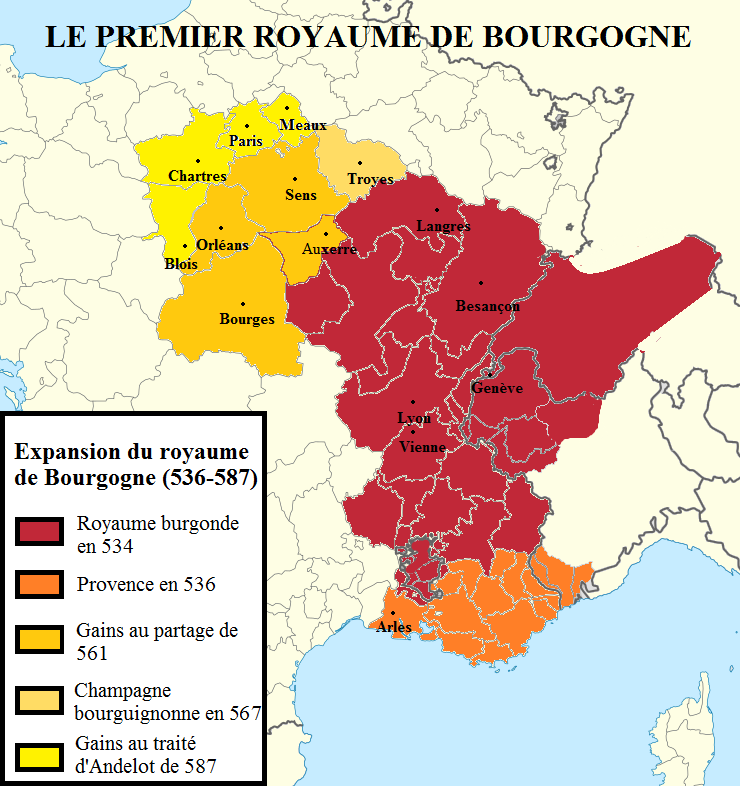 The kingdom of Burgundy — Source: Wikimedia Commons
It controlled major economic axes:
- the Rhône valley, a trade route to the Mediterranean
- the Saône, linking Burgundy to northern regions
- several important former Roman cities
Among the kingdom’s main cities:
- Orléans
- Chalon-sur-Saône
- Autun
- Lyon
- Vienne
These cities had powerful bishoprics and an administrative tradition inherited from the Roman Empire.
Burgundy was therefore a rich and relatively stable kingdom, but also a territory exposed to neighbours’ ambitions.
⚔️ Between his brothers: a fragile position
The political situation quickly became explosive.
Two of Guntram’s brothers entered a violent rivalry:
- Sigebert I, king of Austrasia
- Chilperic I, king of Neustria
Their conflict, triggered after the assassination of Galswintha, sister of Queen Brunhilda, plunged the Frankish world into a long war.
Guntram found himself between the two camps.
Depending on circumstances, he supported one side and then the other, mainly seeking to preserve his own kingdom’s stability.
This balancing policy sometimes earned him a reputation as a king-arbiter.
⚔️ Wars and rivalries after 575
The death of Chilperic I in 584 did not end conflicts.
The royal feud continued in new forms. Powerful aristocrats played decisive roles, notably:
- Egidius, bishop of Reims
- Guntram Boso, influential Austrasian duke
These figures, once close to Chilperic, tried to maintain influence in the political struggles between kingdoms.
At the same time, some Austrasian nobles supported Gundovald, a supposed natural son of Chlothar I, who attempted to be recognised as king.
This threatened Guntram directly.
In 585, the king led a campaign as far as Saint-Bertrand-de-Comminges in southern Gaul to crush the rebellion and impose authority.
Gundovald’s defeat ended this dynastic challenge.
🤝 The Treaty of Andelot (587)
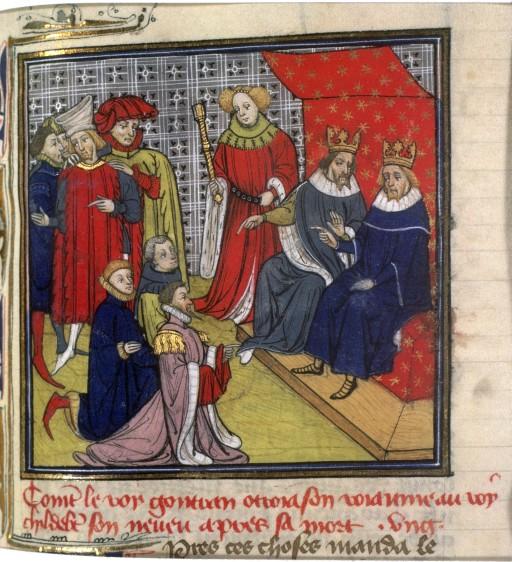 The Treaty of Andelot — Source: Wikimedia Commons
After Gundovald’s defeat, Guntram strengthened his alliances.
On 28 November 587, he met King Childebert II, son of Sigebert I and Brunhilda.
They concluded the Treaty of Andelot, near Chaumont.
The treaty organised a durable alliance between Burgundy and Austrasia.
It notably provided that:
- the two kings promised mutual aid and loyalty
- each recognised the other’s territorial rights
- if one sovereign died, the survivor would inherit his kingdom
This treaty is exceptional for the time: its full text is preserved thanks to Gregory of Tours.
It is one of the rare detailed diplomatic agreements of the Early Middle Ages.
⚔️ War against the Visigoths (588–589)
In the late 580s, Guntram tried to extend his influence southward.
He wanted to recover Septimania, controlled by the Visigothic kingdom.
In 588 or 589, he sent an army led by Austrovald, duke of Aquitaine.
But the campaign ended in failure.
Near Carcassonne, the Frankish army was defeated by forces of the Visigothic king Reccared, commanded by Duke Claudius of Lusitania.
According to Gregory of Tours, losses were heavy:
- around 5,000 dead
- 2,000 prisoners
This defeat ended Frankish ambitions in Gothic Gaul.
⛪ A king closely tied to the Church
Unlike some Merovingian kings known for violence, Guntram is often described as very religious.
Chronicles, especially Gregory of Tours, emphasise his piety:
- he supported bishops
- he protected monasteries
- he financed religious foundations
Bishops played a major political role in his kingdom.
They served as intermediaries between king and cities and sometimes participated in diplomatic negotiations.
This alliance with the Church strengthened royal legitimacy and helped stabilise Burgundy.
⛪ The foundation of Saint-Marcel Abbey
 Saint-Marcel Abbey — Source: Wikimedia Commons
Guntram’s reign was also marked by strong religious activity.
After choosing Chalon-sur-Saône as royal residence, he founded a monastery around 577 in the city’s outskirts: Saint-Marcel Abbey.
The monastery was dedicated to Saint Marcel, a 2nd-century martyr of Lyon.
In 584, Guntram instituted perpetual psalmody, a monastic practice of reciting psalms without interruption.
He also reorganised major monasteries linked to his realm:
- Saint-Bénigne of Dijon
- Saint-Maurice of Agaune
These were placed under the joint authority of Abbot Apollinaris of Agaune.
At his death, Guntram was buried in the basilica of Saint-Marcel, which he had founded.
⚔️ Defending the kingdom
Despite his reputation as a peaceful king, Guntram also had to lead military campaigns.
He notably faced:
- internal aristocratic revolts
- Lombard incursions from Italy
- armies of his brothers when alliances shifted
Burgundy thus became a zone of confrontation between Frankish kingdoms, but Guntram managed to preserve most of his territory.
☘️ The arrival of Saint Columbanus
Toward the end of his reign, Guntram welcomed the Irish monk Columbanus, a major figure of European monasticism.
Columbanus arrived in Gaul as a peregrinus, an itinerant missionary.
In 591, he received permission to settle in a forested region on the frontier between Burgundy and Austrasia.
He founded a first monastery at Annegray, in the Vosges.
Soon after, he created the important monastery of Luxeuil, which became one of the kingdom’s great religious centres.
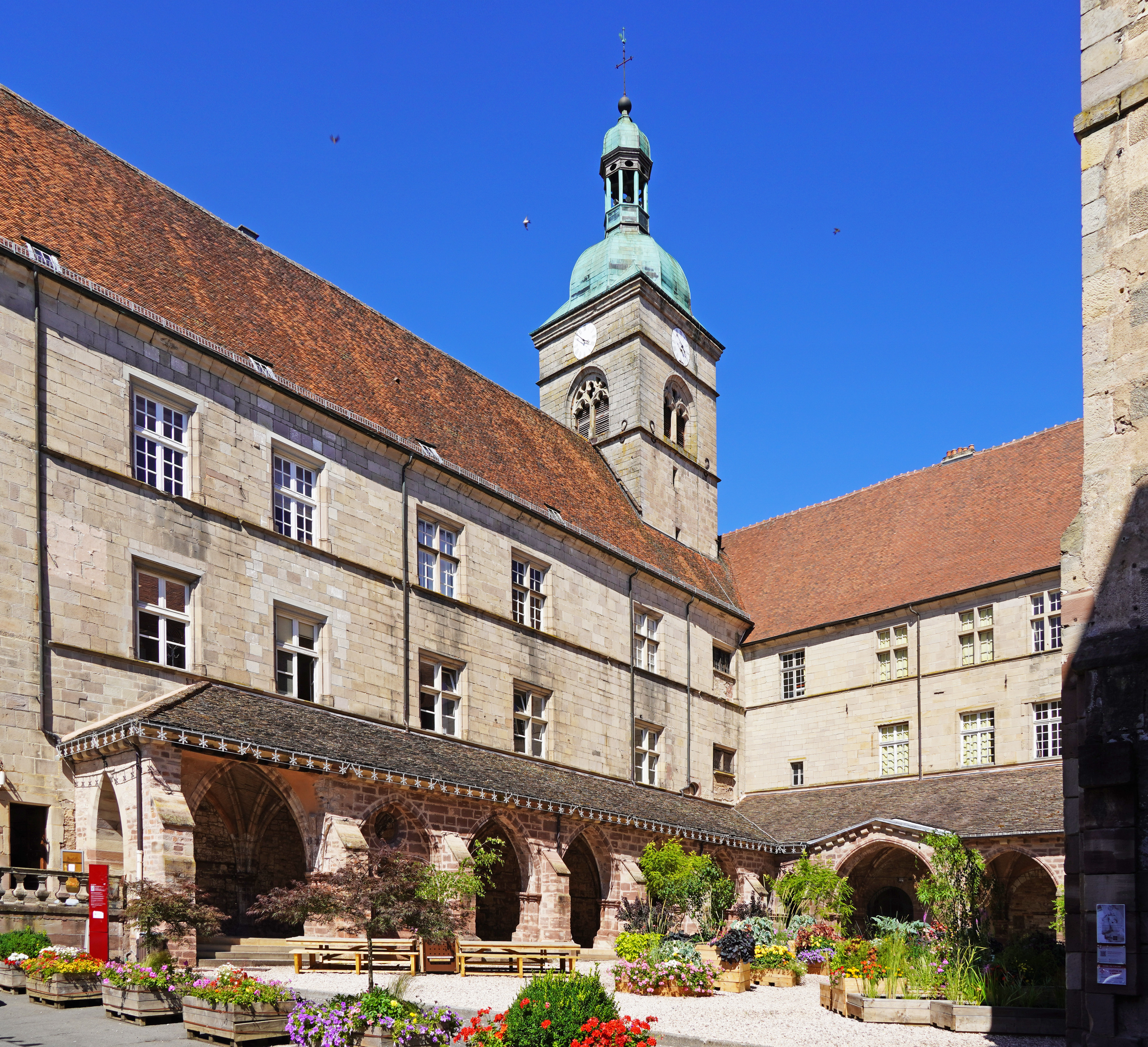 Luxeuil — Source: Wikimedia Commons
These foundations contributed to the spread of Christianity and enhanced the spiritual prestige of Guntram’s reign.
☠️ The end of the reign
King Guntram died in 592.
Having no direct heir, his kingdom passed to Childebert II, king of Austrasia, according to their agreements.
This succession was important: a large part of the Frankish kingdoms was again united under one sovereign.
⚰️ The king’s death
Guntram died at Chalon-sur-Saône on 28 March 592.
Under the Treaty of Andelot, his kingdom was transmitted to Childebert II.
Bishops honoured Guntram for his piety and support of the Church.
Over time, he was even venerated as Saint Guntram, especially in Burgundy and Maurienne.
🧠 Key takeaways
- Guntram ruled Burgundy from 561 to 592, one of the richest and best-structured kingdoms of the Frankish world.
- He governed a land of cities, bishoprics, and major trade routes, between Saône, Rhône, and Loire.
- Facing rivalries between Austrasia and Neustria, he often played the role of arbiter, aiming to preserve balance.
- He also defended authority through war, notably against Gundovald and in the campaign against the Visigoths.
- His reign was deeply shaped by alliance with the Church: support to bishops, monastic foundations, religious prestige.
- The Treaty of Andelot (587) is a key political act: it seals alliance with Childebert II and organises succession.
- At his death in 592, Burgundy passed to Childebert II, temporarily uniting much of the Frankish kingdoms.
- Guntram’s memory became that of a pious peacemaker king, later venerated as Saint Guntram.
Image credits
- The kingdom of the Franks in 561 — Romain0, Public domain, via Wikimedia Commons
- The kingdom of Burgundy — PhylémonCyclone, CC0, via Wikimedia Commons
- The Treaty of Andelot — Jean Fouquet, Public domain, via Wikimedia Commons
- Saint-Marcel Abbey — Hersendis, Public domain, via Wikimedia Commons
- Luxeuil monastery — A.BourgeoisP, CC BY-SA 4.0 https://creativecommons.org/licenses/by-sa/4.0, via Wikimedia Commons