


Pepin of Herstal: Prince of the Franks (687–714)
p4687 à 714
After Tertry (687), one thing becomes obvious: the Merovingian king still exists, but the man who truly decides is no longer the king. The centre of gravity of power shifts definitively toward Austrasia, and toward one family: the Pippinids.
Pepin of Herstal, master of the wealthy estates of the Meuse valley and mayor of the palace of Austrasia, becomes the kingdom’s arbiter. His victory at Tertry allows him to dominate Neustria and impose his authority over the whole Frankish realm.
His power does not rest on a crown, but on three solid pillars:
- military force, allowing him to impose authority over rival aristocracies
- aristocratic alliances, inherited from the networks of Pepin of Landen and Arnulf of Metz
- a rich and strategic territorial base, centred on the Meuse valley
Little by little, Pepin governs like the true head of the kingdom, while Merovingian kings remain officially on the throne.
⏳ Timeline of power without a crown
- 687: Pepin of Herstal wins at Tertry. Neustrian aristocracy is forced to recognise his authority.
- c. 690: Pepin consolidates power by placing supporters in key positions in administration and the army.
- 695: he strengthens Austrasian control over strategic regions and reinforces networks loyal to the Pippinids.
- Late 7th century: Pepin governs as the de facto leader of the realm, while Merovingian kings remain in the background.
- 714: Pepin dies. A succession crisis erupts, opening the way to the rise of Charles Martel.
👑 Real power: the mayor of the palace becomes “princeps”
With Pepin of Herstal, the office of mayor of the palace changes nature.
Once a court officer managing the royal household, the mayor becomes a true political head of the kingdom.
Pepin governs by relying on:
- control of the Frankish army
- influence over great aristocratic families
- a network of counts and bishops who owe their position to him
In several documents of the period, Pepin is designated “Princeps Francorum” — the “first of the Franks”. The title reveals political reality: even without a crown, he exercises an authority comparable to that of a king.
Merovingian kings remain useful: they embody dynastic legitimacy. But political decisions now pass through the mayor of the palace and his circle.
🔍 Zoom – “Princeps Francorum”: when the mayor of the palace rules like a king
🗺️ The Meuse estates: the Pippinid power base
Pippinid power also rests on an exceptional territorial base.
Their centre lies in the Meuse valley, around Herstal, Jupille, and nearby regions.
These estates offer several advantages:
- significant agricultural revenues
- the ability to mobilise loyal warriors
- strategic control of river trade routes linking Gaul to northern Europe
Thanks to this base, Pepin can finance campaigns, reward allies, and maintain lasting influence over the Frankish aristocracy.
🔍 Zoom – The Meuse valley: the territorial base of the Pippinids
⚔️ Frisia: conquer and convert
One of Pepin’s great political goals is to extend Frankish influence northward, into Frisia.
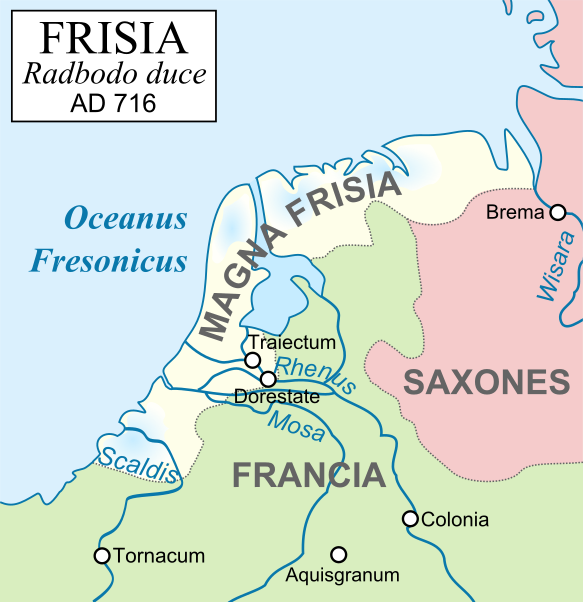 Frisia (716) — Source: Wikimedia Commons
This area is strategic: it controls the mouths of the Rhine and the Meuse, major commercial routes linking Gaul to the North Sea.
Around 689, Pepin fights the Frisian king Radbod I near Dorestad, a major trading centre on the Lower Rhine.
The Frankish victory establishes durable influence, even if domination remains fragile.
Pepin combines military conquest with religious policy: he supports Christian missionaries, especially Willibrord, who begins evangelising Frisia.
With Pepin’s backing, Willibrord founds a mission centre at Utrecht, which becomes a key anchor of Christianisation in the region.
This alliance of military conquest and religious mission becomes a hallmark of later Carolingian policy.
🔍 Zoom – Dorestad and Utrecht: Radbod, Willibrord, and conquest-Christianisation
⚖️ 714: a death, a crisis, an heir
When Pepin of Herstal dies in 714, he leaves immense power behind — but a fragile succession.
His legitimate heir is his grandson Theudoald, still a child. His widow Plectrude tries to act as regent to protect the family inheritance.
But several aristocratic factions contest the succession. In this troubled context, a new figure emerges: Charles Martel, Pepin’s illegitimate son.
Political skill, military talent, and the support of part of the aristocracy will soon allow Charles Martel to impose himself as the new strongman of the realm.
🔍 Zoom – 714: succession crisis and the birth of a strongman
🧠 Key takeaways
- After Tertry (687), Pepin of Herstal becomes the true master of the Frankish kingdom.
- The mayor of the palace governs as political leader, while the Merovingian king remains symbolic.
- Pippinid estates in the Meuse valley provide the economic and military base of this domination.
- Campaigns against Frisia and support for Christian missions strengthen Frankish influence.
- Pepin’s death in 714 triggers a succession crisis that opens the way for Charles Martel.
Image credits
- Pepin of Herstal — Louis Gallait, CC BY-SA 3.0 https://creativecommons.org/licenses/by-sa/3.0, via Wikimedia Commons
- Frisia 716-la — CC BY-SA 3.0 https://creativecommons.org/licenses/by-sa/3.0, via Wikimedia Commons