

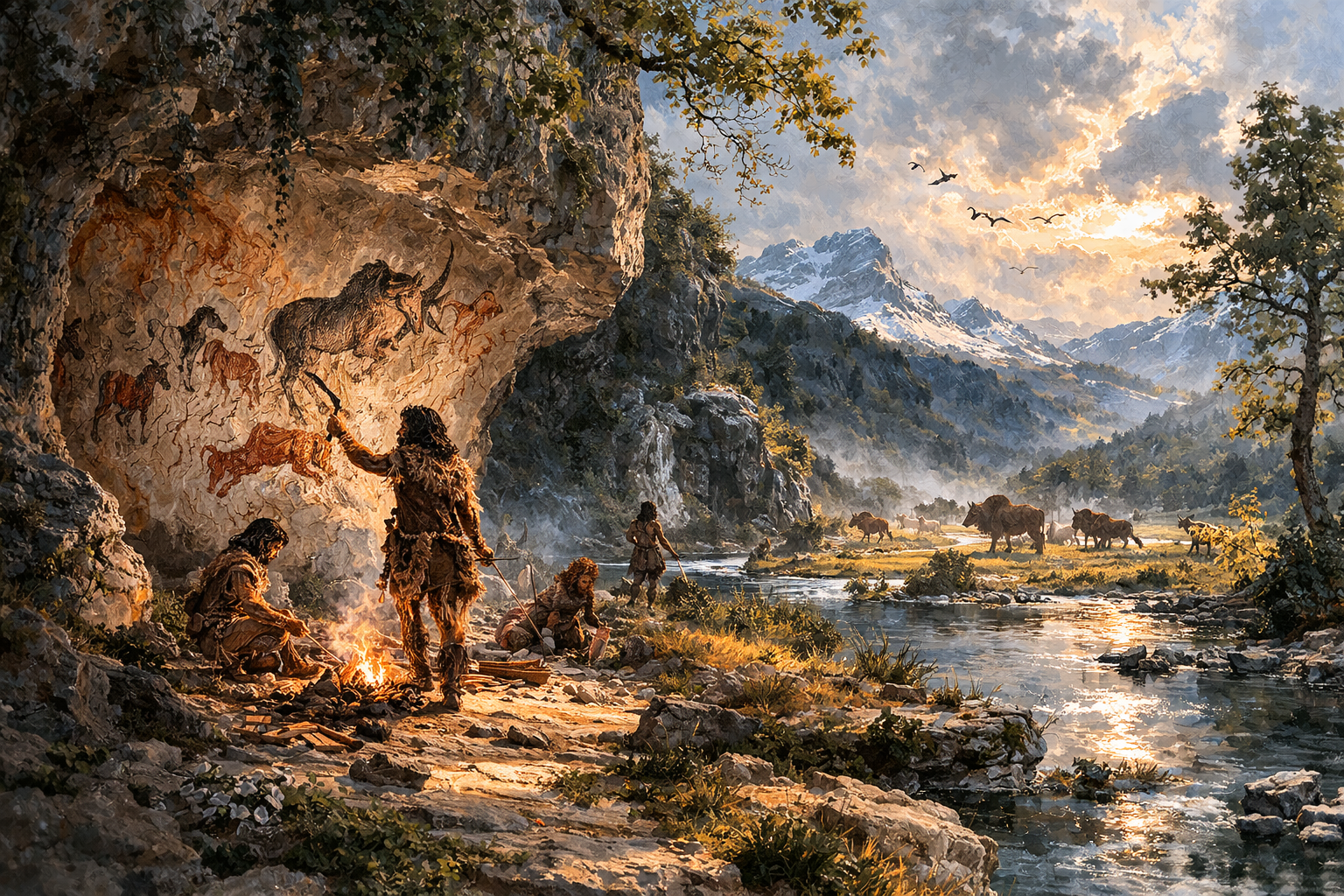
The Peak of the Paleolithic
p1Environ –45 000 à –10 000 avant notre ère
🪨 Prehistory — Chapter 2
The Peak of the Paleolithic in France: when humanity becomes creative
🌍 France, a center of the Upper Paleolithic
Between –45,000 and –10,000 years, the territory of present-day France became one of the major cultural centers of humanity.
Human groups no longer simply survived: they created, symbolized, and transmitted.
This period marks a fundamental turning point:
- emergence of symbolic behavior,
- development of art,
- lasting technical innovations.
Prehistory entered its richest and most expressive phase.
🧍 Neanderthal: master of the European cold

Model of an elderly individual of the species Homo neanderthalensis, Natural History Museum of Vienna.
Neanderthals occupied much of Europe, including France, for hundreds of thousands of years.
Perfectly adapted to cold climates, they had:
- a robust body,
- large lung capacity,
- excellent control of their environment.
But Neanderthals were not defined by physical strength alone.
⚰️ The first burial practices
In France, several archaeological sites show that Neanderthals were the first humans to bury their dead.
These practices suggest:
- an awareness of death,
- a form of symbolic thinking,
- the beginnings of spiritual beliefs.
This discovery long challenged the image of Neanderthals as primitive and cultureless.
To understand their disappearance, see:
🔍 Zoom – The mystery of Neanderthal extinction
🧬 The arrival of Cro-Magnon in France

Skull of one of the individuals from the Cro-Magnon rock shelter (Cro-Magnon 1), Musée de l’Homme, Paris.
Around 40,000 years ago, a new humanity arrived in what is now France:
Homo sapiens, commonly referred to as Cro-Magnon.
These humans are our direct ancestors.
They are distinguished by:
- more complex language,
- broader social organization,
- a greater ability to transmit knowledge.
For several millennia, Cro-Magnon and Neanderthals coexisted in France, sometimes sharing the same territories.
🎨 The birth of Art: a cultural revolution
The Upper Paleolithic marks the explosion of prehistoric art, and France is one of its global epicenters.
Art was not decorative.
It was linked to:
- beliefs,
- knowledge transmission,
- the relationship between humans and the animal world.
🐂 Unique sanctuaries in the world
France is home to two exceptional sites:
- Chauvet Cave
The oldest known paintings, over 36,000 years old, with striking realism.
.jpg?width=512)
Panel of the horses (general view), replica of Chauvet Cave.
- Lascaux Cave
Often called the “Sistine Chapel of Prehistory”, famous for its horses, aurochs, and mastery of movement.

Paintings from Lascaux Cave.
🔍 Zoom – Lascaux, a global masterpiece
🪡 Innovating to live better
Humans of the Upper Paleolithic developed major technological innovations.
Among the most important:
- the eye needle, allowing tailored clothing,
- the spear-thrower (atlatl), greatly improving hunting efficiency,
- the first jewelry, made from bones, shells, or stones.
These objects reflect:
- an aesthetic sense,
- a social identity,
- advanced symbolic thinking.
🏕️ A new way of inhabiting the world
Camps became more structured.
Humans organized space into:
- resting areas,
- working areas,
- spaces dedicated to collective activities.
This organization reflects a more stable and coordinated society.
🔍 Zoom – Daily life in a tent camp
🔥 A fundamental legacy
The peak of the Paleolithic in France marks:
- the birth of art,
- the emergence of beliefs,
- the first lasting cultural expressions.
These hunter-gatherer societies laid the cultural foundations of humanity, long before the invention of agriculture.
📸 Image credits
- Neanderthal man — Jakub Hałun, CC BY-SA 4.0, via Wikimedia Commons
- Cro-Magnon skull — 120, CC BY-SA 3.0, via Wikimedia Commons
- Chauvet paintings — Claude Valette, CC BY-SA 4.0, via Wikimedia Commons
- Lascaux paintings — JoJan, CC BY 4.0, via Wikimedia Commons
📚 Sources
- INRAP – Upper Paleolithic in France
https://www.inrap.fr - French Ministry of Culture – Prehistoric art
https://www.culture.gouv.fr - National Museum of Natural History
https://www.mnhn.fr - CNRS – Neanderthals and Homo sapiens
https://www.cnrs.fr - Encyclopædia Britannica – Upper Paleolithic
https://www.britannica.com