

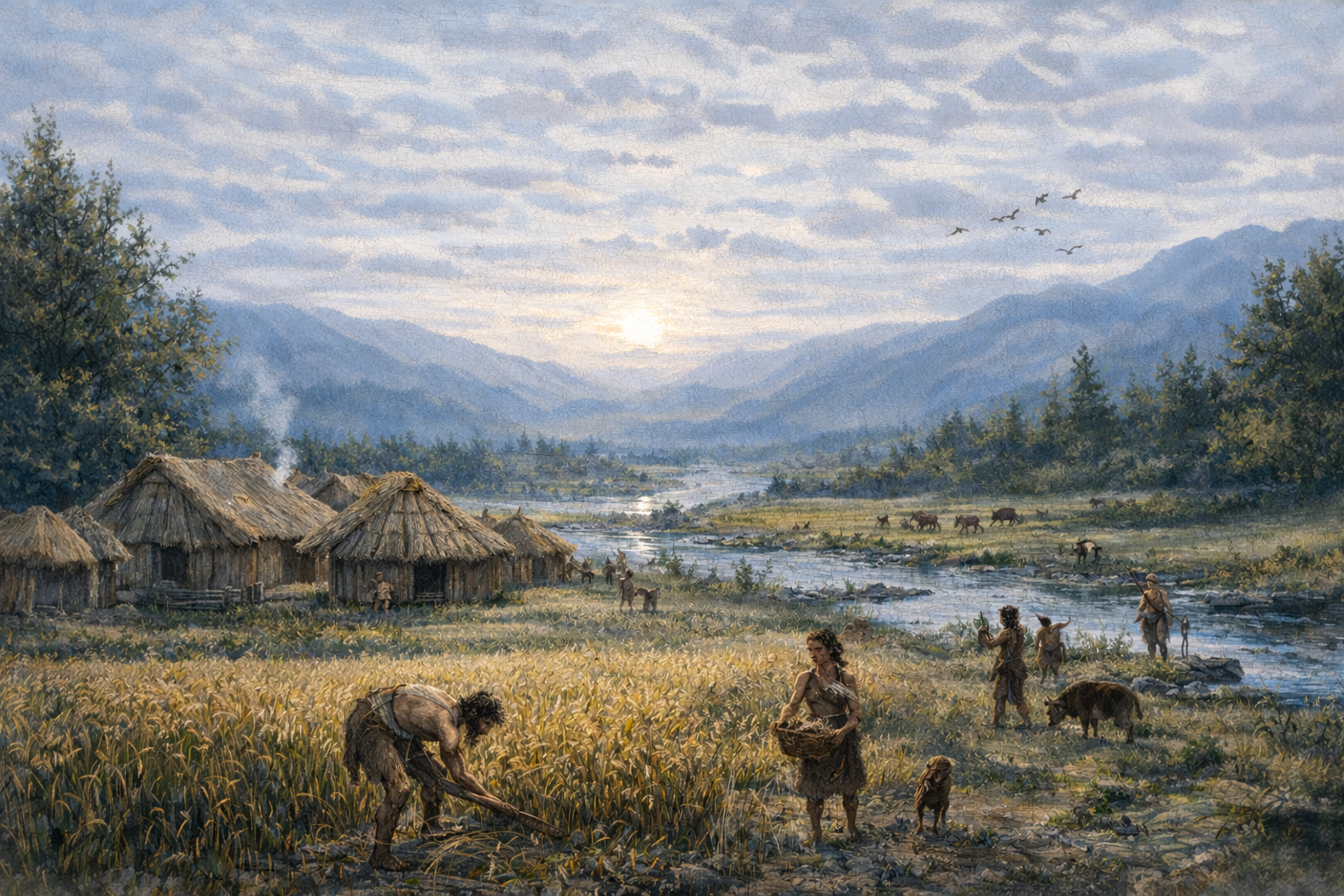
The Neolithic Revolution
p1≈ –6 000 à –2 500 av. J.-C.
🏠 From nomadic to sedentary life
For hundreds of thousands of years, humans were nomadic, following animal herds. Around 6000 BCE, this way of life changed radically in what is now France.
This revolution did not originate in France: it arrived through two major migration routes:
- The Mediterranean route: Populations from Italy settled along the coasts of Provence and Languedoc (Cardial culture).
- The Continental route: Farmers followed the Danube and entered from the east, settling in the Paris Basin.
Humans then built the first permanent villages. They no longer relied on temporary shelters but constructed solid houses made of wood, earth (wattle and daub), and thatch. In Bercy (Paris), archaeologists have uncovered traces of these dwellings and even dugout canoes, showing that early populations had already mastered river navigation.

The Neolithic village of Skara Brae (reconstruction).
🌾 Mastering nature: agriculture and animal husbandry
This is the greatest revolution in human history. Instead of simply gathering and hunting, humans became producers.
- Agriculture: Cultivation of key crops such as wheat, barley, and legumes (lentils, peas)
- Animal husbandry: Domestication of animals (sheep, goats, cattle, pigs), providing meat, milk, wool, and labor
This new abundance allowed populations to grow, but it came at a cost: work became more demanding, and close contact with animals introduced new diseases.
⚱️ New techniques, new needs
Sedentary life required new tools and networks:
- Polished stone: Unlike chipped stone, it is much more durable. It allowed the production of axes capable of clearing France’s dense forests.
- Pottery and salt: Pottery was used to store grains. This period also marks the beginning of salt exploitation (notably in Lorraine), essential for preserving meat and feeding livestock.
- Long-distance trade: Valuable jade axes, quarried in the Alps, have been found as far as Brittany—evidence of trade networks spanning hundreds of kilometers.
_pht.jpg?width=512)
Neolithic polished flint axe discovered in Marly-la-Ville.

Neolithic ceramic jar (National Archaeology Museum).
👑 A transforming society
With sedentary life and food storage, society changed. For the first time, inequalities appeared:
- Some individuals accumulated more wealth than others
- A hierarchy emerged: chiefs, warriors, and priests
- The first conflicts arose over control of fertile land and food resources
🗿 The mystery of megaliths
The Neolithic is also the age of the first large stone constructions: megaliths (from Greek mega: large, and lithos: stone).
France is home to remarkable sites that reflect a new level of social organization capable of mobilizing hundreds of people to build monuments:
- Menhirs: Standing stones, sometimes engraved with symbols
- Dolmens: Monumental collective tombs. The wealthiest individuals were buried with ornaments made of gold or jade

Partial view of the Ménec alignments in Carnac.
🔍 Zoom – The Carnac alignments
🧠 Key takeaways
- Agriculture arrived via two routes (south and east)
- Invention of production (crops, livestock) and preservation (pottery, salt)
- Emergence of social hierarchy and property
- Construction of the first monuments: megaliths
📸 Image credits
- Neolithic village — Archaeology Scotland, CC BY-SA 4.0, via Wikimedia Commons
- Polished axe — Cangadoba, CC BY-SA 4.0, via Wikimedia Commons
- Neolithic pottery — Calame, CC BY-SA 3.0, via Wikimedia Commons
- Carnac alignments — JLPC, CC BY-SA 3.0, via Wikimedia Commons