

Marseille and the Phocaeans
p2≈ –600 av. J.-C.

Massaliote amphora from the 4th century BCE. Source: Wikimedia Commons
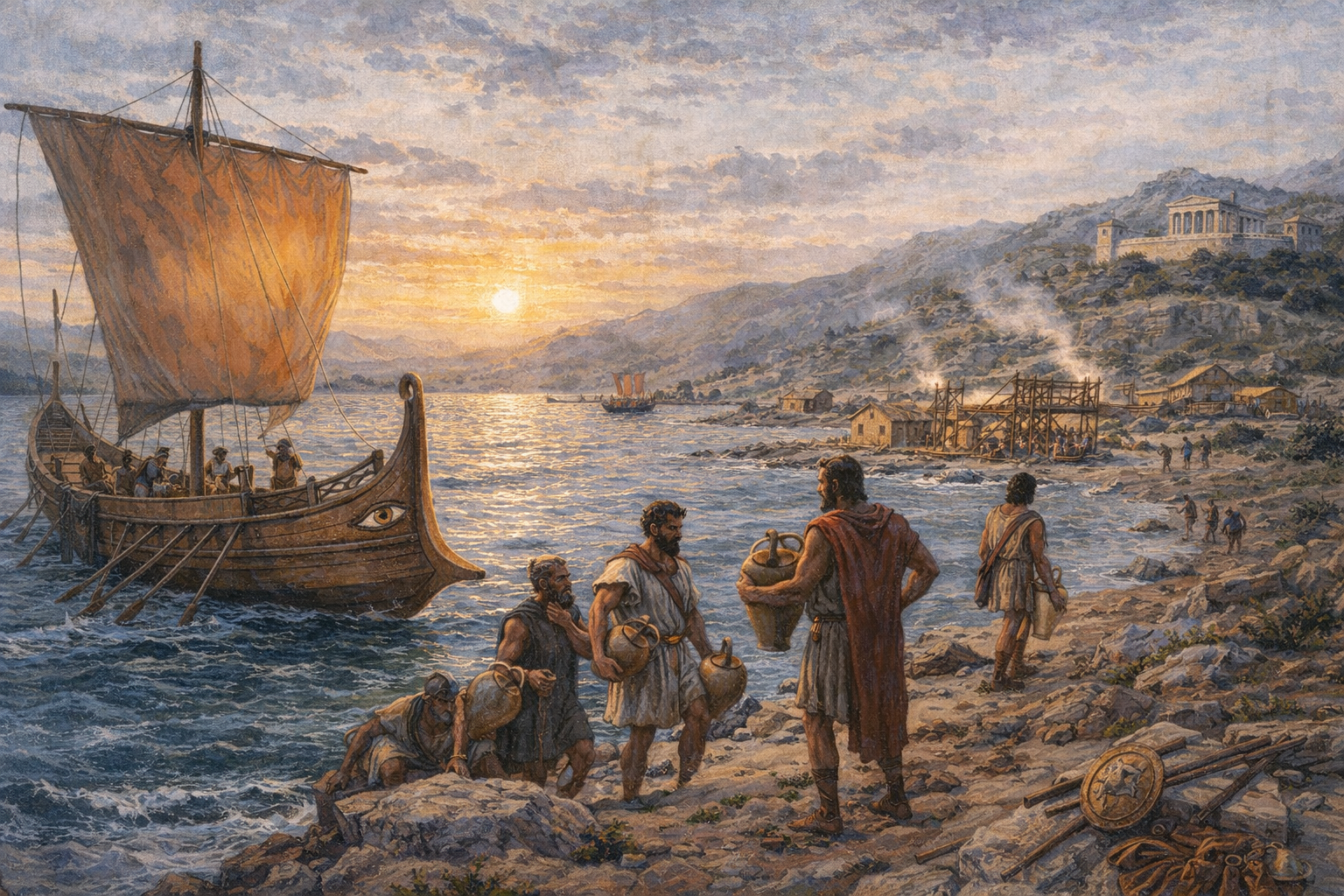
Around 600 BCE, the history of France took a decisive turn. Greek sailors from the city of Phocaea (in Asia Minor, present-day Turkey) landed on the coasts of Provence. They were seeking new trading posts to exchange their goods for northern metals.
This is how Massalia (Marseille) was founded—the oldest city in France and the first true organized city on its territory.
💍 An alliance sealed by marriage
The Greek settlement was not established by force, but through alliance. According to legend, the Greek leader Protis arrived on the day when the king of the local Segobrigii tribe, Nannus, was marrying off his daughter Gyptis.
During the banquet, Gyptis had to choose her husband by offering him a cup of water. To everyone’s surprise, she chose the Greek stranger. As a dowry, Protis received the land around the Lacydon inlet (today’s Old Port) to found his city.
🔍 Zoom – The legend of Gyptis and Protis
🏛️ The organization of a powerful city-state
Massalia was not just a trading post—it was an independent and highly organized city-state (polis).
- Government: The city was ruled by a council of 600 aristocrats, known as the “Timouchoi”. They oversaw laws, justice, and defense
- Urban planning: The Greeks introduced planned cities with grid-like streets, drainage systems, and strong stone fortifications to defend against sometimes hostile Gallic tribes
- Religion: Daily life revolved around Greek gods. Temples dedicated to Artemis of Ephesus and Apollo Delphinios, protector of sailors, stood on the heights of the city

The Jardin des Vestiges in Marseille: remains of the ancient port and Greek fortifications. Source: Wikimedia Commons
🍷 A cultural and agricultural revolution
The Phocaeans brought innovations that would transform Gaul:
- Agriculture: Introduction of vine cultivation and the olive tree. The Gauls discovered wine, which became a luxury product, sometimes exchanged for slaves or precious metals
- Economy: Massalia minted its own silver coins (drachmas). The Gauls gradually adopted the concept of money, moving away from barter
- Writing: The Greeks introduced the alphabet. For the first time, contracts and laws could be written in what is now France

Massaliote amphora from the 6th century BCE. Source: Wikimedia Commons
🔍 Zoom – The Wine and Olive Trade Route
💰 The engine of trade: salt and metals
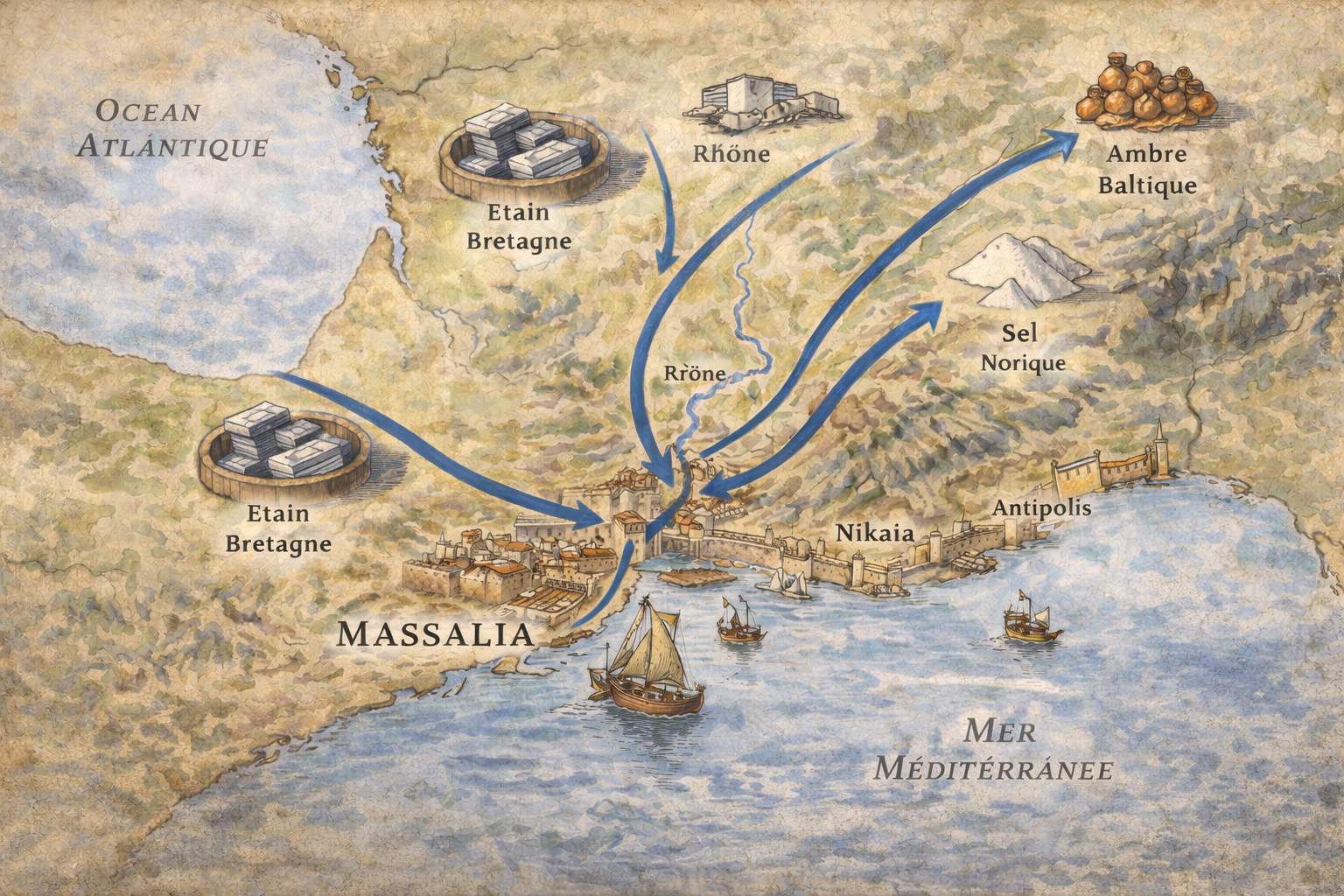
Massalia became a key hub between the Mediterranean and northern Europe.
- The Greeks exported wine, olive oil, and refined pottery
- In return, they transported down the Rhône tin (from Brittany), amber (from the Baltic), and salt, all essential resources at the time
This wealth enabled Massalia to found other colonies along the coast: Nikaia (Nice), Antipolis (Antibes), and Agathē (Agde).
🧭 Pytheas: explorer of distant worlds
Marseille was also a city of scholars. Around 325 BCE, the sailor Pytheas embarked on an extraordinary journey. He passed through the Strait of Gibraltar, sailed to Britain, and possibly reached Iceland or Norway, describing for the first time the northern ice and the midnight sun.
🔍 Zoom – Pytheas of Massalia: the explorer of the frozen seas
🧠 Key takeaways
- Foundation of Marseille (Massalia) around 600 BCE by Greeks from Phocaea
- Initial peaceful alliance between Greeks and Gauls
- Introduction of vine, olive, coinage, and writing
- Massalia became a major political and commercial power in the Mediterranean
📸 Image credits
- Jardin des Vestiges — © José Luiz Bernardes Ribeiro, CC BY-SA 3.0, via Wikimedia Commons
- Massaliote amphora — Robert Valette, CC BY-SA 3.0, via Wikimedia Commons
- Old Port of Marseille — Jean-Pierre Dalbéra, CC BY 2.0, via Wikimedia Commons
📚 Sources
- Justin – Epitome of the Philippic Histories (Book XLIII)
- Aristotle – Constitution of the Massaliotes
- Museum of History of Marseille – Ancient collections and Jardin des Vestiges
- INRAP – Marseille, 2,600 years of urban history
- Strabo – Geography (Book IV)