

The Golden Age of the Gauls
p2≈ –400 à –200 av. J.-C.
In the 4th century BCE, the Gaulish world reached its peak.
Emerging from the transformations of the previous century, Celtic peoples were no longer just forming:
they became a major force on the European stage.
From Gaul to Italy, from the Balkans to Anatolia, their influence expanded.
It was a powerful, mobile, and feared world… yet still deeply divided.
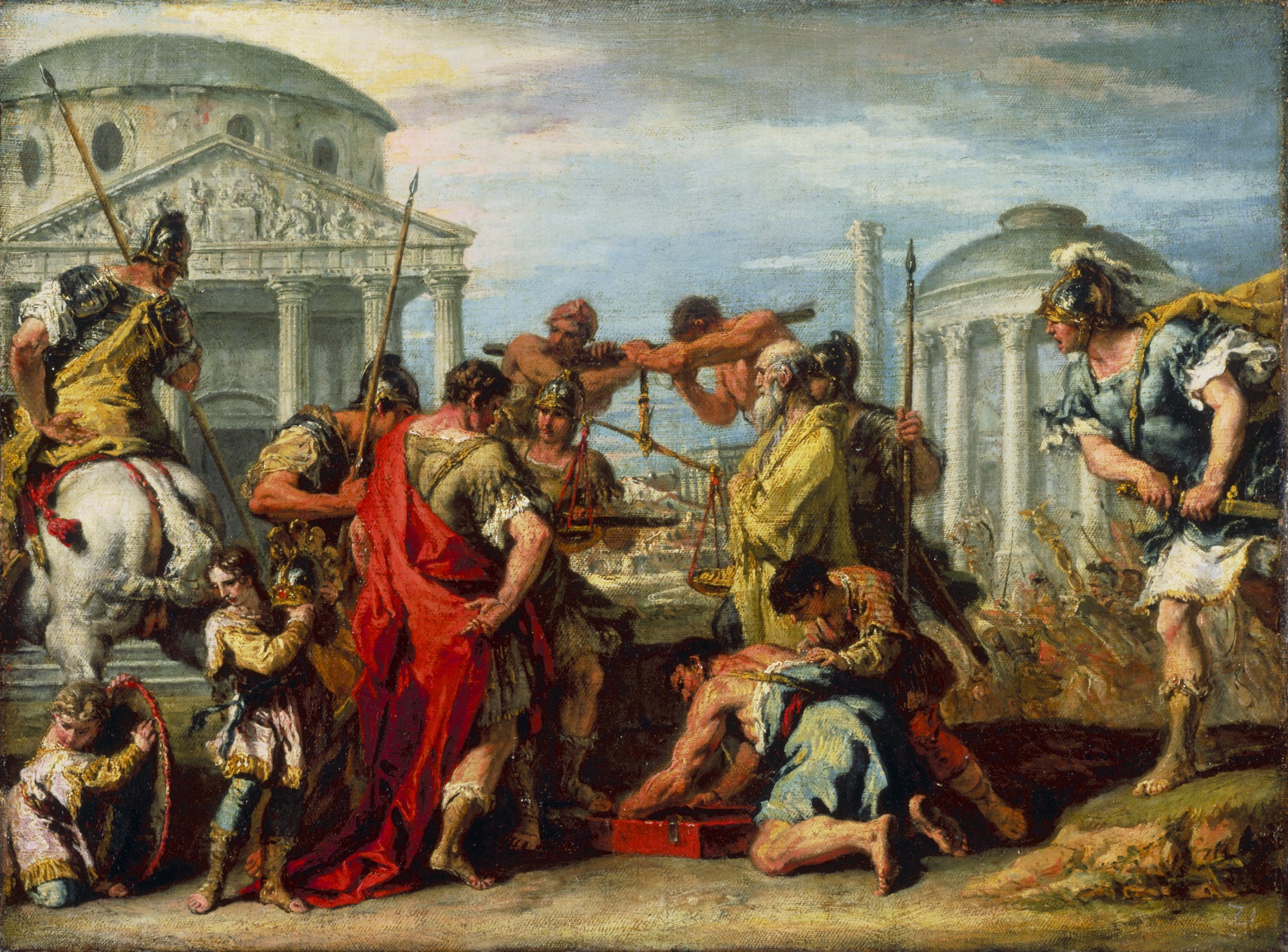
–390: when the Gauls captured Rome
Around 390 BCE, the Gauls, led by the chief Brennus, crossed the Alps and invaded Italy.
Drawn by the wealth of the peninsula, they confronted the Romans on the banks of the Allia River.
The Roman army was crushed.
The road to Rome lay open.
The Gauls entered the city, largely abandoned.
Rome was sacked. Only the Capitoline Hill held out, where the last Roman defenders took refuge.
This episode, remembered for the phrase “Vae victis” (“Woe to the vanquished”), left a lasting mark.

Brennus weighing the ransom of Rome — Source: Wikimedia Commons
For Rome, it was a trauma.
For the Gauls, a demonstration of power.
Zoom: The sack of Rome by the Gauls
🌍 A Celtic Europe
Between 400 and 200 BCE, Celtic peoples occupied a vast territory.
Their presence extended across:
- Gaul (modern France)
- Northern Italy
- the Balkans
- as far as Asia Minor (where the Galatians emerged)
Never before had the Celts occupied such a wide area.
Europe at that time was, to a large extent, a Celtic Europe.
🏛️ Beyond the Alps: the Gauls in Italy
After their initial incursions, several Gaulish groups settled permanently in northern Italy.
Among them:
- the Senones
- the Boii
- the Insubres
They occupied the Po Valley, founded settlements, and controlled territories.
This was no longer simple migration:
it was true settlement.
Rome now faced powerful and unpredictable neighbors.
⚔️ Celts and the great civilizations
In the 3rd century BCE, the Celts confronted the major powers of the Mediterranean world.
Around 280 BCE, Celtic groups invaded the Balkans and reached Greece.
They threatened prestigious sanctuaries such as Delphi.
Some continued into Asia Minor, where they settled permanently.
These peoples became known as the Galatians.
The Celts were no longer just neighbors:
they had become major players in the ancient world.
🐘 The Gauls and Hannibal
In 218 BCE, another key moment connected Gaul to Mediterranean history.
The Carthaginian general Hannibal crossed the Alps with his army and elephants.
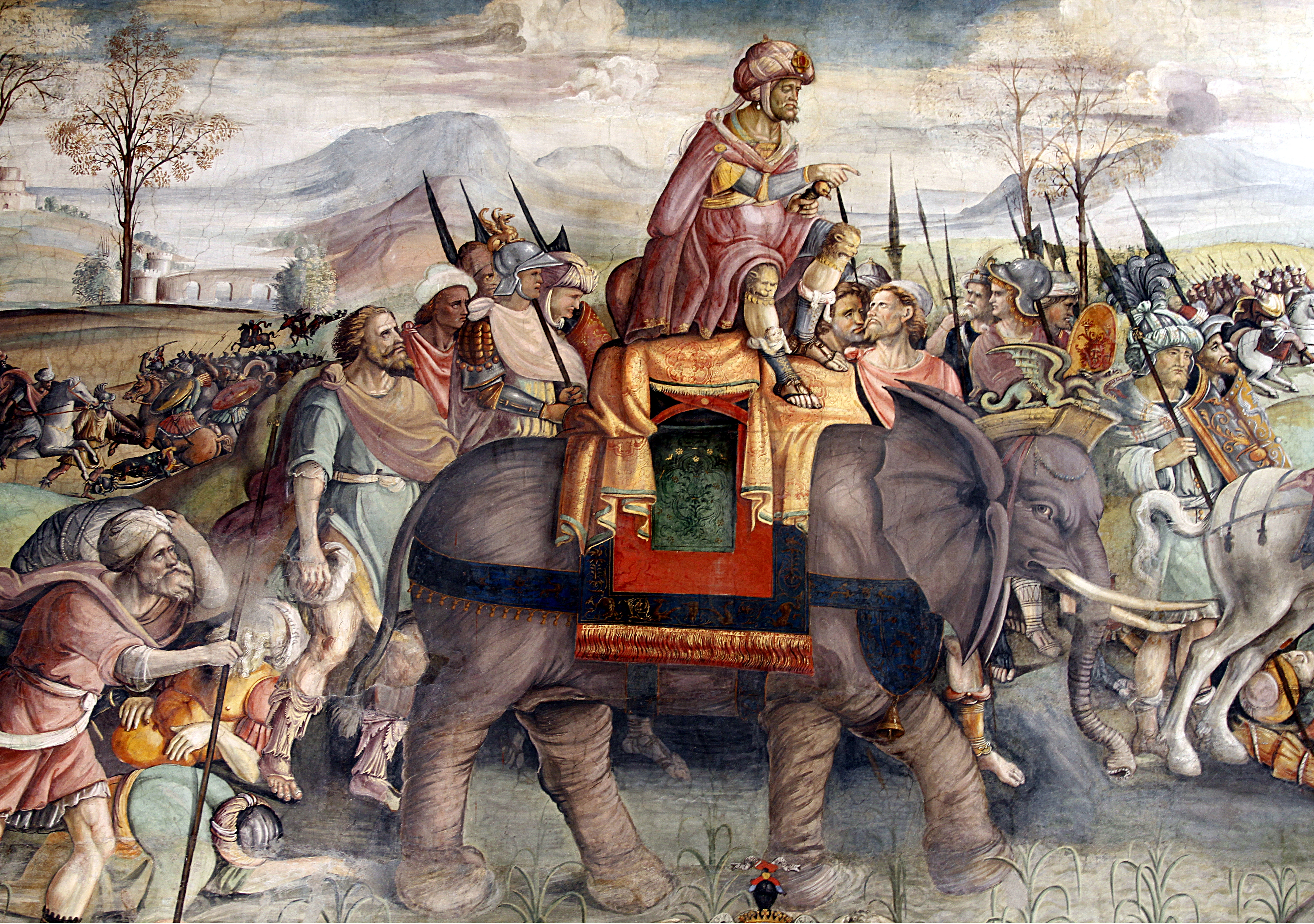
Hannibal crossing the Alps — Source: Wikimedia Commons
Along the way, he formed alliances with several Gaulish tribes.
They joined his forces against Rome.
The Gauls were not mere spectators:
they became strategic allies in one of the greatest conflicts of Antiquity.
⚖️ A power without unity
Despite their strength, the Gauls never formed a unified state.
The Celtic world remained divided:
- into independent tribes
- into temporary alliances
- into constant rivalries
Each people pursued its own interests.
There was no shared strategy, no central authority.
This lack of unity limited their ability to dominate in the long term against organized powers like Rome.
🔍 Key takeaways
- Around 390 BCE, the Gauls sacked Rome and left a lasting impact
- The Celts dominated much of Europe between 400 and 200 BCE
- Gaulish peoples settled in northern Italy
- The Celts reached Greece and Asia Minor (Galatians)
- The Gauls took part in major conflicts, notably alongside Hannibal
- Despite their power, they remained deeply divided
✨ Conclusion
By the 3rd century BCE, the Gaulish world had reached its peak.
Powerful, mobile, and feared, the Celts dominated much of Europe.
But this power rested on a fragile balance.
Without political unity, the Gauls could not transform their dominance into a true empire.
And against an organized, disciplined, and ambitious power like Rome…
the balance of power was beginning to shift.
📸 Image credits
- Brennus weighing the ransom of Rome — Jacques-Antoine Beaufort, Public Domain, via Wikimedia Commons
- Hannibal crossing the Alps — © José Luiz Bernardes Ribeiro