

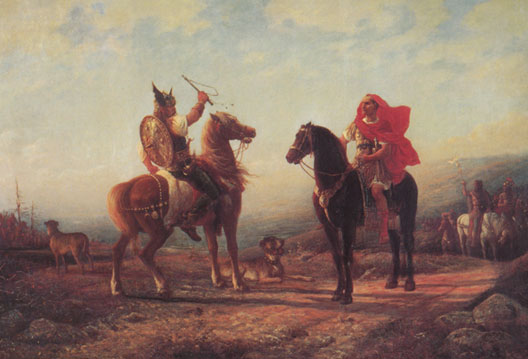
Gaul Faces Rome
p2≈ –200 à –58 av. J.-C.
In the 2nd century BCE, the balance of the Gaulish world began to shift.
After several centuries of power and expansion, the peoples of Gaul were no longer the sole dominant force in Western Europe.

Map of Gaulish peoples – Source: Wikimedia Commons
To the south, a new power was rising: Rome.
At first discreet, its influence became increasingly visible… then impossible to ignore.
🏛️ Rome enters Gaul
Around 125–121 BCE, Rome intervened directly in Gaul for the first time.
Officially, it came to assist the Greek city of Massalia, threatened by neighboring peoples.
Among them were the Salyens (or Salluvii), a powerful confederation based in Provence, around present-day Aix-en-Provence, with their capital at Entremont.

Map of the Salyen peoples – Source: Wikimedia Commons
These populations, often described as Celto-Ligurian, controlled much of southeastern Gaul and were among the region’s main powers.
The area was highly strategic—a crossroads of trade and a contact zone between the Celtic and Mediterranean worlds.
But behind Rome’s intervention lay a broader objective:
securing routes between Italy and Spain.
Rome launched military campaigns against several Gaulish peoples:
- the Salyens in Provence
- the Allobroges in the Rhône valley
- the Arverni, one of the most powerful peoples of Gaul

Protohistoric settlement in Provence – Source: Wikimedia Commons
Roman armies achieved decisive victories.
And Rome did not leave.
It settled permanently in the south, marking the beginning of a lasting Roman presence in Gaul.
🛣️ The birth of Roman Gaul (Gallia Narbonensis)
Following its victories, Rome created a new province:
Gallia Narbonensis.
This region, corresponding to southern France, became Roman territory.

Map of Roman Gaul – Source: Wikimedia Commons
It allowed Rome to:
- control trade routes
- move armies efficiently
- strengthen its influence
Cities developed, and roads were built, such as the Via Domitia.
For the first time, part of Gaul became Roman.
👑 The great Gaulish peoples
At this time, Gaul was dominated by several major peoples:
- the Arverni in central Gaul
- the Aedui, allies of Rome
- the Sequani, rivals of the Aedui
- the Allobroges, in the southeast
These groups had influential leaders, large territories, and powerful networks.
Gaul was structured… but not unified.
⚖️ A divided Gaul
Relations between Gaulish peoples were marked by rivalry.
Alliances and conflicts constantly shifted:
- Aedui vs. Sequani
- power struggles among major tribes
- competition for control of trade
No central authority emerged.
This division weakened the entire Gaulish world.
🌍 External pressures
At the same time, new threats appeared from the east.
Germanic peoples crossed the Rhine and gradually settled in Gaul.
Among them, one leader stood out: Ariovistus.
Leader of a Germanic coalition (likely from the Suebi), he settled in Alsace and nearby regions between 75 and 58 BCE.
Notably, Ariovistus was familiar with both Gaulish and Roman worlds:
- he spoke Celtic
- he maintained relations with Rome
- he was even recognized as a “friend of the Roman people”
But behind this recognition lay greater ambitions.
⚔️ An alliance turns into a trap
The conflict between Gaulish peoples was not only political—it was also economic.
The Aedui and the Sequani competed for control of a strategic route:
the Arar River (Saône).
This river was a major trade axis.
Whoever controlled it could:
- tax goods
- dominate north–south exchanges
- strengthen economic power
The Sequani, based in the east, also controlled access to the Rhine and relied on strongholds such as Vesontio (Besançon).

Reconstruction of Vesontio – Source: Wikimedia Commons
The conflict was both economic and political.
In this context, the Sequani made a decisive choice:
they called upon Germanic warriors led by Ariovistus.
Between 65 and 62 BCE, the Sequani-Germanic coalition defeated the Aedui.
The Aedui were crushed.
They lost much of their cavalry and were forced to give hostages.
The Sequani regained disputed territories, including parts of the Saône valley.
But this victory came at a cost.
Ariovistus demanded compensation.
The Sequani had to cede land, particularly in Alsace.
Germanic groups settled permanently in Gaul.
The situation quickly spiraled out of control.
Ariovistus no longer acted as an ally:
- he imposed his authority
- demanded more land
- brought in additional Germanic groups
After the battle of Magetobriga, Germanic domination took hold.
The Aedui were defeated.
Even the Sequani became dependent.
What began as an alliance turned into occupation.
⚖️ A trapped Gaul
The situation became critical.
Gaulish peoples were now caught between:
- internal rivalries
- Germanic pressure
- growing Roman influence
Even diplomatic efforts failed.
The Aeduan druid Diviciacus went to Rome seeking help… without success.
At that time, Ariovistus was still useful to Rome.
👤 A pretext for Caesar
When Julius Caesar rose to power, the situation changed.
Ariovistus became an ideal opponent.
He represented:
- an external threat
- instability in Gaul
- a danger to Rome’s allies
⚔️ Caesar against Ariovistus
In 58 BCE, Julius Caesar took action.
Officially, he intervened to protect threatened Gaulish peoples.
In reality, he pursued a broader objective: asserting Roman power in Gaul.
That same year, Caesar led two campaigns.
The first was against the Helvetii, a migrating people heading west. They were defeated at Bibracte and forced to return to their lands.
Caesar had proven his military strength.
⚔️ The confrontation with Ariovistus
After this victory, Caesar turned toward Ariovistus.
The meeting between the two leaders was tense.
Ariovistus proposed dividing Gaul:
- the north under Germanic control
- the south under Roman influence
Caesar refused.
War became inevitable.
🛡️ A decisive battle
On September 14, 58 BCE, the two armies clashed.
The battle likely took place in Alsace, at the foothills of the Vosges (exact location uncertain).
The Romans won decisively.
Ariovistus’s army was crushed, and the retreat turned into a massacre.
Ancient sources describe a pursuit lasting dozens of kilometers to the Rhine.
Losses were heavy.
🌊 The flight of Ariovistus

The flight of Ariovistus – Source: Wikimedia Commons
Ariovistus narrowly escaped. Wounded, he crossed the Rhine with a few companions.
Most of his army was killed or scattered. His relatives were captured or killed.
His power in Gaul was broken.
⚖️ A victory with major consequences
This victory profoundly changed the situation:
- the Germans were pushed back
- Caesar appeared as the protector of the Gauls
- Rome became the arbiter of conflicts
But above all, Rome was now militarily engaged in Gaul.
What had been an intervention became a lasting presence.
By defeating Ariovistus, Caesar did not just protect Gaul:
he opened the path to its conquest.
⚠️ An explosive situation
Between internal rivalries and external pressures, Gaul entered a critical phase:
- conflicts between peoples
- foreign interventions
- political instability
Some Gauls even sought Rome’s help.
Without realizing it, they opened the door to a far deeper intervention.
🔍 Key takeaways
- Rome intervened in Gaul as early as 125 BCE
- Gallia Narbonensis became a Roman province
- Powerful Gaulish peoples dominated the territory
- Gaul remained deeply divided
- External pressures destabilized the region
- By 59 BCE, Caesar was preparing to intervene
✨ Conclusion
On the eve of the conquest, Gaul stood at a turning point.
Powerful yet divided, rich yet unstable, it now attracted Rome’s full attention.
Everything was in place for a decisive confrontation.
And this time, it was no longer the Gauls marching on Rome…
It was Rome preparing to enter Gaul.
📸 Image credits
- Map of the Salyen peoples — Bourrichon, CC BY-SA 3.0
- Map of Gaulish peoples — Treanna, CC BY 1.0
- Map of Roman Gaul — Patotable4, CC BY-SA 4.0
- Protohistoric Provence — Wisi eu, CC0
- Vesontio reconstruction — Arnaud 25, CC BY-SA 3.0
- The flight of Ariovistus — Horace Castelli, Public Domain