

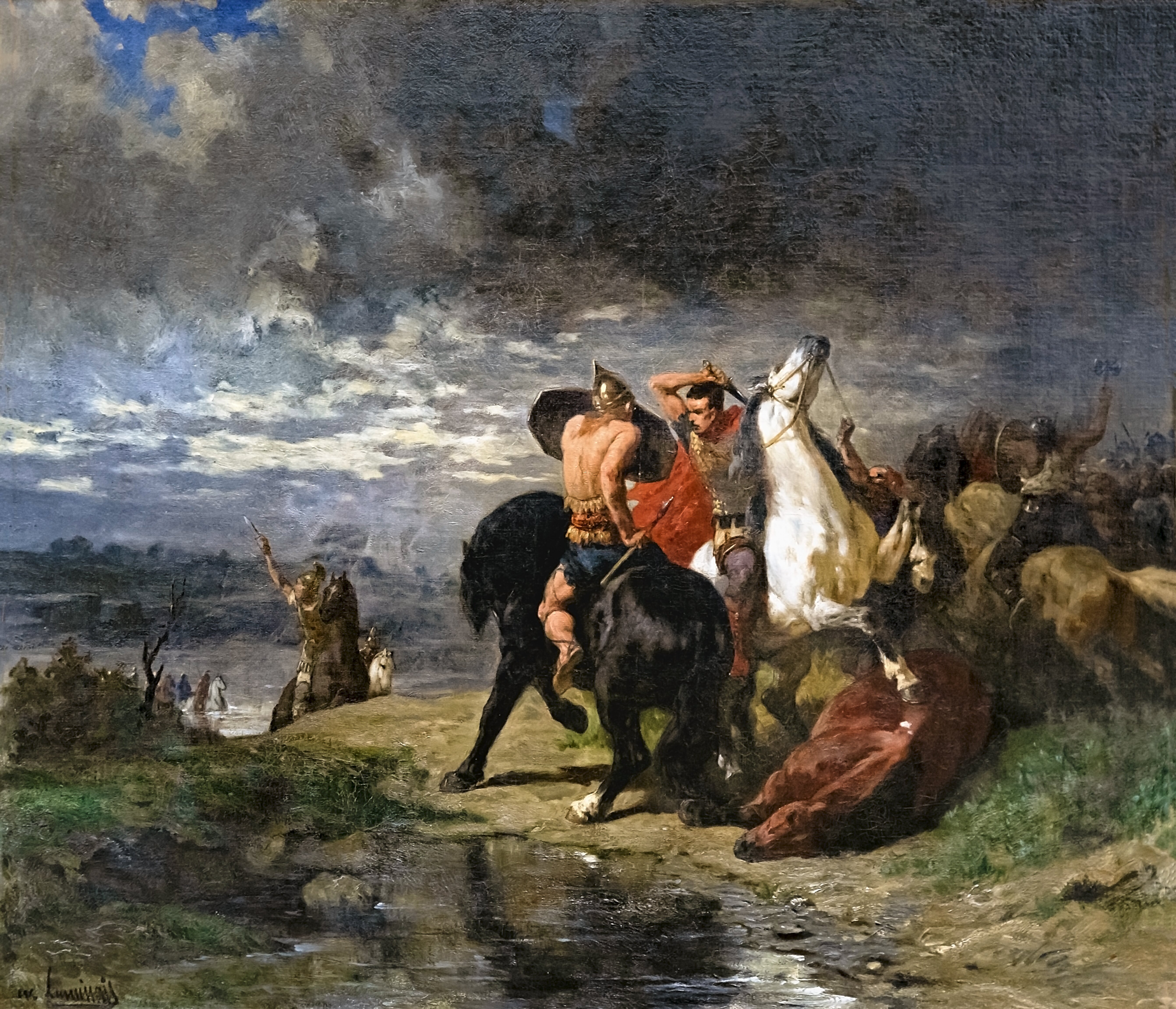
The Gallic Wars
p2≈ –58 à –53 av. J.-C.
The Gallic Wars began in 58 BCE, when Julius Caesar took command of the Gallic provinces.
The first years of the conflict (58 to 53 BCE) were marked by a series of military campaigns that gradually allowed Rome to impose its authority over much of Gaul.
These operations pitted the Roman legions against various Gallic peoples, in a context of progressive conquest and local resistance.
58 BCE: the beginning of the war
In the spring of 58 BCE, Julius Caesar left Rome to take up his command in Gaul, granted by the lex Vatinia. He arrived at Genava (Geneva) on March 28.
At the same time, the Helvetii, accompanied by several other peoples (the Latobici, Rauraques, Tulingi, and Boii), began a migration westward toward the territory of the Santones. This movement involved several hundred thousand people.
Concerned, the Aedui, allies of Rome, requested Caesar’s intervention. Caesar prevented the Helvetii from crossing the Rhône at Genava by having the bridge destroyed.
The Helvetii then bypassed the obstacle by passing through the territory of the Sequani. Caesar pursued them and confronted them in June 58 BCE at the battle of the Arar (Saône), then in July near Bibracte. The Helvetii were defeated and forced to return to their homeland.
In the same year, Caesar intervened against the Germanic leader Ariovistus, who had settled in Gaul. After an attempted negotiation, the two armies clashed on September 14, 58 BCE, probably in Alsace. Ariovistus was defeated and pushed back beyond the Rhine.
 Helvetian campaign -58 - Source: Wikimedia Commons
These operations marked the true beginning of the Gallic Wars and firmly established the Roman military presence.
57 BCE: the conquest of the north
In 57 BCE, Caesar campaigned against the peoples of northern Gaul, collectively known as the Belgae.
In the spring, they attacked the stronghold of Bibrax, held by the Remi, allies of Rome. Caesar intervened and forced the attackers to withdraw.
The armies then clashed near the river Axona (Aisne). The Belgae, led in particular by the Suessionian chief Galba, were repelled.
In July 57 BCE, Caesar faced a new coalition composed notably of the Nervii and the Atrebates, at the battle of the Sabis (probably the Sambre). The Roman legions were initially put under severe pressure, but they managed to regain the advantage and win the battle.
 Belgic campaign -57 - Source: Wikimedia Commons
Following these campaigns, much of northern Gaul came under Roman control. Caesar notably recognized Commius as king of the Atrebates.
56 BCE: expansion of operations
In 56 BCE, military operations expanded into several regions.
In Armorica, the Veneti revolted and detained Roman envoys. Caesar organized a fleet under the command of Decimus Brutus. The naval battle, probably fought in the Gulf of Morbihan, ended with the destruction of the Venetic fleet and the submission of the region.
At the same time, the legate Quintus Titurius Sabinus campaigned against several peoples of the west, notably the Unelli, the Lexovii, and the Aulerci Eburovices, whom he defeated in a land campaign.
In the south, Publius Crassus led a campaign in Aquitania. He fought the Sotiates, led by King Adiatuanos, and achieved a victory that extended Roman influence.
 Aquitanian campaign -56 - Source: Wikimedia Commons
By the end of the year, Germanic peoples, the Usipetes and the Tencteri, had crossed the Rhine and settled on its left bank, maintaining pressure on the eastern frontier.
55 BCE: operations on the Rhine and the first expedition to Britain
In 55 BCE, Caesar launched several operations aimed at securing the frontiers and demonstrating Roman power.
In the spring, he intervened against the Germanic peoples of the Usipetes and the Tencteri, settled between the Meuse and the Rhine. After tensions and negotiations, the confrontation ended in a major defeat for these peoples, a large part of whom were annihilated.
Following this campaign, Caesar had a wooden bridge built over the Rhine, probably in the region of present-day Bonn. He crossed the river with his troops, carried out a show of force in Germanic territory, and returned to Gaul after a few days.
This operation was mainly political and strategic in scope: it aimed to deter further Germanic incursions and to demonstrate Rome’s ability to intervene beyond its frontiers.
During the summer, Caesar prepared an expedition to insular Britain (modern Great Britain), a land still little known to the Romans but suspected of supporting certain Gallic resistances.
The departure took place between August 25 and 27 from Portus Itius.
Caesar relied in particular on Commius, king of the Atrebates, who took part in the preparations and acted as an intermediary with the local populations. Captured during the operations, he was later released. The Atrebates would subsequently become a client kingdom of Rome.
The expedition quickly encountered difficulties:
- resistance from local populations
- complex logistics
- storms
On August 30 and 31, a storm damaged part of the Roman fleet.
The operation remained limited and did not establish lasting control over the territory.
In mid-September, Caesar returned to Gaul. His troops were distributed among winter quarters, mainly in Gallia Belgica, while he himself returned to Cisalpine Gaul.
 Campaign of 55 BCE - Source: Wikimedia Commons
Thus, 55 BCE marked a phase of expansion and power projection, without durable territorial gains outside Gaul.
54 BCE: expedition to Britain and revolts in Gaul
 Campaign of 54 BCE - Source: Wikimedia Commons
In 54 BCE, Caesar continued operations on several fronts.
In the spring, he first intervened against the Treveri, a people of Belgic Gaul, in order to stabilize the region after internal tensions. This campaign followed his return from Illyria, where he had settled various conflicts.
During the summer, Caesar launched a second expedition to insular Britain, between July and September. Unlike the previous year, the operation involved larger forces.
The Romans confronted several British peoples, notably those led by Cassivellaunus. After a series of clashes, he surrendered at the end of the summer.
 Cassivellaunus - Source: Wikimedia Commons
Despite this success, Caesar did not establish a lasting occupation. He left Britain and returned to Gaul on September 20, 54 BCE.
⚔️ The revolt of the Eburones
Shortly after his return, a revolt broke out in Belgic Gaul.
The Eburones, led by Ambiorix, rose up against Roman occupation.
 Statue of Ambiorix - Source: Wikimedia Commons
A Roman legion, commanded by the generals Sabinus and Cotta, was attacked and annihilated at the battle of Aduatuca, probably in the region of Tongeren.
Both commanders were killed.
This episode was one of the most serious setbacks suffered by Caesar in Gaul.
⚔️ Suppression of the uprisings
Faced with this situation, Caesar reacted quickly.
In November 54 BCE, he led a campaign in Belgic Gaul to suppress the revolt of the Eburones and the Nervii.
He notably managed to relieve the camp of his lieutenant Quintus Cicero, besieged by the insurgents.
At the same time, Titus Labienus conducted operations against the Treveri, led by Indutiomarus, and succeeded in containing their uprising.
⚖️ An unstable situation
The year 54 BCE marked a turning point in the war.
Despite the successes in Britain, the situation in Gaul became more unstable:
- revolts multiplied
- some Roman armies suffered heavy losses
- Rome’s authority was increasingly challenged
These events announced a more difficult phase of the conflict for Caesar in the years that followed.
53 BCE: repression and reorganization of Gaul
In 53 BCE, Caesar undertook a series of operations intended to restore his authority after the revolts of the previous year.
At the beginning of spring, he received reinforcements of two legions sent by Pompey, bringing the total number of legions under his command in Gaul to around ten. This increase in manpower allowed him to conduct simultaneous campaigns.
Caesar first campaigned against the Nervii, devastating their territory. He then directed his operations against the Eburones, responsible for the revolt led by Ambiorix.
He successively fought several peoples allied with the Eburones, notably the Menapii and the Treveri, defeating them separately. He then turned against the Germanic peoples who had supported the insurgents.
As in the previous year, Caesar crossed the Rhine after having a new bridge built. This expedition aimed to deter any Germanic assistance to the rebels. However, he did not pursue the Suebi, who withdrew into forested areas that were difficult to access.
Caesar then resumed his campaign against the Eburones. He systematically devastated their territory, isolating their forces. Ambiorix managed to escape capture.
⚖️ Assemblies and political control
In April 53 BCE, Caesar summoned a general assembly of the Gallic peoples at Samarobriva (Amiens). Three peoples refused to attend: the Treveri, the Carnutes, and the Senones.
Caesar dissolved the assembly and campaigned against these peoples, subduing them.
During the summer, he continued his operations in forest regions, notably in the Ardennes, still searching for Ambiorix, without succeeding in capturing him.
In the autumn, Caesar convened a new assembly at Durocortorum (Reims). This meeting, known as the concilium Galliae, was intended to judge those responsible for the revolts, particularly among the Senones and Carnutes.
The legions were then distributed into winter quarters in several regions, notably among the Lingones and the Senones, close to recently pacified areas.
Caesar finally returned to Cisalpine Gaul.
⚖️ A strengthened but fragile domination
The year 53 BCE was marked by severe repression of the revolts and a political reorganization of the territory.
Although Roman authority was reaffirmed, tensions remained strong. Several Gallic peoples, subdued but hostile, retained the capacity to resist.
These events prepared the general uprising that would erupt the following year.
🔍 Key takeaways
- The Gallic Wars lasted from 58 to 51 BCE
- Caesar successively fought the Helvetii, the Belgae, and several Gallic peoples
- The conquest progressed through successive campaigns
- Roman domination advanced step by step between 58 and 53 BCE
- Major revolts began to appear from 54 BCE onward
✨ Conclusion
Between 58 and 53 BCE, Caesar gradually extended Roman influence over a large part of Gaul.
Despite these successes, Roman domination remained fragile. Revolts multiplied, and several Gallic peoples challenged Roman authority.
On the eve of 52 BCE, the situation was unstable.
A large-scale uprising was taking shape.
It would be led by a chief capable of uniting the Gauls against Rome.
📸 Image credits
- Helvetian campaign -58: User:Coldeel, CC BY-SA 3.0 https://creativecommons.org/licenses/by-sa/3.0, via Wikimedia Commons
- Belgic campaign -57: User:Coldeel, CC BY-SA 3.0 https://creativecommons.org/licenses/by-sa/3.0, via Wikimedia Commons
- Aquitanian campaign -56: User:Coldeel, CC BY-SA 3.0 https://creativecommons.org/licenses/by-sa/3.0, via Wikimedia Commons
- Campaign of 55 BCE: J.C EVEN, CC BY-SA 4.0 https://creativecommons.org/licenses/by-sa/4.0, via Wikimedia Commons
- Cassivellaunus: The Miriam and Ira D. Wallach Division of Art, Prints and Photographs: Print Collection, The New York Public Library., CC BY-SA 4.0 https://creativecommons.org/licenses/by-sa/4.0, via Wikimedia Commons
- Campaign of 54 BCE: User:Cristiano64 (Transferred by User:Coldeel/Originally uploaded by Cristiano64 (it)), CC BY-SA 3.0 https://creativecommons.org/licenses/by-sa/3.0, via Wikimedia Commons
- Statue of Ambiorix: I, ArtMechanic, CC BY-SA 3.0 http://creativecommons.org/licenses/by-sa/3.0/, via Wikimedia Commons