

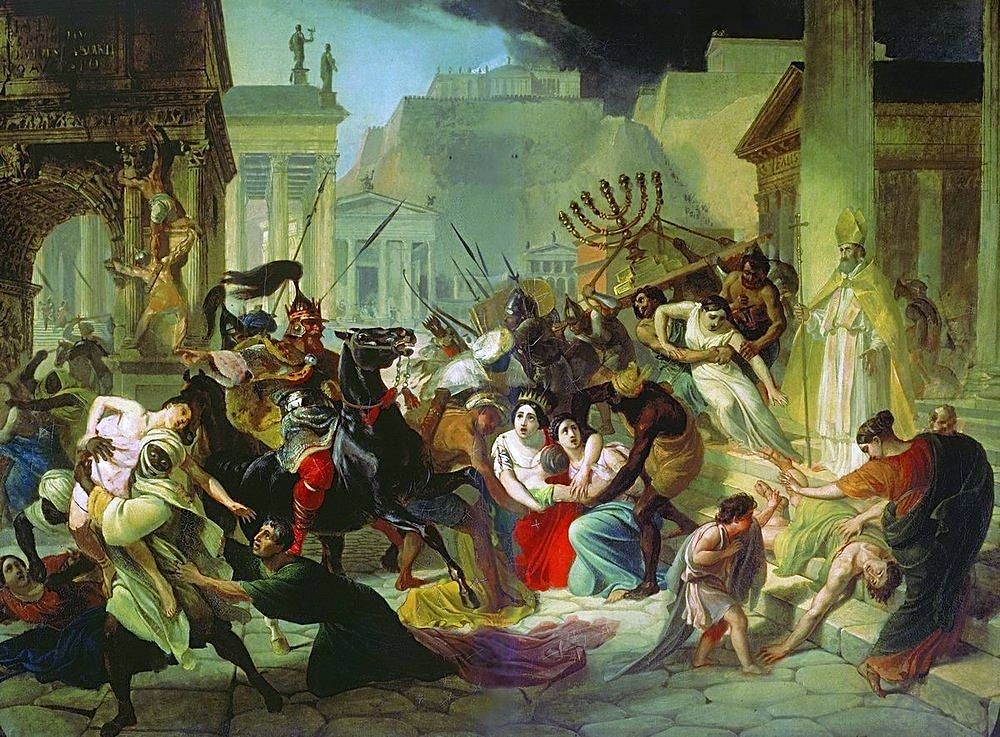
The Fall of Roman Gaul
p3400 à 476
At the beginning of the 5th century, Gaul enters a period of profound upheaval. The Western Roman Empire—weakened by the political, economic, and military crises of the 3rd and 4th centuries—can no longer maintain its authority over all of its territories. Administrative structures still exist, but their effectiveness declines in the face of mounting challenges.
Borders that were once firmly defended become increasingly porous. Raids multiply and then turn into lasting settlements. At the same time, imperial power is undermined by internal struggles and rivalries among generals, reducing its ability to respond effectively.
In this context, Gaul finds itself at the heart of the transformation of the Roman West. Invasions, civil wars, and population movements disrupt established balances. Some regions gradually slip out of Rome’s control, while new local powers emerge.
People adapt to this instability. Cities retreat behind their walls, the countryside is sometimes abandoned or reorganised, and local elites must deal with new political and military actors.
Within a few decades, Gaul thus shifts from a province integrated into the Empire to a fragmented territory, where residual Roman authorities coexist with new kingdoms formed by Germanic peoples.
This period is not a sudden collapse, but a gradual transformation. It marks the end of Antiquity in Gaul and opens the way to a new territorial organisation that foreshadows the medieval world.
⚔️ 406: the Rhine crossing
December 31, 406 marks a decisive turning point. Taking advantage of the frozen Rhine, several Germanic peoples—Vandals, Suebi, and Alans—cross the frontier and enter Gaul in large numbers.
This event signals the breakdown of the Roman defensive system. Invasions are no longer mere raids: they bring major destruction and a lasting loss of territorial control.
⚔️ 401–410: the breakdown of the Roman system
At the start of the 5th century, the Western Roman Empire enters a critical phase. External threats multiply, while internal struggles durably weaken central power. Gaul, on the front line, suffers the consequences of this disorganisation directly.
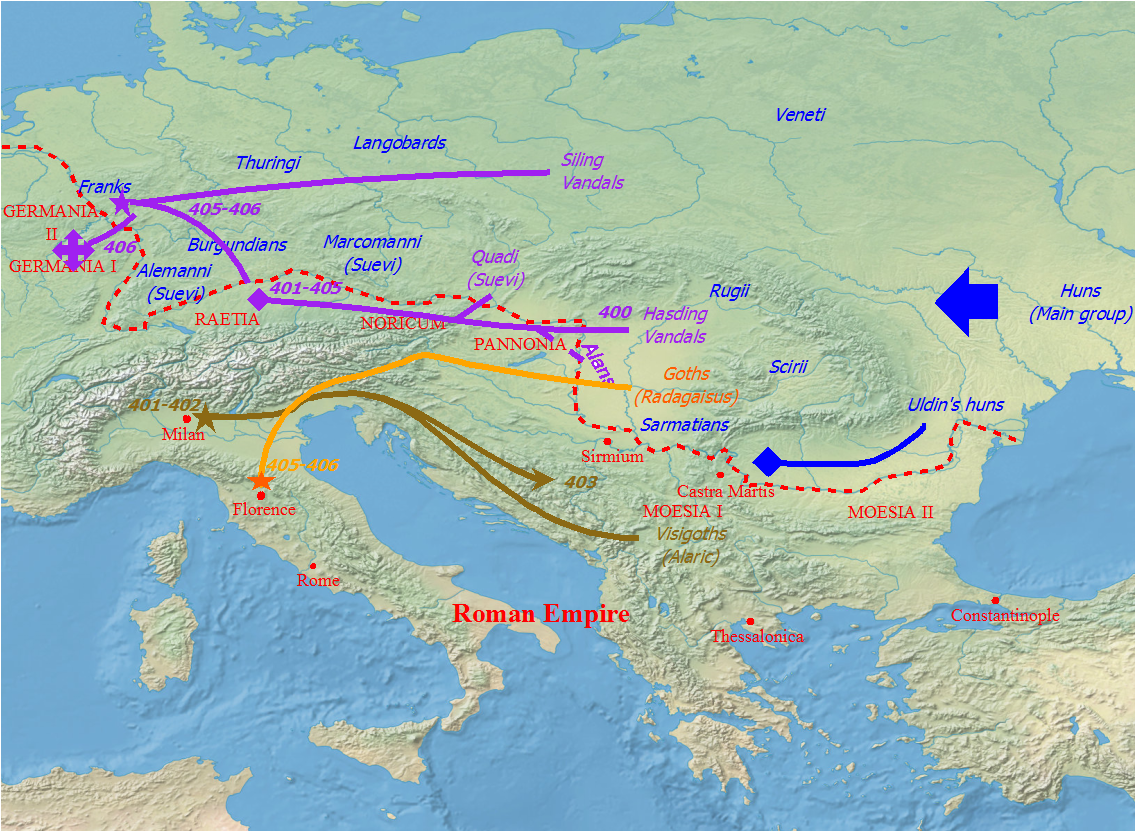 Pressure on the Roman frontier — Source: Wikimedia Commons
From 401 onward, the Visigoths led by Alaric invade northern Italy. The Empire must urgently mobilise its forces to defend its most essential territories. The general Stilicho, a key figure in Roman defence, intervenes with troops drawn in particular from Gaul. He manages to push back Alaric at the battles of Pollentia (402) and Verona (403), temporarily saving Italy.
However, these victories come at a high cost. To defend Italy, the Empire has to strip its frontiers, especially along the Rhine. This choice durably weakens Gaul’s defence and exposes it to external pressures.
The situation worsens again in 405, when Radagaisus invades Italy with a large coalition of peoples. Stilicho must once more mobilise all available forces, including barbarian contingents and allies such as the Huns. To face this threat, the western provinces are weakened even further.
It is in this context of military imbalance that the decisive event occurs. On December 31, 406, taking advantage of the frozen Rhine, several peoples—Vandals, Suebi, Alans, and Burgundians—cross the frontier en masse. Roman defences, now too weak, cannot contain the invasion.
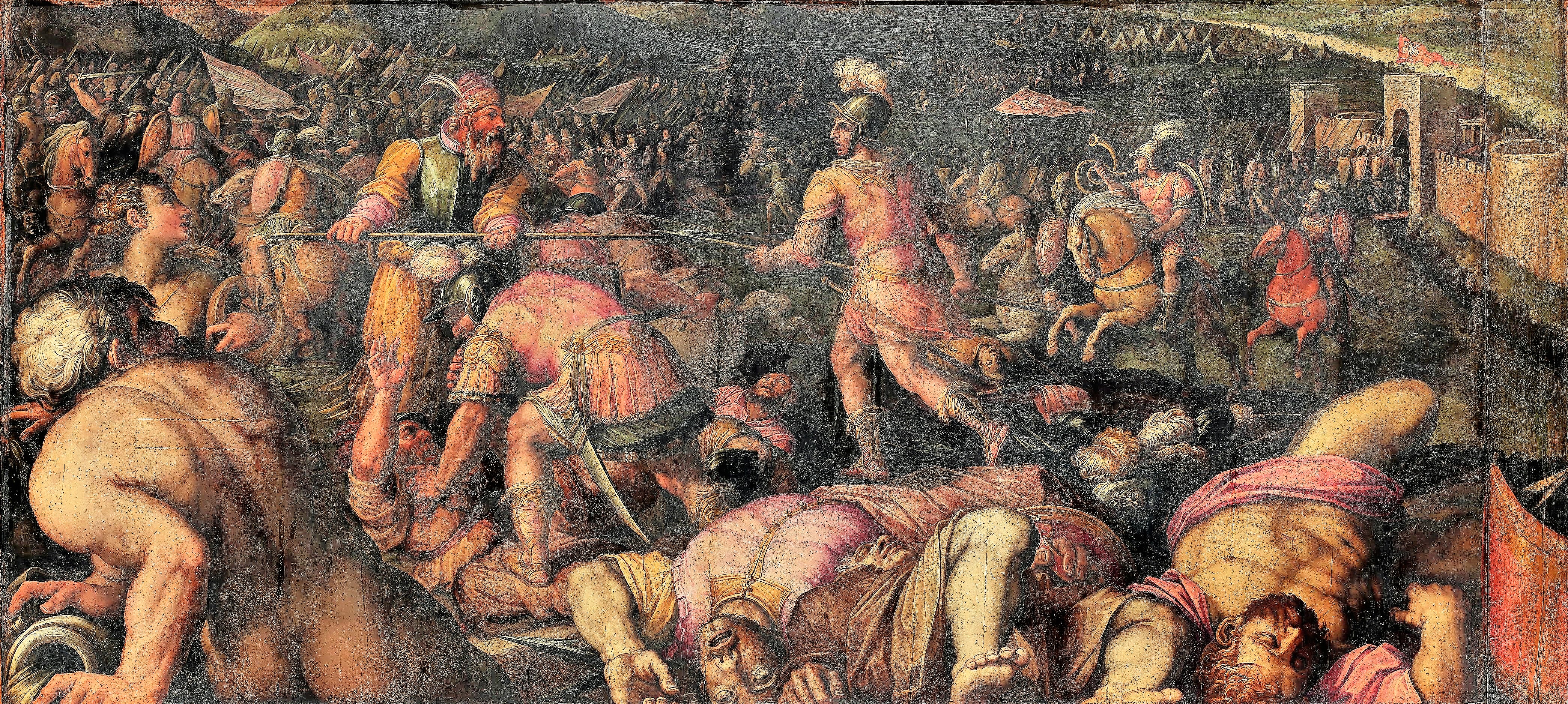 Defeat of Radagaisus — Source: Wikimedia Commons
In 407, the situation becomes uncontrollable. Invaders ravage Gaul, plunder cities, and destabilise the countryside. At the same time, a usurper, Constantine III, is proclaimed emperor by the legions of Britain. He crosses the Channel, establishes himself in Gaul, and tries to restore order—revealing the central government’s inability to manage the crisis.
 Stilicho executed — Source: Wikimedia Commons
The year 408 marks another turning point. Stilicho, the Empire’s main military support, is executed as a result of political rivalries. His disappearance deprives the West of its best defender. At the same time, violence breaks out against the families of barbarian soldiers, pushing many former allies to join Rome’s enemies.
Taking advantage of this situation, Alaric resumes his march on Italy and besieges Rome. After months of tension and negotiations, the city is finally taken and plundered in August 410. This event—unprecedented for centuries—has a considerable impact across the Empire.
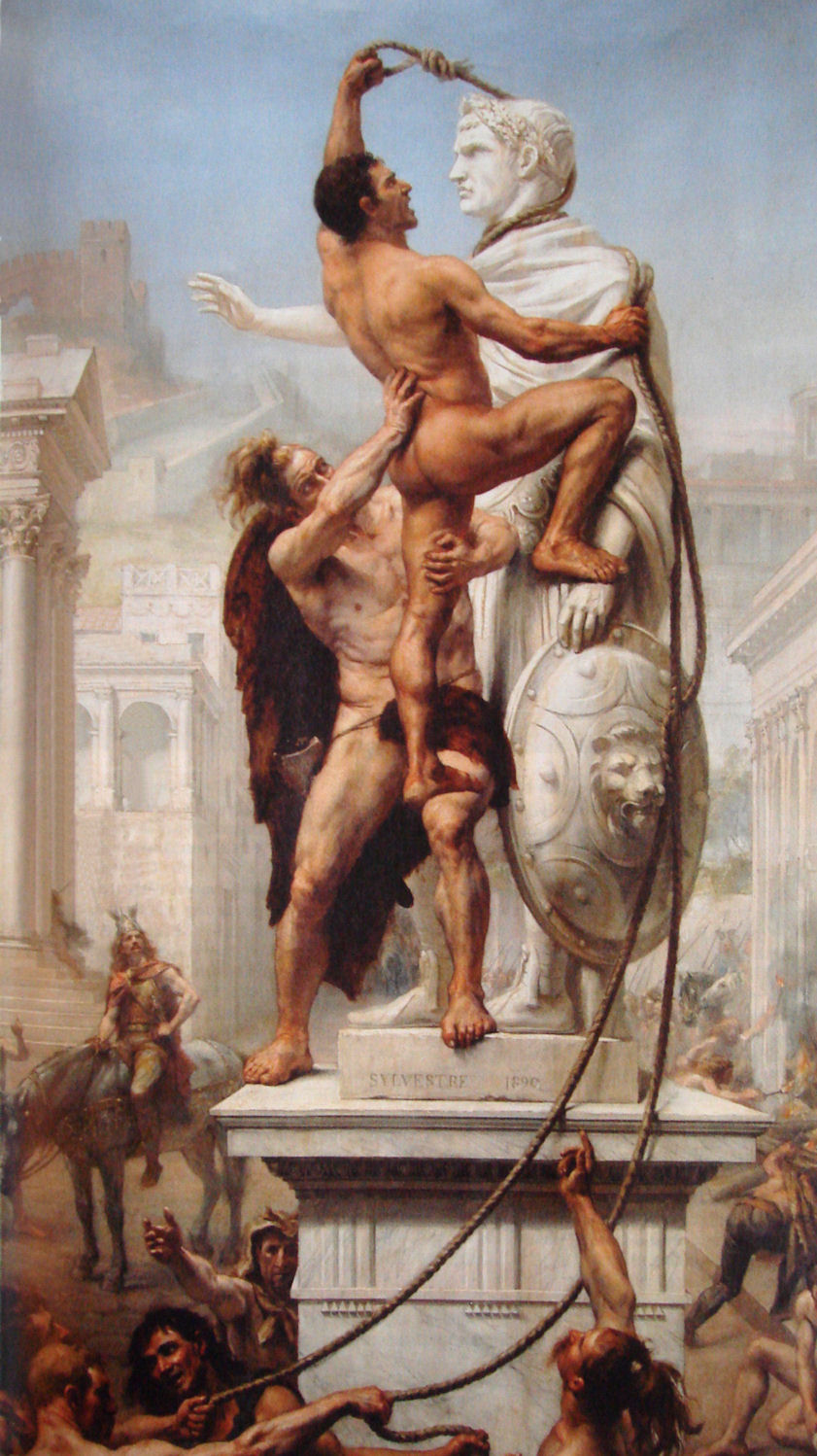 Sack of Rome — Source: Wikimedia Commons
The sack of Rome symbolises the breakdown of the Roman system in the West. The Empire has not yet disappeared, but it has lost the ability to protect its cities, control its armies, and defend its frontiers.
For Gaul, the consequences are lasting. Invasions continue, Roman authority gradually fades, and new balances begin to emerge. The Roman world as it had existed for centuries is now deeply transformed.
🐎 411–453: recomposition and the Hunnic threat
After the shock of 406–410, Gaul enters a phase of unstable recomposition. Roman power attempts to regain control, but it must now contend with usurpers, peoples settled on its territory, and new threats coming from the east.
In 411–413, the situation remains chaotic. The usurper Constantine III, who had tried to restore Roman authority in Gaul, is besieged and executed. Other claimants appear, such as Jovinus, supported by barbarian leaders, before being eliminated in turn. These events illustrate the collapse of imperial authority and the growing dependence on local forces.
At the same time, Germanic peoples settle durably. The Visigoths, led by Athaulf, establish themselves in southern Gaul, occupying major cities such as Narbonne, Bordeaux, and Toulouse. The Burgundians settle between the Rhine and the Alps, forming an early structured kingdom. The Empire tries to turn these groups into allies, but its control remains limited.
From the 420s onward, one figure dominates Western politics: the general Aetius. Having lived among the Huns in his youth, he uses their forces as allies to maintain order in Gaul. He manages to contain certain revolts and push back some settled peoples, but this strategy reveals Rome’s growing dependence on external powers.
 Hunnic Empire — Source: Wikimedia Commons
Meanwhile, a new power rises in the east: the Hunnic Empire. Under its leaders—and above all under Attila from the 440s—it builds a vast political and military entity. Its strength rests on a mobile and formidable cavalry, capable of striking quickly and destabilising Roman armies.
The Huns impose their domination on many peoples and force the Eastern Roman Empire to pay heavy tribute. Gradually, they become the main threat to the Roman world as a whole.
In Gaul, this pressure is felt indirectly. Population movements caused by the Huns accelerate migrations westward. Balances become increasingly fragile, and alliances between Romans and Germanic peoples become indispensable.
 Hunnic invasion — Source: Wikimedia Commons
The turning point comes in 451, when Attila launches a major invasion of Gaul. His army—made up of Huns and many allied peoples—ravages the regions it crosses, from Metz to Orléans.
 A historical map showing Attila’s invasion of Gaul in AD 451 and the Battle of the Catalaunian Plains. Probable routes are shown, along with major cities threatened or plundered by the Huns. — Source: Wikimedia Commons
Faced with this threat, an exceptional coalition forms. General Aetius gathers Roman forces and allies notably with the Visigoths. The two armies confront Attila at the Battle of the Catalaunian Plains. The fighting is extremely violent, but it stops the Hunnic advance.
This victory marks one of the last great military successes of the Western Empire. However, it does not durably restore the situation.
The following year, in 452, Attila invades Italy, showing that his power remains intact. Only in 453, with his sudden death, does the Hunnic Empire quickly break apart. Deprived of their leader, subjected peoples disperse and the direct threat disappears.
Nevertheless, the consequences are lasting. The Huns have deeply destabilised the Roman Empire and accelerated ongoing transformations. In Gaul, Roman authority is now reduced, and barbarian kingdoms assert themselves as the dominant new actors.
Thus, between 411 and 453, Gaul moves from a space in crisis to a territory being reshaped, marked by Rome’s gradual withdrawal and the emergence of a new political order.
🛡️ The settlement of barbarian peoples
Over the course of the 5th century, Gaul undergoes a decisive transformation: so‑called “barbarian” peoples—initially arriving as invaders, mercenaries, or Roman allies—settle there progressively and durably. This does not happen all at once. It results from a series of agreements, conflicts, and population movements, at a time when the Western Roman Empire no longer has the means to fully control the territory.
After the Rhine crossing in 406, several groups pass through Gaul. Not all settle immediately in a lasting way. The Vandals, Suebi, and part of the Alans first devastate the territory before continuing toward Spain from 409 onward. Their passage nonetheless deeply disrupts Roman Gaul and demonstrates that imperial frontiers can no longer contain large‑scale migrations.
The first to establish themselves durably in the southwest are the Visigoths. Initially present as a mobile military force in the 410s, they intervene in the Empire’s political struggles—sometimes as enemies, sometimes as allies. After years of conflict, an agreement is reached with Rome in 418: the Visigoths receive lands in Aquitaine, probably in the region between Toulouse, Bordeaux, and the Garonne basin. They officially become federates of the Empire—allies settled on Roman soil in exchange for military service. Toulouse gradually becomes their main centre of power. This settlement marks a major turning point: for the first time, a Germanic people durably controls an important part of Gaul while keeping its own political organisation.
The Burgundians then settle more stably. First established around Worms on the Rhine, they are crushed in 436–437 by a Roman intervention supported by Hunnic mercenaries. After the destruction of their first kingdom, Rome resettles them in 443 in Sapaudia, a region roughly corresponding to western Switzerland and the areas around the Jura and Lake Geneva. From this base, they gradually extend their influence toward the Rhône valley. Their presence becomes durable in eastern and south‑eastern Gaul. Here again, this is a settlement framed by Rome, but in practice it favours the emergence of a new regional power.
The Franks follow a somewhat different path. They have long been present on the margins of the Roman world, especially along the lower Rhine. Some Frankish groups already serve Rome as federates or auxiliary troops from the 4th century onward. In the 5th century, their implantation strengthens in northern Gaul. The Salian Franks settle durably around Tournai and in Belgica Secunda, likely with the Roman government’s agreement. Their expansion is initially limited but becomes more assertive over the century. Unlike the Visigoths or Burgundians, their domination over Gaul is not yet fully accomplished before 476, but they already constitute a crucial political force in the north.
The Alans are more dispersed. Some follow the Vandals into Spain and then Africa, but other groups are settled by Rome in Gaul, notably around Valence in the early 440s. They serve as a federate people tasked with defending certain fragile zones. Their settlement is real, but it remains less politically structured than that of the Visigoths or Burgundians.
As these settlements multiply, Gaul’s political map changes profoundly. Roman power still survives in some cities, in the administration, and among part of the elites, but it no longer directly controls the whole territory. Large regions pass under the authority of barbarian kings—sometimes allied to Rome, sometimes practically independent.
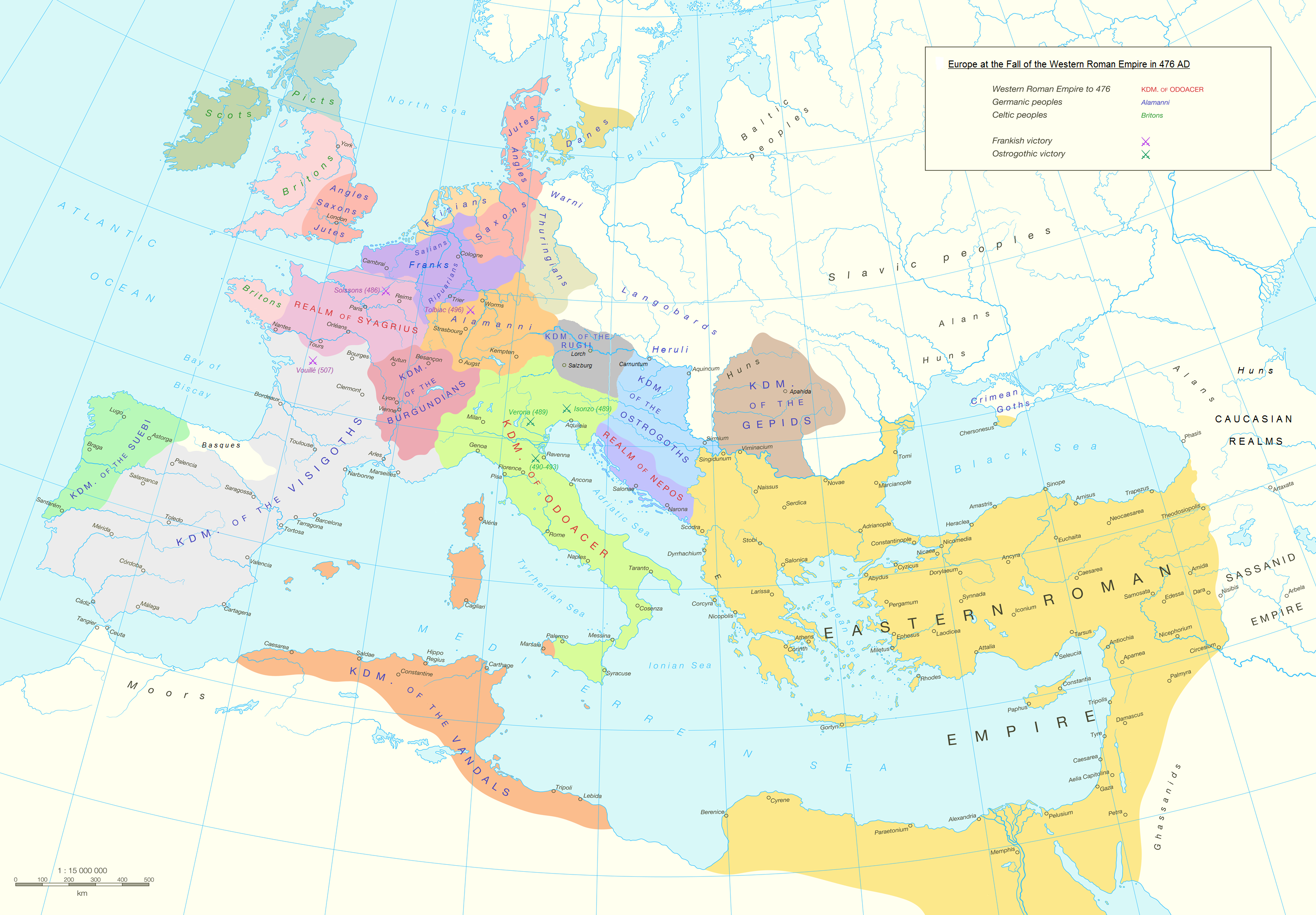 Europe, North Africa, and the Near East after the end of the Western Roman Empire in 476. — Source: Wikimedia Commons
Thus, over the 5th century, Gaul gradually ceases to be an entirely Roman territory. It becomes a space shared between several powers: the Visigoths in the southwest, the Burgundians in the east, and the Franks in the north, while imperial authority is reduced little by little to a few residual areas. This reshaping directly prepares the emergence of the early medieval kingdoms.
🏛️ 454–476: the disappearance of Roman power in Gaul
After Attila’s death in 453, the Western Roman Empire seems briefly freed from its greatest external threat. Yet this disappearance does not bring renewal; it accelerates decline.
In 454, a decisive event fatally weakens the Empire: the general Aetius, the West’s principal defender, is assassinated by Emperor Valentinian III. By eliminating his best commander, the Empire loses the man who still maintained a fragile balance between Romans and barbarian peoples.
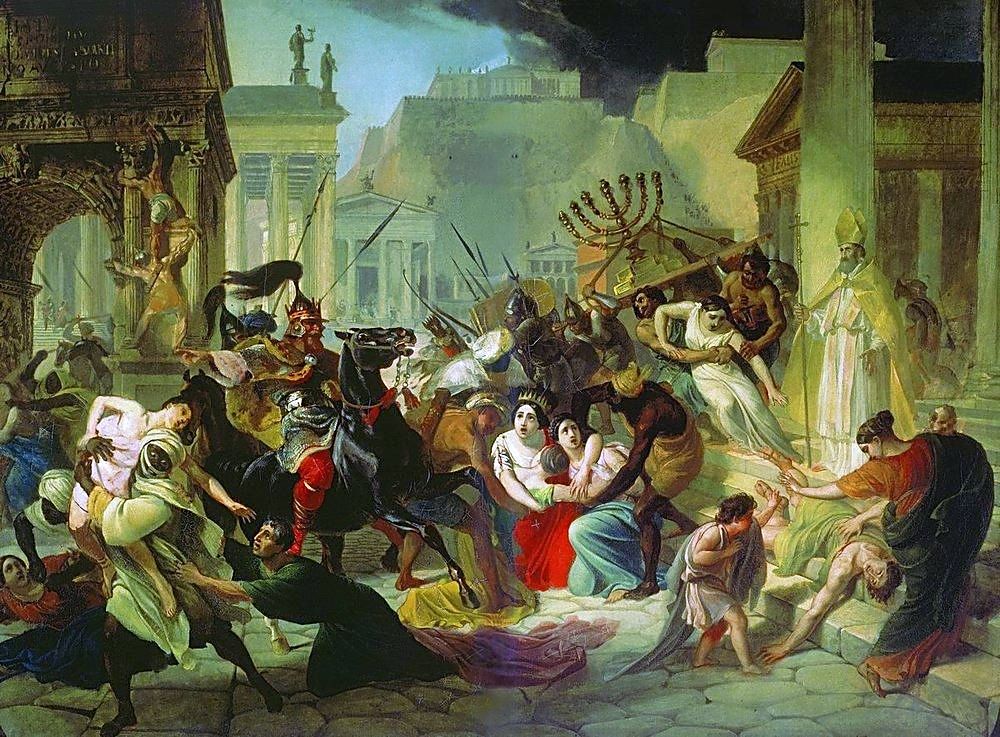 The sack of Rome in 455 — Source: Wikimedia Commons
The following year, in 455, the situation deteriorates brutally. Valentinian III is assassinated, opening a period of political chaos. Emperors succeed one another rapidly, often imposed by generals or military factions. That same year, Rome is plundered again—this time by the Vandals from Africa—delivering a major symbolic blow to imperial prestige.
In this context, real power gradually falls into the hands of military strongmen, often of barbarian origin, such as Ricimer. Emperors become weak figures, unable to truly control the Empire.
Meanwhile, Gaul slips further and further out of Roman authority.
The Visigoths, settled in Aquitaine since 418, extend their domination. Under King Euric from 466 onward, they break definitively with Rome and pursue an independent policy. They gradually conquer much of southern Gaul, notably Auvergne and Provence in the 470s.
The Burgundians, settled in Sapaudia since 443, also strengthen their position in the Rhône valley and take part in regional struggles, sometimes allied with, sometimes opposed to, the Visigoths.
In northern Gaul, another actor rises: the Franks. Under their king Childeric I, they gradually establish themselves as a major military force. Sometimes allied to Rome, they take part in fighting against the Visigoths, notably around Orléans around 463.
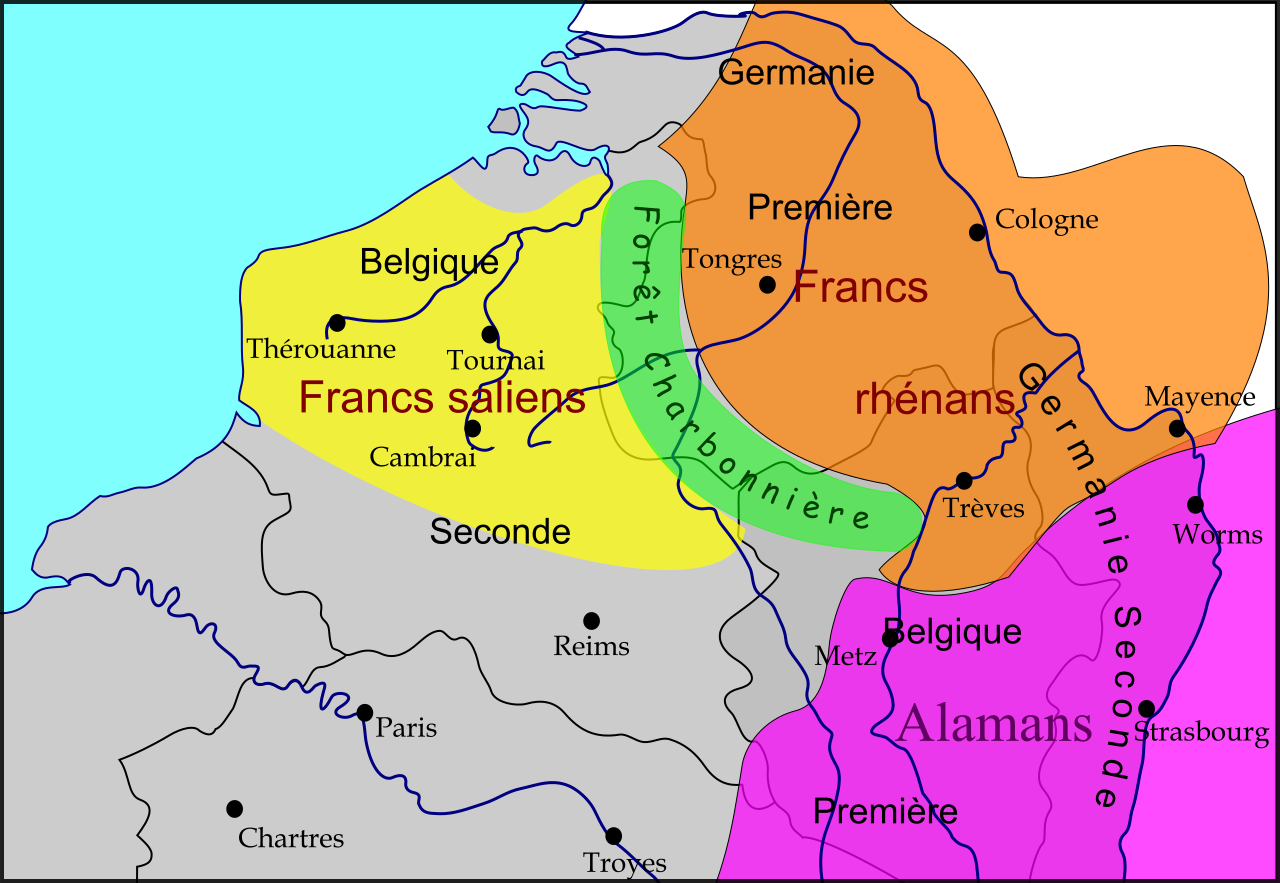 The Franks in Roman Belgium — Source: Wikimedia Commons
Childeric establishes his power around Tournai and strengthens Frankish influence in the north. His authority marks the beginnings of the Merovingian dynasty, which will play a decisive role in Gaul’s history after the Empire’s disappearance.
In the 460s–470s, Roman authority is reduced to a few isolated territories. The general Aegidius, and then his son Syagrius, maintain a form of Roman power in northern Gaul around Soissons. But this authority is now autonomous and cut off from the rest of the Empire.
In 475, a treaty partly formalises the situation: Rome recognises the Visigoths’ conquests and grants them legal control over the territories they already hold. This decision ratifies the loss of a large part of Gaul.
 Odoacer deposes Romulus Augustulus — Source: Wikimedia Commons
The end comes in 476. The barbarian leader Odoacer overthrows the last western emperor, Romulus Augustulus. He sends the imperial insignia back to Constantinople and governs Italy in his name.
This event is traditionally seen as the end of the Western Roman Empire. In reality, Roman power had already disappeared in much of Gaul.
From this point on, the territory is dominated by several kingdoms: the Visigoths in the south, the Burgundians in the east, and the Franks in the north. The Roman world gives way to a new political order, announcing the beginning of the Middle Ages.
Conclusion
Between 400 and 476, Gaul undergoes a radical transformation. Invasions, the settlement of Germanic peoples, and the gradual collapse of Roman authority bring an end to several centuries of imperial domination.
Roman Gaul disappears, replaced by new kingdoms and a different political organisation. This period opens the way to the Middle Ages and marks a major turning point in the region’s history.
Image credits
- Pressure on the Roman frontier: user:Rsteen, CC BY-SA 4.0 https://creativecommons.org/licenses/by-sa/4.0/, via Wikimedia Commons
- Defeat of Radagaisus: Giorgio Vasari, Public domain, via Wikimedia Commons
- Stilicho executed: Lodovico Pogliaghi, Public domain, via Wikimedia Commons
- Hunnic Empire: IvanBondarev, CC BY-SA 4.0 https://creativecommons.org/licenses/by-sa/4.0/, via Wikimedia Commons
- Hunnic invasion: Ulpiano Checa, CC BY-SA 4.0 https://creativecommons.org/licenses/by-sa/4.0/, via Wikimedia Commons
- Hunnic invasion of Gaul in 451: Own work, CC BY-SA 3.0 http://creativecommons.org/licenses/by-sa/3.0/, via Wikimedia Commons
- The end of the Western Roman Empire in 476: Guriezous, CC BY-SA 4.0 https://creativecommons.org/licenses/by-sa/4.0/, via Wikimedia Commons
- The sack of Rome in 455: Karl Bryullov, Public domain, via Wikimedia Commons
- The Franks in Roman Belgium: Odejea, CC BY-SA 3.0 https://creativecommons.org/licenses/by-sa/3.0/, via Wikimedia Commons
- Odoacer deposes Romulus Augustulus: Bernhard Mörlins (B. Moerlins), Public domain, via Wikimedia Commons