


Louis IV \"d’Outremer\": Carolingian Return and the Princes’ War (936–954)
p4936 à 954
When King Rudolph dies in 936, the kingdom’s great men recall from England the Carolingian heir: Louis IV, called “d’Outremer” (“from overseas”) because he grew up at the Anglo‑Saxon court. The choice restores dynastic legitimacy, but not royal power.
The realm is no longer that of the great Carolingians. For decades, monarchical authority has shrunk in favour of territorial princes able to control cities, fortresses, bishoprics, and armed clienteles. Above them stands Hugh the Great, son of Robert I, who organises the young prince’s return without giving up his own pre‑eminence.
Louis IV’s reign is therefore shaped by a central tension: how can a king truly rule when he owes the throne to a prince more powerful than himself?
🔍 Zoom – 19 June 936: “from overseas” and the anointing at Laon
🌊 936–937: first steps under supervision
Rudolph’s death (15 January 936) immediately reopens rivalries among the great. In Burgundy, the duchy is contested between Hugh the Black, brother of the deceased king, Giselbert, his brother‑in‑law, and Hugh the Great, who seeks to extend influence there as well.
In this context, princes recall from England Louis, son of Charles the Simple. The young heir returns less as a free sovereign than as a compromise: a Carolingian legitimate enough to be accepted, but still too young and too isolated to rule alone.
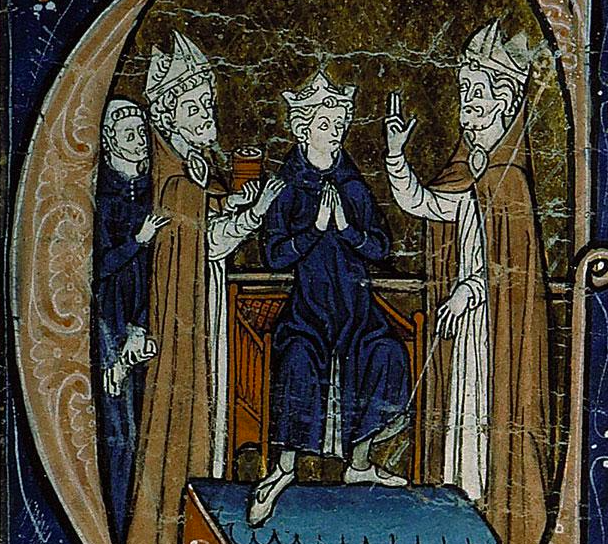 Anointing of Louis IV “d’Outremer” (936) — Wikimedia Commons
On 19 June 936, Louis IV is anointed at Laon by Artald, archbishop of Reims. The ritual gives Carolingian kingship public form again, but under close supervision: Hugh the Great immediately appears as the main architect of the new reign.
Summer 936 shows this dependence clearly. After the coronation, Hugh leads the king into Burgundy; together, they besiege and take Langres from Hugh the Black. On 25–26 July, Louis and Hugh are attested at Auxerre, then proceed to Paris. Even the young king’s itinerary shows he still moves within the Robertian prince’s orbit.
The year also sees broader recompositions. On 7 August, Otto I is anointed king of East Francia at Aachen. In the South, Raymond Pons adopts the title duke of Aquitaine. Across the Frankish world, major principalities assert autonomy.
At year’s end, Louis is at Compiègne (25 December), while Hugh the Great and Hugh the Black make peace and divide Burgundy. The king is present, but the great men still settle most power relations among themselves.
In February 937, Louis tries to escape this dependence. He withdraws to Laon and receives his mother, Eadgifu of Wessex, coming from England. This gesture marks the beginning of a more personal policy: the young Carolingian wants his own entourage and refuses to remain merely the king brought back by the Robertians.
But emancipation is fragile. As soon as Louis steps aside, Hugh the Great draws closer to Herbert II of Vermandois, who retakes Château‑Thierry. The king discovers a durable pattern: every attempt at royal autonomy pushes princes to recombine alliances.
That same year, Hugh strengthens his position by marrying Hedwig, daughter of Henry I of East Francia. In the West, Alan Barbetorte retakes Nantes from the Normans and establishes himself as duke of Brittany. The Carolingian return thus occurs in a kingdom where principalities have never been stronger.
👑 Legitimate kingship, materially weak
Anointing grants Louis IV dynastic and religious legitimacy, but concrete resources remain limited.
The king relies on a small core of power centres:
- Laon, the main Carolingian refuge;
- Reims, the symbolic heart of anointing;
- a few abbeys, fisc, and ecclesiastical revenues;
- some aristocratic and episcopal loyalties in the north‑east.
This base is modest compared to the great princes of Burgundy, Aquitaine, Flanders, the Robertian sphere, or Normandy. In practice, monarchy can no longer govern alone: it must function as an arbitral power, trying less to impose than to prevent any one prince from crushing the others.
🏰 Hugh the Great, “duke of the Franks”
Royal fragility is intensified by Hugh the Great’s unique position.
Recognised as dux Francorum (“duke of the Franks”), he is not a vassal like the others. The title expresses an official pre‑eminence: Hugh is, in practice, the first figure in the kingdom after the king.
The early reign makes this clear: Hugh recalls the young Carolingian, accompanies him in Burgundy, negotiates with other great men, and frames the first movements of royal power. He acts like a co‑manager of the realm.
Louis understands the danger quickly. His withdrawal to Laon (937) signals he does not accept being a façade king. He seeks to build his own court, rely on loyal bishops, and restore real content to Carolingian authority.
But this opens the struggle that shapes the whole reign:
Louis is king by dynastic right; Hugh dominates through political force.
🚧 938–942: trying to escape princely tutelage
Louis IV does not accept long being a ceremonial king. He seeks to govern actively, regain military initiative, and rebuild a royal court.
In early 938, he operates in the Soissons region: he besieges Montigny, held by the brigand Serlus, then, called by Archbishop Artald, undertakes the siege of the citadel of Laon, recently built by Herbert II of Vermandois. The use of siege engines shows the king’s desire to reassert control over strategic fortresses.
At the same time, princely balance continues to be reshaped. In 938, the Treaty of Langres divides Burgundy among Hugh the Black, Giselbert of Chalon, and Hugh the Great, all keeping the title duke of Burgundy. Hugh the Black swears fidelity to the king, but the compromise also reveals monarchical weakness: the king recognises balances he cannot enforce alone.
In 939, Louis returns to Laon after a campaign in Lotharingia. He confirms charters for the abbey of Saint‑Pons‑de‑Thomières, showing he also governs by diplomas and protections. In Brittany, the victory of Alan Barbetorte at Trans (1 August 939) ends Scandinavian occupation and restores an autonomous Breton power.
 View over Saint‑Pons‑de‑Thomières — Wikimedia Commons
In the North, the king must also navigate rivalry among Arnulf of Flanders, Herluin of Montreuil, and the Normans. Loyalties change constantly; princes negotiate directly. Louis tries to revive an active kingship, but every attempt at control triggers a reaction by the great.
The conflict crystallises around:
- control of bishoprics, especially Reims;
- aristocratic loyalties in the North;
- fortresses such as Laon, Château‑Thierry, Pierrepont;
- and the capacity to speak in the name of Frankish legitimacy.
🔍 Zoom – 938–942: Artald, alliances, and early supports
🧭 939–942: Lotharingia and the rise of Ottonian arbitration
Like earlier Frankish kings, Louis looks east. Lotharingia remains a prestigious and strategic border space, tied to Carolingian legitimacy.
In 939, and again in 940, Louis tries to assert presence there, but meets the growing power of Otto I, increasingly able to intervene in western affairs.
In 940, Otto reorganises Lotharingia, reconciles with his brother Henry, and names him duke. Then his political action reaches West Francia: at Attigny, Hugh the Great and Herbert II of Vermandois pay homage to Otto, showing some western princes now seek external support against their own king.
Otto’s army crosses West Francia to the Seine. Louis, after Otto’s withdrawal, returns to Laon, besieges Pierrepont, and marches again toward Lotharingia with Artald of Reims. Otto meets him; a truce follows.
In 941, ties tighten further: Herbert II visits Otto. In 942, Otto openly mediates. At Visé on the Meuse, he reconciles Louis IV, Hugh the Great, and Herbert II. A new fact is established: the West Frankish king can no longer settle the kingdom’s greatest conflicts alone; he must accept arbitration by a more powerful neighbour.
🔍 Zoom – 939–942: Lotharingia and Otto I’s arbitration
⛪ 940–941: Reims, Laon, and a legitimacy crisis
The conflict takes a decisive turn when it centres on Reims and Laon, two essential Carolingian places.
In early 940, Louis renews the investiture of Normandy to William Longsword and grants Artald of Reims the title of count and the right to mint. Strengthening a loyal prelate in Reims — city of anointing and dynastic memory — is politically crucial.
Princes react immediately. After a failed conciliation, Hugh the Great, Herbert II, and William of Normandy drive Artald out of Reims (summer 940) and replace him with Hugh of Vermandois. They then besiege Laon. Louis returns quickly with allies and relieves the city.
At the Synod of Soissons (27 March 941), Artald is formally deposed in favour of Hugh of Reims. This is not merely ecclesiastical: controlling Reims means controlling the language of legitimacy.
In spring and summer 941, Louis tries again. He appoints Roger count, but Herbert and Hugh besiege Laon once more. Louis raises an army in Perthois but is defeated in Porcien by vassals who defect. Even Artald, weakened, reconciles with Herbert and accepts Hugh as archbishop in exchange for enjoyment of certain abbeys.
Reims and Laon become the twin symbols of a Carolingian monarchy fighting for its own existence: an anointed king still lives, but adversaries control great cities, bishoprics, and fortresses.
🔍 Zoom – 940–941: Reims, oaths, and legitimacy crisis
⚓ 942–946: Normandy, the king’s captivity, collapse of royal initiative
Late 942 first seems favourable. On 17 December, William Longsword, duke of Normandy, is assassinated at Picquigny by men of Arnulf of Flanders. His son Richard, still very young, succeeds him. Louis tries to exploit the minority: he takes the young duke under royal protection, pulls him into the royal sphere, and attempts to prevent Normandy from becoming fully autonomous.
Herbert II’s death (23 February 943) also seems to open room. His principality is divided among sons. Artald emerges from retirement; the king promises to restore him. Louis intervenes in Normandy, defeats leaders Turmod and Setric, secures young Richard’s person, and entrusts Rouen to Herluin of Montreuil.
But successes are offset by concessions. At Compiègne, Hugh reconciles the king with Herbert’s sons and Arnulf, secures confirmation of his title duke of the Franks, and obtains the concession of all Burgundy.
In 944, Louis tries to broaden support. He travels in Aquitaine with Queen Gerberga, meets southern lords at Nevers, retakes Montigny near Soissons, and receives Amiens through its bishop. But war with Herbert’s sons flares again. In parallel, Louis campaigns in Normandy with Arnulf and Herluin and is well received at Rouen by Normans around Bernard the Dane. When Hugh marches on Bayeux, Louis orders him to withdraw, adding friction.
In 945, royal initiative collapses. Enemies of the king burn Montigny; Compiègne is plundered. Louis ravages Vermandois with an army recruited in Normandy, besieges Reims (May), and agrees to a truce in early July. But on 13 July 945, invited to Bayeux by the Viking Haraldr, Louis falls into an ambush on the Dives. His escort is massacred, including Herluin of Montreuil. Taken to Rouen, Louis is delivered by Bernard the Dane to Hugh the Great, who keeps him prisoner until 946.
During captivity, Richard I is recognised in Normandy (assembly of Saint‑Clair‑sur‑Epte). The principality escapes royal control.
In 946, the situation partly reverses through external intervention. Louis is freed in June, but Hugh obtains Laon. Queen Gerberga appeals to her brother Otto I, who intervenes with Conrad of Burgundy. They retake Reims after three days, expel Hugh of Vermandois, and restore Artald. But the political result is clear: Richard I is definitively recognised in Normandy, while Louis regains position only through increased dependence on Otto.
🔍 Zoom – 943–946: Normandy, Picquigny, Rouen, and the king’s fall
🪤 945–948: captivity, humiliation, and restoration under conditions
Louis’s captivity is a major political humiliation. The king is moved, negotiated, and used as a stake in princely strategy. Restoration depends less on royal force than on external pressure, especially Otto I.
The high point is the Church’s intervention: councils and sanctions try to restore a legitimacy framework above noble quarrels.
🔍 Zoom – 945–948: Rouen, captivity, and the Council of Ingelheim
🛡️ 946–954: restored under Ottonian protection
From 946, Louis can only regain position by leaning on Otto I.
Ottonian intervention restores Artald at Reims, giving Louis a crucial symbolic support point. But it comes with a political cost: West Frankish Carolingian monarchy appears partly framed by a stronger neighbour.
In 948–949, Louis tries to use Church weapons against Hugh the Great: synods, “trial”, threats of excommunication. Politics now plays out as much in bishoprics and councils as in battles.
The reign is not frozen in powerlessness. In the 950s, Louis slowly rebuilds a royal network around Laon, Reims, and Compiègne, recombining alliances and governing by arbitration more than imposition.
Queen Gerberga plays a major stabilising role through rank and networks, preparing succession.
🔍 Zoom – 946: Reims restored and the return under Ottonian control
🔍 Zoom – 948–949: the “trial” of Hugh the Great
⚰️ 954: accidental death and succession
On 10 September 954, Louis IV dies at Reims after a hunting accident.
His death does not topple the dynasty: his son Lothair succeeds him, proof that Carolingian continuity endures despite crises.
But succession remains under supervision: the kingdom’s great men, especially Hugh the Great, remain key arbiters.
Louis leaves a mixed legacy: he does not restore Carolingian monarchy’s old strength, but he prevents it from disappearing. In a prince‑dominated kingdom, that alone is an achievement.
🔍 Zoom – 954: Lothair, a Carolingian under supervision
🔍 Zoom – 954: the king’s death and the wolf legend
🧠 Key takeaways
- 936: the great men recall Louis IV, but kingship remains dependent on princes.
- 936–945: Louis tries to escape Hugh the Great’s tutelage, triggering a renewed princes’ war.
- 939–942: Lotharingia and Otto I severely limit royal room for manoeuvre.
- 940–941: Reims becomes a crisis of legitimacy as much as power.
- 943–948: Norman conflict, king’s capture, restoration under constraint.
- 946–954: partial recovery through Ottonian backing, episcopal networks, and Gerberga.
- 954: Louis dies; Lothair succeeds, Carolingian continuity maintained under aristocratic control.
Image credits
- Portrait of Louis IV “d’Outremer” — Charles de Steuben, Public domain, via Wikimedia Commons
- Anointing of Louis IV “d’Outre‑Mer” (c. 1275–1280) — CC BY-SA 3.0 https://creativecommons.org/licenses/by-sa/3.0, via Wikimedia Commons
- View over Saint‑Pons‑de‑Thomières — Fagairolles 34, CC BY-SA 4.0 https://creativecommons.org/licenses/by-sa/4.0, via Wikimedia Commons