
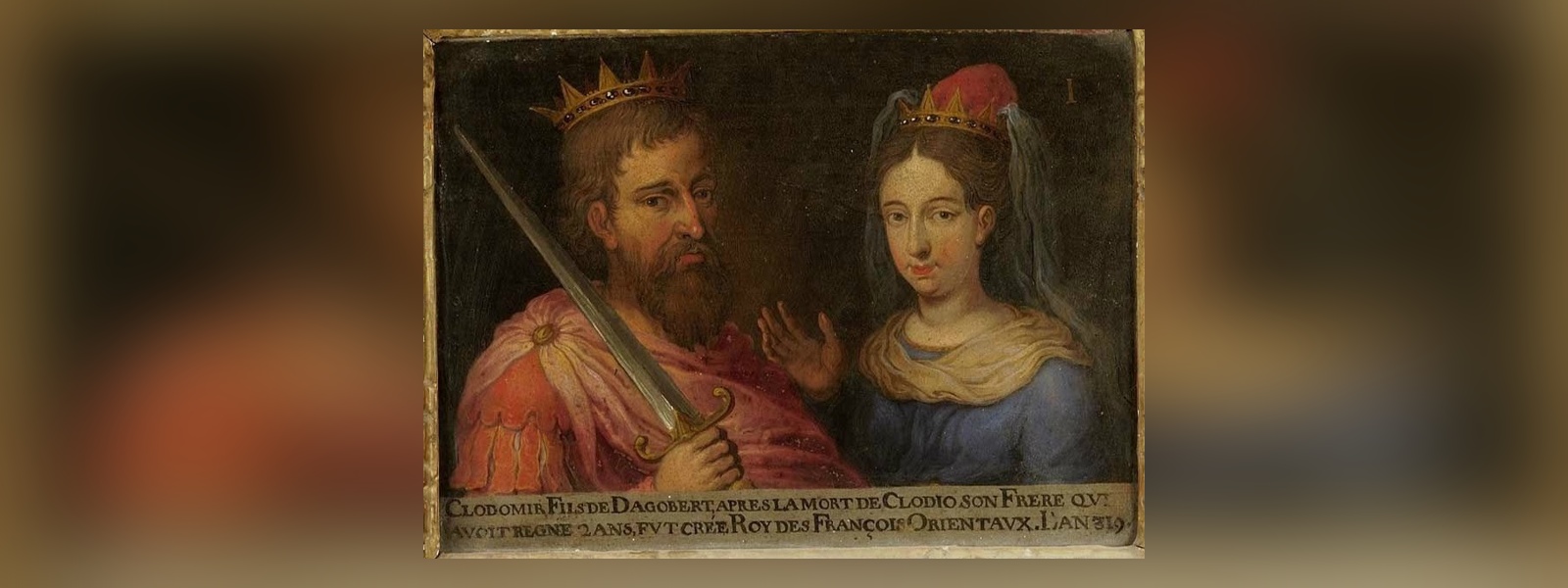
Clodomir: Orléans and the Burgundian War (Orléans)
p4511 à 524
 Division of the Frankish kingdom after the death of Clovis — Source: Wikimedia Commons
After Clovis died in 511, the Frankish kingdom he had patiently built was divided among his four sons. This division was not exceptional: among the Franks, the kingdom was considered a family inheritance, to be shared among heirs.
Clodomir, the second son of Clovis and Queen Clotilde, received a set of territories located in central Gaul. His realm was organised around the Loire valley, with Orléans as the main royal residence.
His reign was relatively short, but it took place at a crucial moment in Merovingian history: the period when Clovis’s sons tried to continue the expansion of the Frankish realm while also competing with one another.
🗺️ A kingdom in the centre of Gaul
Clodomir’s kingdom held a strategic position.
It notably included:
- Orléans, a major city on the Loire
- Tours, a key religious centre
- several territories situated between the kingdoms of his brothers
The Loire valley was a wealthy region:
- fertile agricultural land
- crossroads of major trade routes
- several towns inherited from the Roman period
But Clodomir’s realm was also fragile. It was surrounded by:
- Childebert’s kingdom to the west
- Chlothar’s to the north
- Theuderic’s to the east
This proximity made family alliances necessary — and dangerous.
🏰 Burgundy: a coveted kingdom
 The Burgundian kingdom at the beginning of the 6th century — Source: Wikimedia Commons
To the southeast of Gaul stood a powerful kingdom: that of the Burgundians.
It had several advantages:
- prosperous cities such as Lyon, Vienne, and Geneva
- an administration still marked by Roman heritage
- significant economic resources
The Burgundians were also linked to Clodomir’s family through a tragic story: the mother of the Frankish kings, Clotilde, was a Burgundian princess whose parents were killed during power struggles in her original kingdom.
The war against Burgundy was therefore both:
- a campaign of conquest
- a dynastic revenge
⚔️ 523–524: war against the Burgundians
Around 523, Clovis’s sons launched a major campaign against the Burgundian kingdom.
The main Frankish kings involved were:
- Clodomir
- Chlothar
- Childebert
The Burgundian king Sigismund was captured by the Franks.
Clodomir had Sigismund and his relatives executed, hoping to permanently weaken the Burgundian dynasty.
However, Sigismund’s brother, Godomar, quickly took power and organised resistance.
⚔️ 524: the decisive battle
In 524, the Frankish armies faced the Burgundians again.
The battle took place near Vézeronce, in today’s Isère department.
During the fighting, Clodomir was killed.
According to medieval chronicles, his death caused panic in the Frankish ranks.
The Burgundians then managed to repel the enemy army.
The king’s death turned an ambitious campaign into a political disaster.
👶 Clodomir’s sons: a tragic fate
Clodomir’s death created a major problem: his sons were still children.
In the Merovingian system, minor heirs were extremely vulnerable.
Clodomir’s brothers, Chlothar and Childebert, decided to seize his kingdom.
According to Gregory of Tours, they demanded that Queen Clotilde hand over the children.
The princes were then executed.
Only one escaped the massacre:
Clodoald, who chose to become a monk.
He would later be known as Saint Cloud.
This episode illustrates the brutality of Merovingian dynastic struggles.
🏛️ The kingdom of Orléans disappears
After Clodomir’s death and the elimination of his heirs, his kingdom was divided among his brothers.
The territories of Orléans were mainly absorbed by:
- Chlothar I
- Childebert I
This division strengthened their power and altered the political balance between the Frankish kingdoms.
🧠 Key takeaways
- 511: division of Clovis’s kingdom.
- Clodomir receives the realm centred on Orléans.
- 523–524: war against the Burgundians.
- 524: Clodomir dies at the battle of Vézeronce.
- His sons are eliminated, except Clodoald (Saint Cloud).
- The kingdom of Orléans disappears to the benefit of his brothers.
Clodomir’s reign shows how unstable the Merovingian world was: Frankish kings were both allies and rivals, and dynastic warfare constantly reshaped the map of the kingdom.
📷 Image credits
- Map of the partition of the Frankish kingdom (511) — Wikimedia Commons
- Map of the Burgundian kingdom — PhylémonCyclone, CC0, via Wikimedia Commons
📚 Sources
Primary sources (public domain)
- Gregory of Tours, History of the Franks
https://fr.wikisource.org/wiki/Histoire_des_Francs
Free historical resources
-
Clodomir — Wikipedia
https://fr.wikipedia.org/wiki/Clodomir -
Battle of Vézeronce — Wikipedia
https://fr.wikipedia.org/wiki/Bataille_de_Vézeronce