

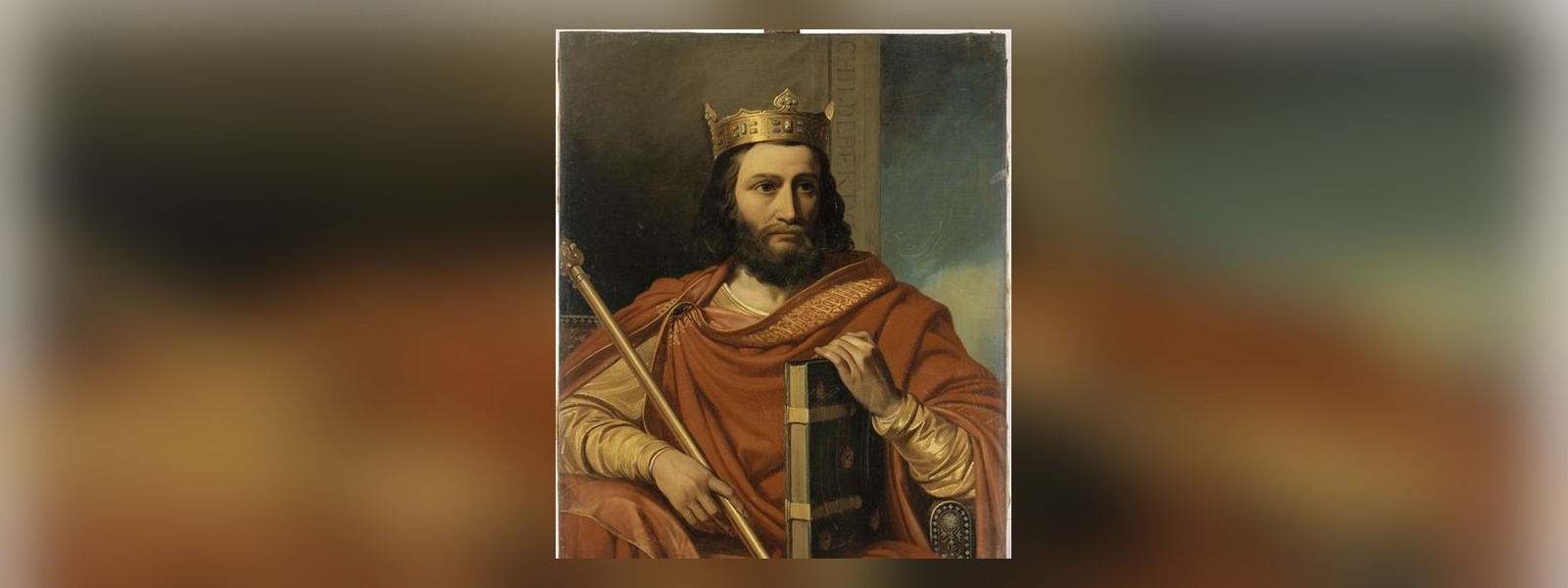
Childebert I: Paris, Alliances, and Expansion (Paris)
p4511 à 558
 Division of the Frankish kingdom after the death of Clovis — Source: Wikimedia Commons
When Clovis died in 511, his kingdom was divided among his four sons according to Frankish tradition.
Childebert I received a realm centred on Paris, extending toward western Gaul.
His reign is one of the longest of the first Merovingian generation: it lasted nearly half a century, from 511 to 558.
During this period, the Frankish kings did not rule a unified state.
Each king ruled over a portion of the kingdom while remaining members of the same dynasty.
They could therefore:
- ally against an external enemy,
- dispute inherited territories,
- or attempt to enlarge their share of the realm.
Childebert’s reign perfectly illustrates this system of shifting alliances and family rivalries.
🗺️ Paris: an emerging centre of power
 Plan of Lutetia (Paris) in Antiquity — Source: Wikimedia Commons
At the beginning of the 6th century, Paris was not yet the capital of a centralised kingdom.
However, the city had several major advantages:
- located at the crossroads of key trade routes
- controlling the Seine valley
- supported by a strong Christian tradition
Clovis himself had already chosen Paris as one of his residences.
Under Childebert, the city gradually became a major political and religious centre of the Frankish world.
Kings stayed there regularly and relied on bishops to organise power.
🤝 Brothers, coalitions, and rivalries
Relations between Clovis’s sons were complex.
The four kings were:
- Theuderic I (Austrasia)
- Clodomir (Orléans)
- Childebert I (Paris)
- Chlothar I (Soissons)
They could ally against a neighbouring kingdom and then fight over the conquered territories.
Example: the war against the Burgundians
In the years 523–524, the Frankish brothers led a campaign against the Burgundians.
The Burgundian king Sigismund was captured and executed.
However, the war turned badly:
in 524, Clodomir was killed at the battle of Vézeronce.
After his death, Childebert and Chlothar seized his kingdom.
👶 Clodomir’s sons: a tragic episode
According to Gregory of Tours, Clodomir’s sons became a political stake.
Childebert and Chlothar feared they would claim their inheritance.
The two kings therefore decided to eliminate them.
Two princes were killed.
The third, Clodoald, escaped death by becoming a monk.
He would later be known as Saint Cloud, from whom the modern town takes its name.
This episode shows the brutality of Merovingian dynastic struggles.
⚔️ 531–534: campaigns and expansion
Childebert also took part in other military campaigns alongside his brothers.
Among the most important:
- wars against the Burgundians
- conflicts with the Thuringians
- internal rivalries between Frankish kingdoms
These campaigns made it possible to:
- obtain loot
- strengthen warriors’ loyalty
- increase the king’s prestige
⚔️ 541–542: the expedition into Visigothic Spain
 The Visigothic kingdom around the year 500 — Source: Wikimedia Commons
One of the most famous episodes of Childebert’s reign is his expedition into Visigothic Spain.
Around 541–542, Childebert and his brother Chlothar crossed the Pyrenees.
They attacked the city of Zaragoza.
According to tradition, the inhabitants organised a religious procession that impressed the Franks.
The city was not taken, but the Frankish kings obtained rich booty and brought back several Christian relics.
Among them was said to be the tunic of Saint Vincent, carried to Paris.
Childebert built a church to house this relic.
This church would later become the abbey of Saint-Germain-des-Prés.
⛪ Childebert and the Church
Childebert maintained close relations with the Church.
Like many Merovingian kings, he sought to strengthen his legitimacy by supporting religious institutions.
He notably took part in:
- founding monasteries
- building churches
- protecting bishops
The foundation of the church of Saint Vincent in Paris (future Saint-Germain-des-Prés) is one of the best-known examples of this policy.
🧩 558: the end of a reign and the kingdom’s reunification
Childebert died in 558.
He left no lasting heir capable of maintaining his kingdom.
This situation allowed his brother Chlothar I to recover his territories.
For the first time since Clovis’s death, the Frankish kingdom was reunited under a single king.
This unity would remain fragile.
🧠 Key takeaways
- 511: division of Clovis’s kingdom.
- Childebert I receives a realm centred on Paris.
- He participates in wars against the Burgundians and many campaigns with his brothers.
- 541–542: expedition into Visigothic Spain.
- He supports the Church and founds the church of Saint Vincent in Paris.
- 558: his death allows Chlothar I to reunify the Frankish kingdom.
Childebert thus appears as an important king of the first Merovingian generation:
less famous than Clovis or Chlothar, but a major actor in alliances, conquests, and the rise of Frankish power in Gaul.
📷 Image credits
- Map of the partition of the Frankish kingdom (511) — Wikimedia Commons
- Plan of Lutetia (ancient Paris) — Renou, Laurent (Paris, 1947), model-maker, CC0, via Wikimedia Commons
- Map of the Visigothic kingdom — Spedona, CC BY-SA 3.0 https://creativecommons.org/licenses/by-sa/3.0, via Wikimedia Commons
- King Childebert I — Jean Louis Bezard, Public domain, via Wikimedia Commons
📚 Sources
Primary sources (public domain)
- Gregory of Tours, History of the Franks
https://fr.wikisource.org/wiki/Histoire_des_Francs
Free historical resources
-
Childebert I — Wikipedia
https://fr.wikipedia.org/wiki/Childebert_Ier -
Siege of Zaragoza (541) — Wikipedia
https://fr.wikipedia.org/wiki/Siège_de_Saragosse_(541)