


Dagobert I: The Last Great Merovingian King
p4629 à 639
Son of Chlothar II, Dagobert I reigned from 629 to 639. His reign is often seen as the golden age of the Merovingian dynasty: a period of relative stability, royal prestige, and religious influence, just before the slow weakening of Merovingian power.
A skilful politician, Dagobert managed to preserve the unity of the kingdom inherited from his father while facing the ambitions of regional aristocracies, especially in Austrasia. He surrounded himself with remarkable advisers such as Eligius (Éloi), Dadon (Saint Ouen), Arnulf of Metz, and Pepin of Landen.
His reign marks the last moment when a Merovingian king still exercised strong personal power over the whole Regnum Francorum.
⏳ A short but intense reign: timeline
- 623: Dagobert is installed as king of Austrasia by his father Chlothar II.
- 626: he obtains an enlarged Austrasia and sees his authority strengthened.
- 627: campaign against the Saxons.
- 629: death of Chlothar II; Dagobert becomes principal king of the Franks.
- 629–630: his half-brother Charibert II receives a kingdom in Aquitaine.
- 631: war against the Slavs of Samo.
- 632: death of Charibert II; Dagobert recovers Aquitaine.
- 633: agreement with the Saxons for frontier defence.
- 634: his son Sigebert III is installed in Austrasia.
- 635: birth of Clovis II, destined to rule Neustria and Burgundy.
- 637–638: new campaigns against the Vascones.
- 639: Dagobert dies; end of the last great Merovingian reign.
👑 623: Dagobert, king of Austrasia
In 623, the great men of Austrasia demanded a king present among them. They disliked that the centre of power was in Neustria and believed they were disadvantaged compared with western elites.
Bishop Arnulf of Metz intervened with Chlothar II. The king first refused to come himself, but eventually agreed to send his son Dagobert to Austrasia as an associated king, with delegated authority.
This kingdom still remained deprived of several western regions: parts of Champagne, the Upper Meuse, and cities such as Reims, Verdun, Toul, or Châlons remained under the direct control of the principal king.
Dagobert then resided mainly at:
- Metz
- Trier
⛪ Dagobert and Saint Arnulf: training a king
 Dagobert receiving instruction and advice from Bishop Arnulf of Metz — Source: Wikimedia Commons
When Dagobert was sent to Austrasia in 623, he was still a young prince. To rule this difficult kingdom, he was placed under the influence of several major figures of aristocracy and the Church.
Among them, one of the most important was Arnulf, bishop of Metz, the future Saint Arnulf.
Arnulf played a crucial role in the young king’s formation. He introduced him to political responsibilities and encouraged him to govern by relying on the Church and the kingdom’s institutions. Chroniclers say his presence was so constant that Dagobert could not do without him.
Some traditions add that when Arnulf considered withdrawing to live as a hermit, Dagobert strongly opposed it, even threatening to punish his own sons if the bishop abandoned the court. This medieval anecdote illustrates Arnulf’s considerable influence over the young sovereign.
Alongside Arnulf, Dagobert was also surrounded by two other major figures:
- Pepin of Landen, mayor of the palace of Austrasia
- Cunibert, bishop of Cologne
These men formed the true core of Austrasian power. They helped shape the future king of the Franks and introduced him to the realities of government.
This political and religious education deeply marked Dagobert and partly explains the importance he later gave to the Church and monasteries during his reign.
⚖️ Administrative and judicial reforms
Even before becoming king of all the Franks, Dagobert proved active in government.
He sought to strengthen royal justice and give greater coherence to administration.
Among the policies attributed to his Austrasian government:
- better organisation of courts
- a larger role for clerics and bishops in procedures
- the possibility to review certain sentences and appeal
- more regular judicial sessions
- a clearer distinction between the competencies of counts and those of vicars
The king also wanted to limit certain social injustices. The protection of widows, orphans, and the dispossessed was increasingly entrusted to the clergy, which became a leading judicial and moral actor.
This policy extended and deepened the spirit of the Edict of Paris (614) issued by Chlothar II.
🏰 Authority asserted in Austrasia
Dagobert was not merely a symbolic king.
He quickly faced aristocrats who tried to build true regional principalities. One striking case was Chrodoald, a powerful Bavarian aristocrat based west of Trier, who developed commercial and political influence at the expense of royal power.
After consulting his advisers, Dagobert first granted him pardon, but Chrodoald was ultimately assassinated on his return to Metz by men of the patrician Harmaire, with the agreement of the royal circle.
The episode shows that the young king, even while still dependent on his father, already knew how to defend the crown’s authority.
Soon after, Dagobert demanded from Chlothar II a more complete Austrasia. After deliberation among the great men, he obtained in 626 most of Austrasia, except Aquitaine and Provence.
💍 Marriage, court, and dynastic politics
To strengthen political balances, Chlothar II imposed on Dagobert a marriage with Gomatrude, sister of Queen Sichilde. The union was celebrated at Clichy in 626.
But this marriage was purely political and did not last.
Dagobert later separated from her, despite opposition from some churchmen such as Amand. He then married Nanthilde and also maintained relationships with other women of his entourage, in line with practices still frequent among the Merovingians.
These unions pursued the same goal: secure the dynasty and multiply alliances.
⚔️ Campaigns against the Saxons
In 627, taking advantage of unrest on the frontier, the Saxons attacked Austrasia.
Dagobert raised the host and fought their troops. During the battles, he was even wounded in the head. His father Chlothar II intervened with the Neustrian army, allowing the Franks to regain the advantage.
The enemy leader Berthoald was captured and executed.
After this victory, Dagobert strengthened his dominance over the eastern regions and worked to reorganise areas of Saxony and Thuringia.
👑 629: Dagobert becomes king of the Franks
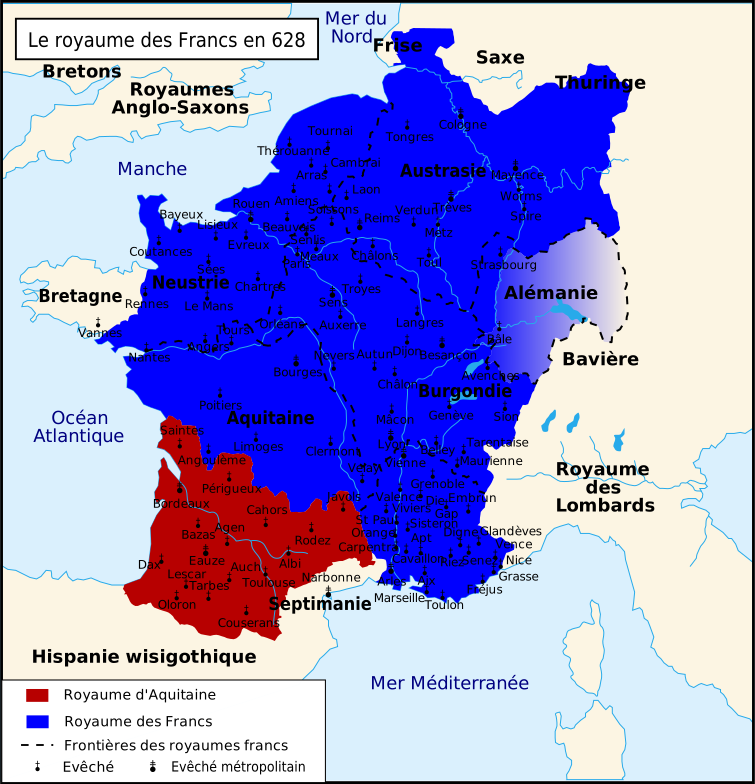 The kingdom of the Franks in 628 — Source: Wikimedia Commons
When Chlothar II died in 629, Dagobert was called to Paris for his father’s funeral.
Succession was not entirely peaceful: some tried to have his half-brother Charibert recognised as heir. Dagobert reacted quickly.
He was acknowledged as principal king of Neustria and Burgundy, and he removed Charibert from the central struggle for power.
To calm the often restless Aquitaine, he created for his half-brother a kingdom of Aquitaine centred on Toulouse. This solution avoided immediate war while keeping Dagobert at the top of the Frankish whole.
 Dagobert sharing his kingdom with his brother Charibert — Source: Wikimedia Commons
⚔️ The humiliation of Duke Sadragesile
 Dagobert humiliating Duke Sadragesile at a banquet — Source: Wikimedia Commons
Even before becoming king of all the Franks, Dagobert had to assert authority against certain great lords.
One of the best-known episodes concerns Sadragesile, duke of Aquitaine, who openly despised the young prince. At a banquet held in the absence of King Chlothar II, Sadragesile repeatedly refused to drink to Dagobert’s health, a grave insult in Frankish aristocratic society.
Furious, Dagobert answered with a spectacular gesture. He ordered that the duke be shaved and beaten with rods, a public humiliation meant to break his prestige.
When Chlothar II learned of the incident, he threatened reprisals against his son. Fearing his father’s anger, Dagobert took refuge in the chapel of Saint-Denis, where the king’s men did not dare enter.
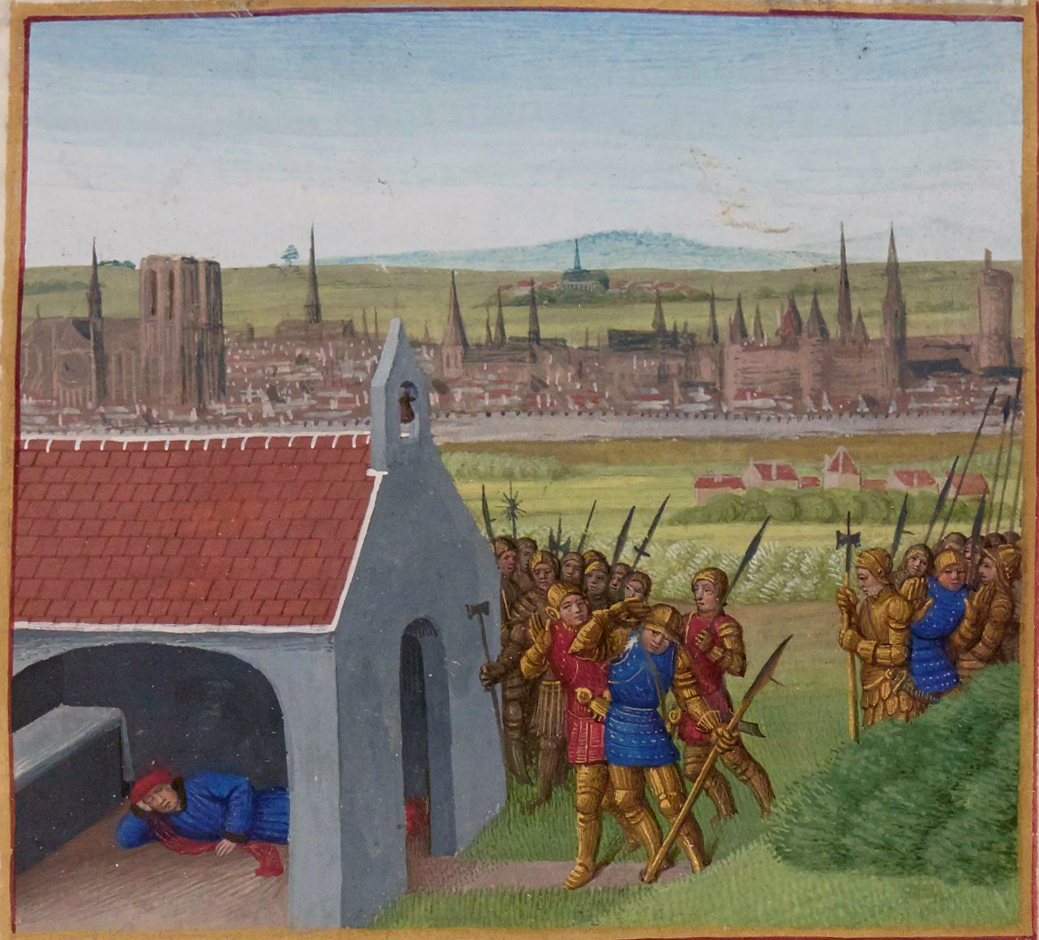 Dagobert taking refuge at Saint-Denis — Source: Wikimedia Commons
According to chroniclers, Dagobert then had a dream in which Saints Denis, Rusticus, and Eleutherius promised him protection. Chlothar eventually reconciled with his son and even offered gifts to the sanctuary.
This episode, blending politics and religious tradition, helped build Dagobert’s reputation as an energetic and sometimes fearsome prince, and it fed the legend of his privileged relationship with the abbey of Saint-Denis.
⚔️ Aquitaine and the death of Charibert II
The kingdom of Aquitaine entrusted to Charibert II acted as a buffer in the southwest against the Vascones and regional unrest.
Charibert led several campaigns and managed to impose authority over part of southern Aquitaine.
But he died in 632, shortly after his young son Chilperic.
This double death allowed Dagobert to recover Aquitaine and restore almost fully the unity of the Frankish kingdom as it had existed under Chlothar II.
He then chose Paris more clearly as the political centre of his kingdom.
⚔️ War against Samo and the Slavs (631)
In the east, Dagobert faced a new threat: the Wends, Slavic peoples united under King Samo.
The conflict began after the assault of Frankish merchants. Dagobert formed a coalition with neighbouring peoples, but the campaign ended badly.
At the battle of Wogastisburg, Frankish troops were defeated. This setback revealed the limits of royal power on the kingdom’s eastern margins.
Despite this, Dagobert kept strong prestige and pursued active diplomacy with neighbours.
🤝 Diplomacy and foreign policy
Dagobert pursued a truly international policy.
He concluded:
- an agreement with the Byzantine emperor Heraclius
- a rapprochement with the Visigoths
- an agreement with the Saxons in 633, so they would help defend against Slavs
He also supported Sisenand’s seizure of power among the Visigoths, in exchange for a major tribute that benefited the abbey of Saint-Denis in particular.
This ability to act on several fronts shows that the Frankish kingdom remained one of the great western powers.
🛠️ Reforms and government
As principal king, Dagobert tried to strengthen central authority.
He aimed to:
- limit autonomist demands of some aristocracies
- reduce patrimonial fragmentation of the kingdom
- rationalise justice and administration
- fight coinage fraud by centralising minting
He relied on prestigious advisers:
- Eligius, goldsmith then administrator of the treasury
- Dadon (Saint Ouen), referendary
- Didier of Cahors
- Amand
With them, he sought to make royal government more stable and effective.
✨ Saint Eligius and the splendour of court
Dagobert’s court was a major artistic centre.
Its most famous figure was Eligius, a brilliant goldsmith, royal treasurer, then bishop.
Eligius created sumptuous objects:
- golden crosses
- shrines
- reliquaries
- ceremonial pieces
The court’s artistic wealth contributed to the king’s prestige.
🔍 Zoom – Saint Eligius: the goldsmith minister
⛪ Saint-Denis and royal prestige
Dagobert made Saint-Denis a central place of monarchy.
He developed the abbey, granted it privileges, revenues, and fair rights. He strongly enhanced its prestige and chose to be buried there.
This was a major political gesture: the king tied his memory to a royal sanctuary that would later become the great necropolis of the kings of France.
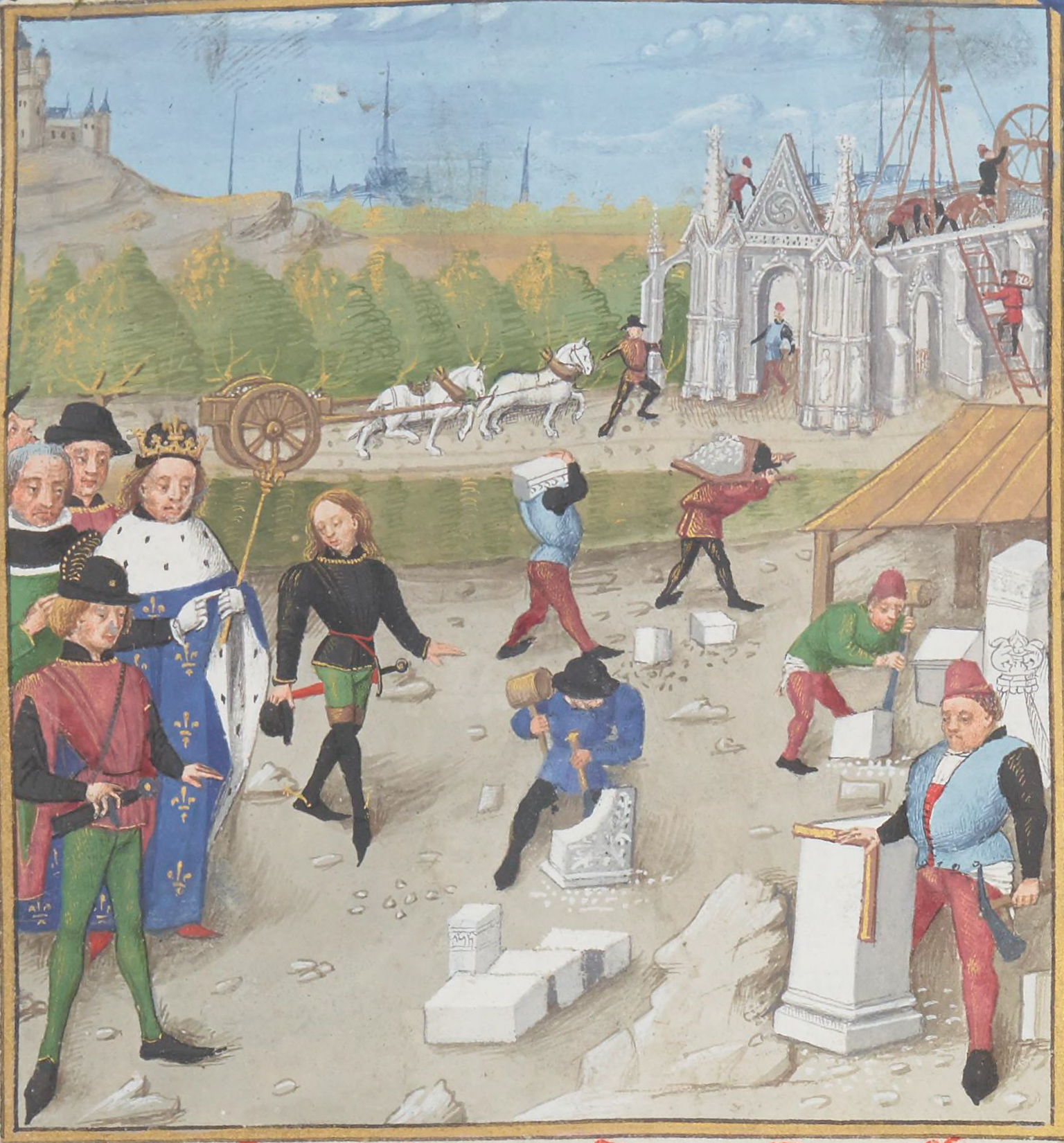 Dagobert visiting the construction site of Saint-Denis — Source: Wikimedia Commons
🔍 Zoom – Saint-Denis: the royal necropolis
⚔️ Brittany and Vasconia
During his reign, Dagobert also watched the western margins.
In Brittany, he dealt with Judicaël, who accepted Frankish suzerainty without publicly humiliating himself. The agreement strengthened ties between Brittany and the Frankish world.
In the southwest, several campaigns were led against the Vascones. The Franks imposed domination at times, without fully controlling the Pyrenean regions.
👑 634–635: dividing to hold
Like his father before him, Dagobert had to accommodate regional aristocracies.
In 634, he was forced to give Austrasia to his son Sigebert III, still a child, to appease local nobility.
In 635, the birth of Clovis II prepared a future division between:
- Austrasia for Sigebert
- Neustria and Burgundy for Clovis
This compromise shows that even the last great Merovingian king could not fully abolish the logic of partitions.
🎭 The myth of “Good King Dagobert”
The famous children’s song paints a fanciful image of a distracted, clumsy king.
In reality, the song dates from the modern era, probably around the French Revolution, and mainly served to ridicule Louis XVI through an old, poorly known king.
The real Dagobert was very different: an energetic, powerful, sometimes harsh sovereign, still capable of effectively governing the whole kingdom.
🔍 Zoom – The myth of Good King Dagobert
👑 The Pippinids and the shadow of the Carolingians
Under Dagobert, great aristocratic families continued to gain power.
The Pippinids and the Arnulfings controlled key positions in Austrasia. Their influence kept growing.
The alliance of these lineages prepared the rise of the future Carolingian dynasty.
🔍 Zoom – The Pippinids: the birth of the Carolingian dynasty
☠️ The king’s death and legacy
Dagobert died in 639, probably at Épinay or Braine, after an illness.
He left two very young sons:
- Sigebert III
- Clovis II
With them, unity of command disappeared.
The mayors of the palace gradually became the true masters of the kingdom, while young Merovingian kings slowly lost most of their power.
Thus opened the period of the so-called “do-nothing kings”, although the expression is later and simplistic.
🧠 Key takeaways
- Dagobert I is the last Merovingian king to exercise strong, personal authority.
- He begins as king of Austrasia before inheriting Neustria, Burgundy, and Aquitaine.
- He pursues active policies of reform, justice, centralisation, and religious prestige.
- His reign is marked by war against Samo, campaigns against the Vascones, and supervision of Brittany.
- He makes Saint-Denis a major place of Frankish monarchy.
- At his death in 639, the kingdom is divided again between his sons, opening the way to the decline of Merovingian royal power.
Image credits
- Dagobert and Saint Arnulf — BnF, Public domain, via Wikimedia Commons
- Dagobert humiliating Sadragesile — Guillaume Cretin, Public domain, via Wikimedia Commons
- Dagobert taking refuge at Saint-Denis — Jean Fouquet, Public domain, via Wikimedia Commons
- Dagobert sharing his kingdom with his brother Charibert — Bibliothèque nationale de France, Public domain, via Wikimedia Commons
- The kingdom of the Franks in 628 — Romain0, Public domain, via Wikimedia Commons
- Dagobert visiting the construction site of Saint-Denis — Robinet Testard, Public domain, via Wikimedia Commons