

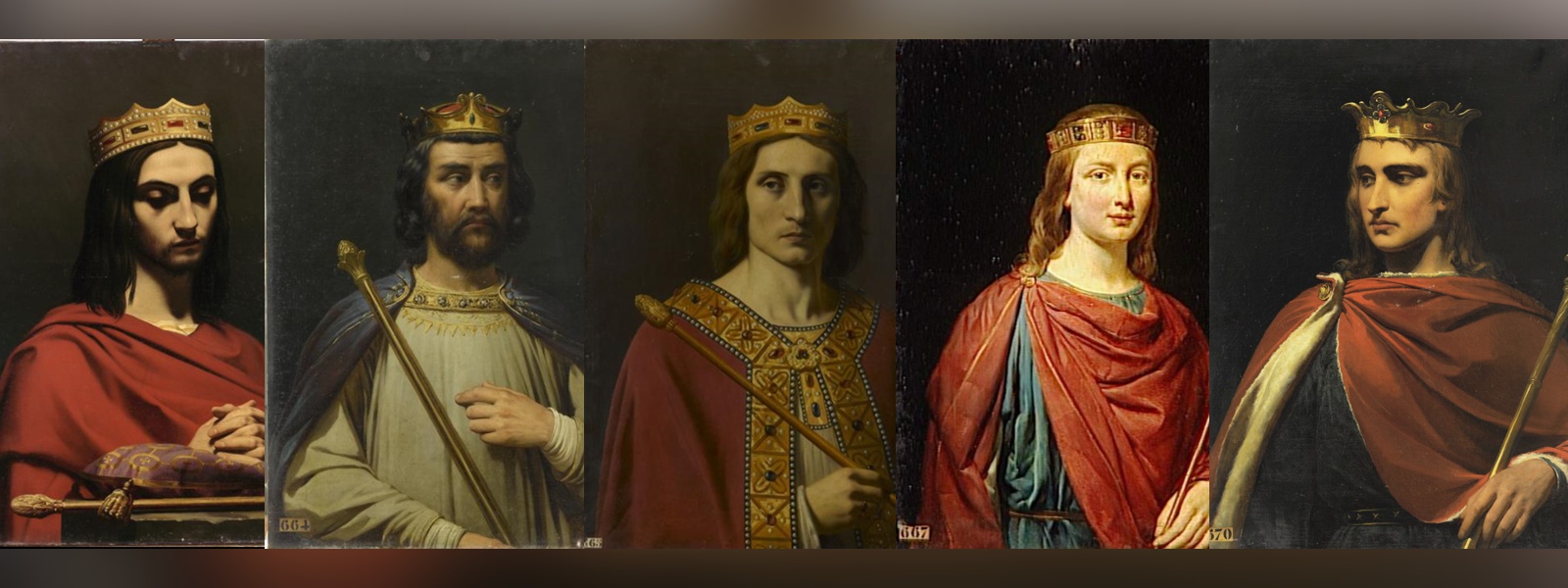
The Mayors of the Palace: Power Shifts (639–687)
p4639 à 687
After the death of Dagobert I in 639, the kingdom of the Franks does not disappear and the Merovingian dynasty remains officially in power. However, the political balance changes profoundly.
The kings who succeed Dagobert are often very young, and their authority depends largely on their entourage. In this context, a function that had once been secondary becomes decisive: the mayor of the palace (maior domus).
Originally, the mayor of the palace was an officer in charge of managing the royal household and the organisation of the court. But in the 7th century, the office evolves rapidly. Mayors of the palace now control:
- aristocratic networks
- the finances of the realm
- the command of the army
- the appointment of counts and bishops
Little by little, they become the true political leaders of the kingdom.
It is this period that Carolingian chroniclers would later call that of the “do-nothing kings” — a polemical expression, because kings still exist, but their real power declines.
⏳ A timeline of the shift
- 639: death of Dagobert I; his sons Sigebert III (Austrasia) and Clovis II (Neustria and Burgundy) inherit the kingdom.
- 656–657: the mayor of the palace Grimoald tries to impose his own dynasty in Austrasia.
- 658–681: in Neustria, Ebroin governs with great brutality and fights rival aristocracies.
- 673–675: King Childeric II briefly reunites the whole Frankish kingdom.
- 687: the battle of Tertry consecrates the domination of Pepin of Herstal, ancestor of the Carolingians.
👑 Child kings and powerful regencies
When Dagobert dies, his heirs are still children.
- Sigebert III, king of Austrasia, is only a few years old.
- Clovis II, king of Neustria and Burgundy, is also very young.
Power is therefore exercised by regents and great aristocrats.
In Neustria, Queen Nanthilde, widow of Dagobert, governs during the first years of Clovis II’s reign.
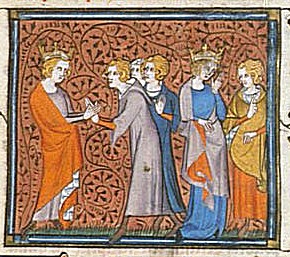 Clovis II and Nanthilde — Source: Wikimedia Commons
Later, Queen Balthild, Clovis II’s wife, plays a major political role. Of modest origin — probably a former Anglo-Saxon slave — she becomes one of the most influential figures of the 7th century.
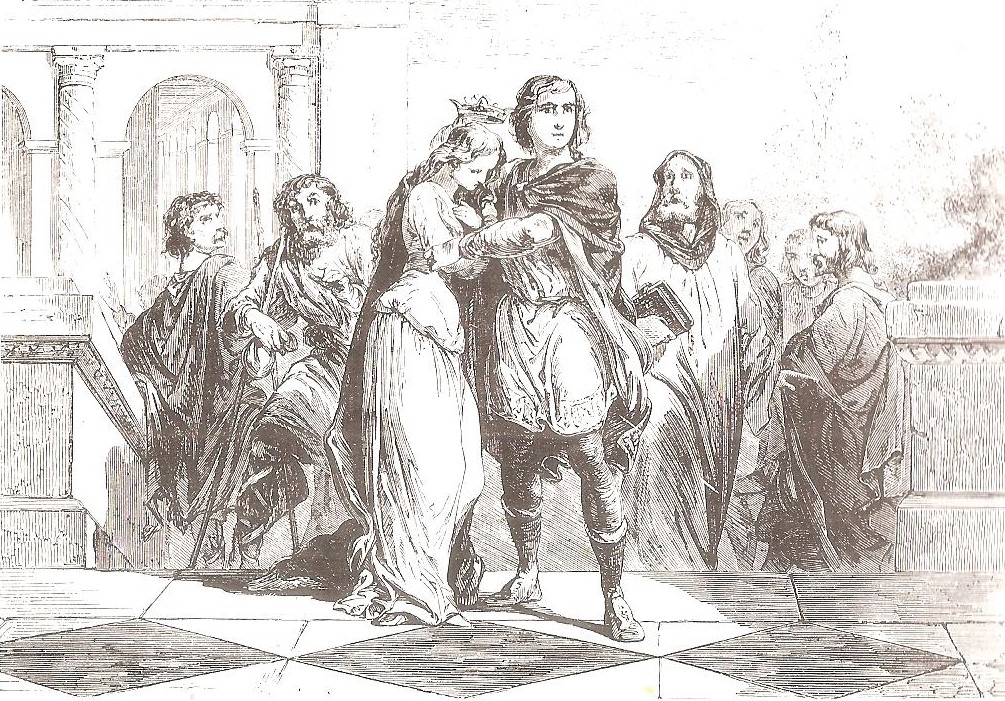 Clovis II buys Balthild — Source: Wikimedia Commons
Balthild leads several important reforms:
- she supports the foundation of many monasteries
- she fights certain forms of slavery
- she tries to limit the excessive influence of some aristocratic families
Despite these efforts, royal authority remains fragile.
🔍 Zoom – Balthild: the former slave who became Queen of the Franks
📜 The “do-nothing kings” chronicle (639–687)
The expression “do-nothing kings” is exaggerated, but it reflects a real phenomenon: kings still reign, but it is often the mayors of the palace who govern.
During this period, several kings follow one another, sometimes simultaneously in different parts of the kingdom.
Neustria and Burgundy
- Clovis II (639–657)
- Chlothar III (657–673)
- Theuderic III (673; then 675–687)
Austrasia
- Sigebert III (639–656)
- Childebert the Adopted (656–662)
- Childeric II (662–673)
- Clovis III (675–676)
- Dagobert II (676–679)
A briefly reunified kingdom
- Childeric II rules the whole kingdom between 673 and 675, before being assassinated in an aristocratic plot.
These frequent changes show how unstable the Merovingian monarchy becomes.
🧩 Austrasia: the Grimoald experiment
In Austrasia, the rise of the mayors of the palace appears clearly with Grimoald, son of the powerful aristocrat Pepin of Landen.
After Pepin’s death, around 639, the office becomes the object of rivalry between factions of the Austrasian nobility. The young king Sigebert III, still a minor, depends heavily on his advisers.
Among them is Otto, a palace officer (domesticus), who holds great influence over the king.
In 642, Grimoald eliminates his rival: he has Otto assassinated through the intermediary of the Alamannic duke Leutharius. After this disappearance, Grimoald becomes mayor of the palace of Austrasia, the most powerful man in the kingdom after the king.
Over the following years, Grimoald consolidates his authority:
- he controls royal administration
- he relies on aristocratic networks inherited from his father
- he governs in practice in the king’s name
When Sigebert III dies in 656, Grimoald sees a unique opportunity.
The king leaves a young son, Dagobert II. Instead of respecting Merovingian succession, Grimoald acts:
- Dagobert is tonsured (a symbolic gesture excluding him from kingship)
- he is sent to a monastery in Ireland
- Grimoald places on the throne his own adopted son, Childebert the Adopted, said to have been recognised as heir by Sigebert III
For the first time in Frankish history, a mayor of the palace tries to replace the Merovingian dynasty with his own line.
This political experiment triggers a violent reaction. A part of the nobility rejects the break with dynastic tradition. Grimoald is captured, handed over to the Neustrian king Chlothar III, imprisoned, then executed around 662.
The episode is not without consequences. It shows that a mayor of the palace can control succession and govern in place of the king.
🔍 Zoom – Grimoald: when a mayor of the palace tries to impose his dynasty
⚔️ Neustria: Ebroin and the politics of force
In Neustria, the struggle for power becomes particularly violent.
The dominant figure of this period is Ebroin, mayor of the palace and true master of the kingdom for several years.
Ebroin appears in the 650s as one of the main supporters of the Merovingian monarchy in Neustria. Unlike great aristocratic families seeking autonomy, he defends the idea of a strong royal power, even though that power passes in reality through his own authority.
Ambitious, energetic, and feared, Ebroin governs with brutality. To maintain his authority, he uses extreme methods:
- forced exiles of political opponents
- assassinations and plots against rivals
- land confiscations to break rebellious families
His goal is clear: prevent regional aristocracies from controlling the monarchy and maintain Neustrian dominance over the Frankish realm.
⚔️ The conflict with Saint Leodegar
Ebroin’s main adversary is Leodegar (Léger), bishop of Autun and member of a great Burgundian aristocratic family.
Leodegar wants to limit the mayor’s authority and strengthen the role of regional elites. A coalition of nobles gathers around him.
In 673, after the death of King Chlothar III, Leodegar participates in raising Childeric II to the throne, trying to govern without Ebroin. Ebroin is captured and confined in a monastery.
After Childeric II is assassinated in 675, Ebroin escapes, returns to power, and launches a major repression.
🩸 The death of Leodegar
Leodegar is captured by Ebroin’s supporters. He suffers a particularly cruel ordeal:
- his eyes are gouged out
- his tongue is cut off
- he is executed around 679
His death provokes strong emotion and he is quickly venerated as a Christian martyr.
This conflict illustrates the transformation of Frankish power in the 7th century: the realm is now dominated by rival aristocratic factions, where bishops, dukes, and mayors of the palace play decisive roles.
🔍 Zoom – Ebroin: the strongman of Neustria
🏇 687: the battle of Tertry
The decisive turning point comes in 687, when rivalry between Neustria and Austrasia leads to a major military confrontation.
In Neustria, power is exercised in the name of King Theuderic III, supported by the mayor of the palace Berchar and Neustrian aristocracy.
Facing them stands the mayor of the palace of Austrasia, Pepin of Herstal, heir of the powerful Pippinid family.
The two camps meet near Tertry, in Picardy, not far from the Somme valley.
Austrasia wins a decisive victory. Neustrian forces are crushed and the political balance of the realm is transformed.
After this victory:
- Pepin of Herstal becomes mayor of the palace of the entire Frankish kingdom
- he governs in the name of King Theuderic III, who remains on the throne but loses most political authority
From this point on, the Austrasian mayor of the palace becomes the true master of the kingdom.
 Pepin of Herstal after the battle of Tertry — Source: Wikimedia Commons
🔍 Zoom – Tertry 687: Pepin of Herstal becomes the kingdom’s arbiter
🧠 Key takeaways
- After 639, Merovingian kings remain on the throne but gradually lose real power.
- The mayors of the palace control the army, aristocratic networks, and administration.
- Grimoald already tries to create an alternative dynasty.
- Ebroin rules Neustria through force and political violence.
- Pepin of Herstal’s victory at Tertry (687) opens the way to Carolingian domination.
Image credits
- Clovis II and Nanthilde — Public domain, via Wikimedia Commons
- Clovis II buys Balthild — Anonyme, CC BY-SA 4.0 https://creativecommons.org/licenses/by-sa/4.0, via Wikimedia Commons
- Pepin of Herstal at Tertry (687) — Jean-Michel Moreau, Public domain, via Wikimedia Commons