


Hugh Capet: The Birth of the Capetian Dynasty (987–996)
p5987 à 996
In 987, the death of Louis V without a direct heir opens a succession crisis in the kingdom of West Francia. The great men of the realm then choose Hugh Capet, Duke of the Franks and head of the Robertians. With him begins a new dynasty: the Capetians.
 Map of France at the end of the 10th century. In blue: the royal domain; the boundaries and names of the other great fiefs are also indicated. The county of Barcelona would in practice become independent by the end of the 9th century.
Yet this choice is far from self-evident. Hugh is neither the most powerful lord in the kingdom nor the natural heir of the Carolingians. His authority rests on a modest domain, centred on an axis running from Senlis to Orléans, and on the support of a group of bishops and great princes. But that very weakness is reassuring: no great feudal lord fears that he will immediately crush the others. In that sense, the new king’s fragility is also part of his political strength.
For nearly a century, the first Capetians will not try to dominate the whole kingdom by force. They will focus above all on holding their domain, strengthening their legitimacy, and passing on the crown without rupture.
🔍 Zoom – 987: Election at Senlis and the Coronation of the First Capetian
🏛️ 987: An “Elected” Kingship Seeking to Become Hereditary
On 1 June 987, Hugh Capet is elected king at Senlis by an assembly of the great men of the kingdom. This choice owes much to the action of Archbishop Adalbero of Reims, who pushes aside the candidacy of Charles of Lorraine, the last major Carolingian claimant. Hugh also benefits from important support, especially among ecclesiastical and princely circles: Gerbert of Aurillac, Duke Richard the Fearless of Normandy, and his brother Henry of Burgundy.
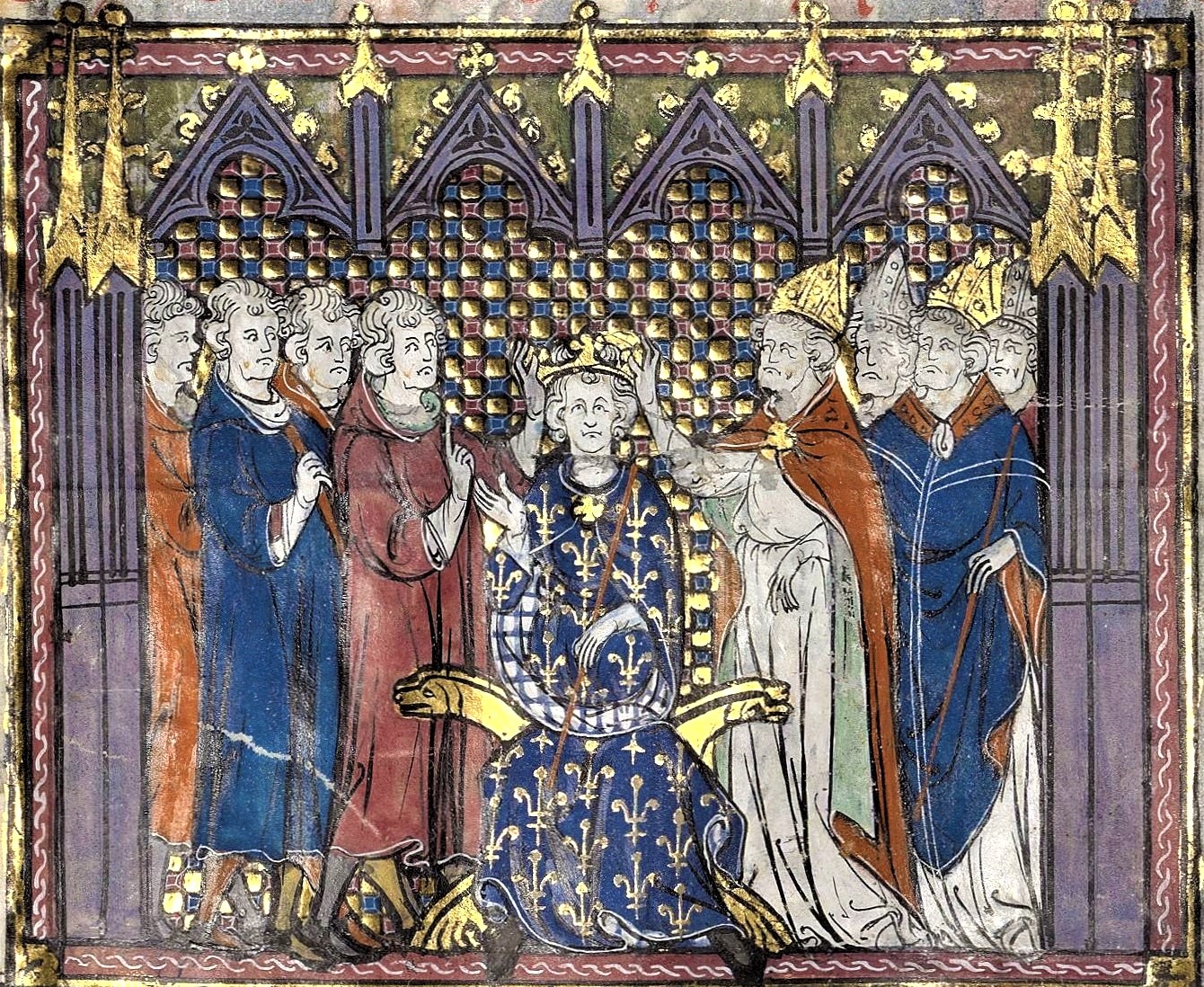 Hugh Capet, the first king of the Capetian dynasty, crowned in 987.
On 3 July 987, Hugh is anointed at Noyon. The place is not accidental: it recalls Carolingian tradition and gives the new king a form of symbolic continuity. But anointing is not enough. In a kingdom where kingship remains partly elective, Hugh must immediately prevent everything from being thrown open again at his death.
His goal is therefore clear: to turn election into dynasty. He wants his son Robert to be recognised as successor during his own lifetime. Adalbero hesitates, because part of the ecclesiastical and political elite prefers a balanced kingship in which great families succeed one another without settling in permanently. Hugh finally prevails by invoking the need to guarantee continuity if the king should leave on campaign.
On 25 December 987, before an assembly gathered at Sainte-Croix of Orléans, Robert is associated with the crown. This second coronation is a decisive act: it lays the foundations for future Capetian continuity. The young prince becomes an associated king, present alongside his father in political and military affairs.
To strengthen this new legitimacy further, Hugh also seeks a prestigious marital alliance. Robert marries Rozala of Italy, widow of Count Arnulf II of Flanders and connected to the Carolingian world. The marriage has strong political meaning, even if it remains fragile and is soon called into question.
🔍 Zoom – Christmas 987: Robert II Associated with the Crown
⚔️ 988–991: The Last Carolingian Threat
The new dynasty is immediately contested. The main rival is Charles of Lorraine, uncle of Louis V and the last credible representative of the Carolingian line. His existence prevents Hugh Capet from presenting himself as an unquestioned king.
In 988, Charles takes action. He seizes Laon, a major stronghold of the kingdom, and captures several important figures, among them Bishop Ascelin, Queen Emma, and Adalbero II of Verdun. This coup shows that the Carolingian cause is still very much alive.
Hugh Capet and his son Robert then besiege Laon, especially in late spring and during the summer of 988. But the city holds out. Imperial mediation is even considered: Empress Theophano offers to arbitrate, proof that the matter goes far beyond a purely local affair. Charles launches sorties, and Hugh must eventually lift the siege. The failure is revealing: the young Capetian monarchy still lacks the military means needed to impose its will quickly.
The crisis becomes even more complicated when the struggle reaches Reims, a seat essential to royal legitimacy. In 989, after the death of Adalbero, Hugh has Arnulf, an illegitimate son of Lothair, elected to the archbishopric. At first the choice seems clever: place a man of Carolingian blood, but loyal to the king. Yet Arnulf proves unstable and tied to Charles.
During these years, Hugh alternates between sieges, devastation, and negotiations. In 989, he and Robert ravage the Laonnois and the Raincy area, but without managing to crush their rival definitively. Isolated, Hugh even tries to buy support, offering for example the county of Dreux to Odo of Blois, without decisive result.
The situation only clears in 991. On 29 March, Bishop Ascelin, through treachery, seizes Charles of Lorraine and Arnulf. Both are handed over to Hugh Capet, who has them imprisoned at Orléans. Laon and Reims then return to royal control.
This reversal changes everything. The last great Carolingian claimant is neutralised, and the Capetian dynasty can now hope to endure.
🔍 Zoom – 988–991: Laon, Reims, and the Neutralisation of Charles
⛪ Reims, Gerbert, and Government Through the Church
Under the first Capetians, royal authority rests less on force than on sacred legitimacy and on the support of the Church. Controlling Reims is therefore crucial: the archbishopric embodies the memory of the anointing and the prestige of Frankish kingship.
After Arnulf’s capture, Hugh convenes the council of Saint-Basle of Verzy in 991. The council deposes Arnulf and replaces him with Gerbert of Aurillac, one of the greatest scholars of his age. The act is politically powerful: it asserts the king’s ability to organise the Church of the kingdom and place his own men in key sees.
 King Hugh Capet witnesses the deposition of Arnulf, Archbishop of Reims and natural son of King Lothair, pronounced after the council held in the church of the monastery of Saint-Basle at Verzy on 17 and 18 June 991.
But this decision angers Pope John XV, who was kept out of the affair. The conflict shows how fragile Capetian power still is: it wants to control the great ecclesiastical sees, but cannot do so without provoking tensions and resistance. Capetian kingship is thus built through a delicate balance between sacral authority, episcopal politics, and relations with Rome.
Gerbert, who gradually draws closer to the Capetians, gives the new regime considerable intellectual and religious backing. Around Reims, a true workshop of Capetian legitimacy takes shape.
🔍 Zoom – Reims and the Making of Legitimacy (989–995)
🏰 991–996: A King Surrounded by Great Princes
Once the Carolingian danger has been removed, Hugh Capet does not become an all-powerful ruler. The kingdom remains dominated by powerful territorial princes: Normandy, Blois, Anjou, Aquitaine, Burgundy, and Brittany pursue their own interests.
His most constant adversary is Odo of Blois, whose possessions directly threaten the royal domain. In 991, he attempts to seize Melun in order to connect his lands in Beauce and Brie. The reaction is revealing of the Capetian mode of government: Hugh does not win alone, but through coalition. The king allies with Count Fulk Nerra of Anjou and Duke Richard I of Normandy. Odo is ultimately defeated, and Melun returns to the royal orbit.
According to a tradition reported later, this defeat gives rise to a famous episode: Odo of Blois, forced to flee, supposedly escapes his pursuers by disguising himself as a shepherd. The anecdote, often illustrated in medieval manuscripts, underlines both the brutality of conflicts between princes and the fragility of the powerful when fortune turns against them.
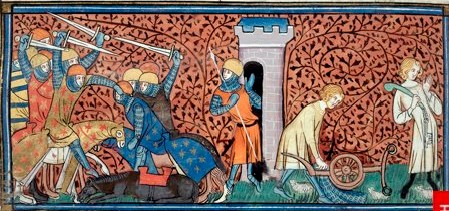 Odo, count of Blois, having been defeated, disguises himself as a shepherd.
At the same time, other great princes consolidate their own power. In 987, after the death of Geoffrey Greymantle, Fulk III Nerra becomes count of Anjou. This is an important event: this energetic prince will soon play a major role in the balance of the kingdom. In 992, he defeats and kills Conan of Brittany at Conquereuil, affirming Angevin ascendancy in the West.
In Aquitaine, ducal power is likewise very strong. After the abdication of William Fierabras, William V the Great asserts himself at the head of a vast and prosperous principality between the Loire and the Garonne. The Capetian king exercises only very limited influence there.
Thus Hugh’s reign is not one of general reconquest, but one of successful political survival in the midst of great princes who are sometimes allies, sometimes threats.
🔍 Zoom – 991–996: Melun, Fulk Nerra, and the Balance of Principalities
🧭 A Kingdom in Transformation: Peace of God and a New Feudal Order
The end of the 10th century is marked by a profound transformation of political order. The public power inherited from the Carolingians weakens, while local lords, castellans, and armed groups increasingly impose their rule on a regional scale. In this context, the Church tries to frame violence through a new political and religious language: the Peace of God.
The movement appears in the late 980s and grows under Hugh Capet. In 989, the council of Charroux condemns violence against peasants, unarmed clerics, and ecclesiastical property. Other meetings follow, especially in the South and the centre of the kingdom, where warriors are asked to swear to respect certain limits.
The movement continues during the 990s. In 994, the council of Saint-Paulien, known as “of Le Puy,” sees Bishop Guy of Le Puy preach the Peace of God. At the same time, a peace council held at Anse, near Lyon, seeks in particular to protect the abbey of Cluny from abuses by neighbouring lords. These initiatives show that the Church is no longer content merely to condemn violence: it is trying to build a local Christian order based on oaths, religious sanctions, and the defence of sacred places.
This development accompanies the rise of a new feudal order. The king does not directly control the whole kingdom, but he can benefit from this climate: by relying on bishops, abbots, and monastic reformers, the Capetian monarchy presents itself as the ally of a Christian order superior to princely rivalries.
The monastic world also takes part in this transformation. The Cluniac reform continues to radiate, and figures such as William of Volpiano, established at Saint-Bénigne of Dijon, spread an ideal of religious restoration, monastic discipline, and spiritual prestige. Hugh Capet’s reign thus stands at the hinge between two worlds: a fading Carolingian order and a feudal and Christian order taking shape.
🔍 Zoom – Peace of God: When the Church Frames Violence
⛪ 995: Reims, Gerbert, and Resistance to Rome
The question of Reims does not end with Arnulf’s deposition in 991. On the contrary, it opens a broader conflict between the Capetian monarchy, the bishops of the kingdom, and the papacy.
In 995, the council of Mouzon, presided over by a papal legate, calls into question the position of Gerbert of Aurillac, whose accession to the archbishopric of Reims remains contested in Rome. Hugh Capet and his son Robert refuse to go and even forbid the bishops of West Francia to attend. The gesture is important: it shows that the king intends to defend the political and ecclesiastical autonomy of his kingdom against papal intervention.
Gerbert nevertheless appears and defends himself vigorously. He acknowledges papal primacy but refuses the idea that Rome can directly govern the affairs of an ecclesiastical province without going through the competent councils. Behind the canonical quarrel lies a political question in reality: who controls the great sees of the kingdom, and who produces the legitimacy of power?
The council of Reims convened afterwards does not settle the dispute either. But the affair shows that the first Capetians are not only trying to survive among the great princes: they are also trying to define the limits of papal authority within the kingdom. Through Reims and Gerbert, the whole place of kingship within the Christian order is being debated.
⚰️ 996: A Quiet Success, a Lasting Dynasty
The final years of the reign show that the Capetian dynasty is now established, though not without tensions. In 996, the death of Odo of Chartres, one of the kingdom’s most powerful princes, alters the political balance. His disappearance leaves his widow Bertha of Burgundy in a delicate position and soon at the centre of a dynastic crisis.
The associated king Robert falls in love with Bertha and wishes to marry her. This project creates tensions with his father Hugh Capet. Behind the personal issue there is already a political difficulty: control over the royal marriage, and therefore over the dynasty’s alliances. Robert, until then married to Rozala, seeks to free himself from a union that has become of little use, but his choice of Bertha opens a new sensitive issue.

In the summer of 996, Hugh, ill, according to tradition makes a pilgrimage to Souvigny, to the tomb of Mayeul of Cluny. Whether fully historical in every detail or magnified by monastic memory, the gesture fits well with the image of a kingship seeking spiritual legitimacy through reforming circles.
Hugh Capet dies on 24 October 996. His reign was not that of a conquering monarchy. He neither subdued the great principalities nor restored former Carolingian power. But he achieved the essential: he made his election accepted, neutralised the last great Carolingian rival, and ensured the transmission of power to his son.
Robert II succeeds him without major rupture. This continuity is Hugh’s true victory. The Capetian dynasty, still fragile, is now rooted. The rest of Robert’s reign will show that much still remains to be consolidated, but the dynastic principle itself has survived its founder.
🔍 Zoom – 996: Transmitting the Crown, Founding a Long Duration
🧠 Key Takeaways
- 1 June 987: Hugh Capet is elected king at Senlis.
- 3 July 987: he is anointed at Noyon.
- 25 December 987: Robert II is associated with the crown.
- 988–991: struggle against Charles of Lorraine, the last great Carolingian danger.
- 991: capture of Charles and Arnulf; lasting shift in favour of the Capetians.
- The years 989–995 show the central role of the Church, through the Peace of God, control of Reims, and the conflict over Gerbert.
- The kingdom remains dominated by great princes such as Odo of Blois, Fulk Nerra, and William V of Aquitaine.
- 24 October 996: Hugh Capet dies; Robert II succeeds him without major crisis.
- The great achievement of the reign is dynastic transmission.
Image Credits
-
France at the end of the 10th century: Bourrichon, CC BY-SA 3.0 https://creativecommons.org/licenses/by-sa/3.0, via Wikimedia Commons
-
Hugh Capet’s coronation in 987: Bibliothèque nationale de France, Public domain, via Wikimedia Commons
-
Hugh Capet deposes Archbishop Arnulf of Reims: Jean Fouquet, Public domain, via Wikimedia Commons
-
Odo of Blois flees disguised as a shepherd: AnonymousUnknown author, Public domain, via Wikimedia Commons
-
The separation of Robert the Pious and Bertha: Jean-Paul Laurens, Public domain, via Wikimedia Commons