

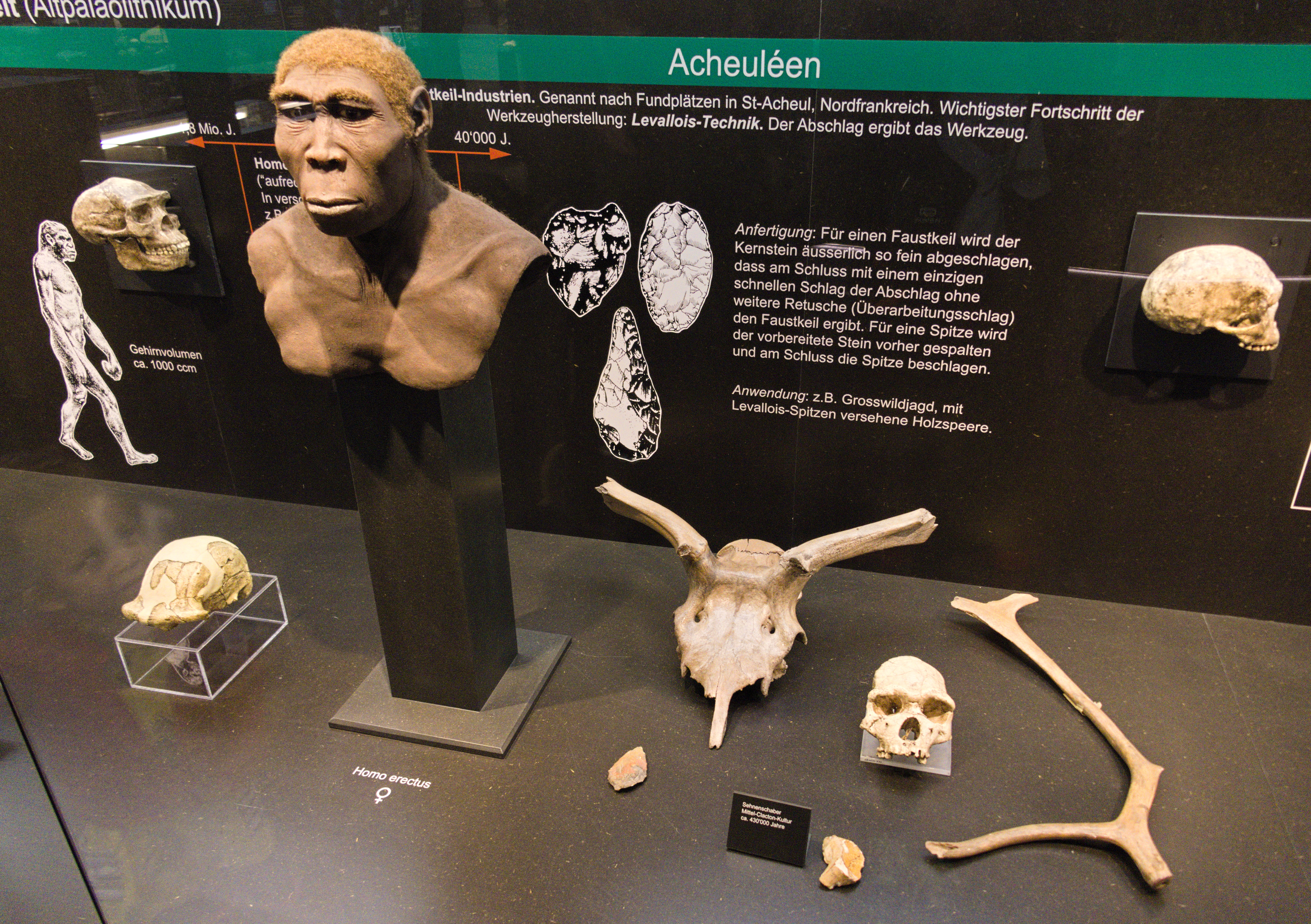
Homo erectus
p1The Origins of Humanity · PREHISTORY
A pioneer of humanity
🌍 Who is Homo erectus?
Homo erectus is one of the first human species to leave Africa.
It appeared around 1.9 million years ago and gradually spread to Asia and Europe.
Its name means “upright man”, as it walked fully upright, like modern humans.
🧠 New abilities
Compared to earlier human species, Homo erectus shows:
- a larger brain,
- a better ability to plan actions,
- a more developed social organization.
These abilities allowed it to adapt to a wide range of environments, sometimes hostile.
🪨 A tool maker
Homo erectus made stone tools, including:
- modified pebbles,
- Acheulean hand axes.
These tools were used to:
- cut meat,
- work wood,
- break bones to access marrow.
Tool-making relied on knowledge passed down within the group.
🔥 The question of fire
Some archaeological sites suggest that Homo erectus may have been among the first humans to use fire.
Fire would have allowed them to:
- keep warm,
- ward off predators,
- cook certain foods.
⚠️ This mastery remains debated depending on regions and periods.
🧭 Presence in Europe and France
The presence of Homo erectus in Europe is attested more than 1 million years ago.
In France, it is known indirectly, through:
- tools,
- traces of occupation,
- modified animal remains.
These groups were nomadic, following resources and seasons.
📸 Image credits
- Homo erectus reconstruction — Tiia Monto, CC BY-SA 3.0, via Wikimedia Commons
📚 Sources
- National Museum of Natural History
- CNRS – Origins of Humanity
- INRAP – Prehistory files
- Encyclopædia Britannica – Homo erectus