


The Origins of Humanity
p1Il y a 1 million d'années
🪨 Prehistory — Chapter 1
The Origins of Humanity in France
🌍 A very ancient land, long before France
Long before France existed as a country, the territory corresponding to present-day France was already inhabited by human groups.
The earliest traces of human presence discovered in France date back to around 1 million years ago.
At that time, Europe was undergoing major climatic changes. The French territory alternated between:
- glacial periods, extremely cold,
- and interglacial periods, more temperate.
These changes directly influenced human life, including their diet, movements, and survival.
🧍 First human generations: the pioneers
The first humans present in France belonged to ancient species that are now extinct:
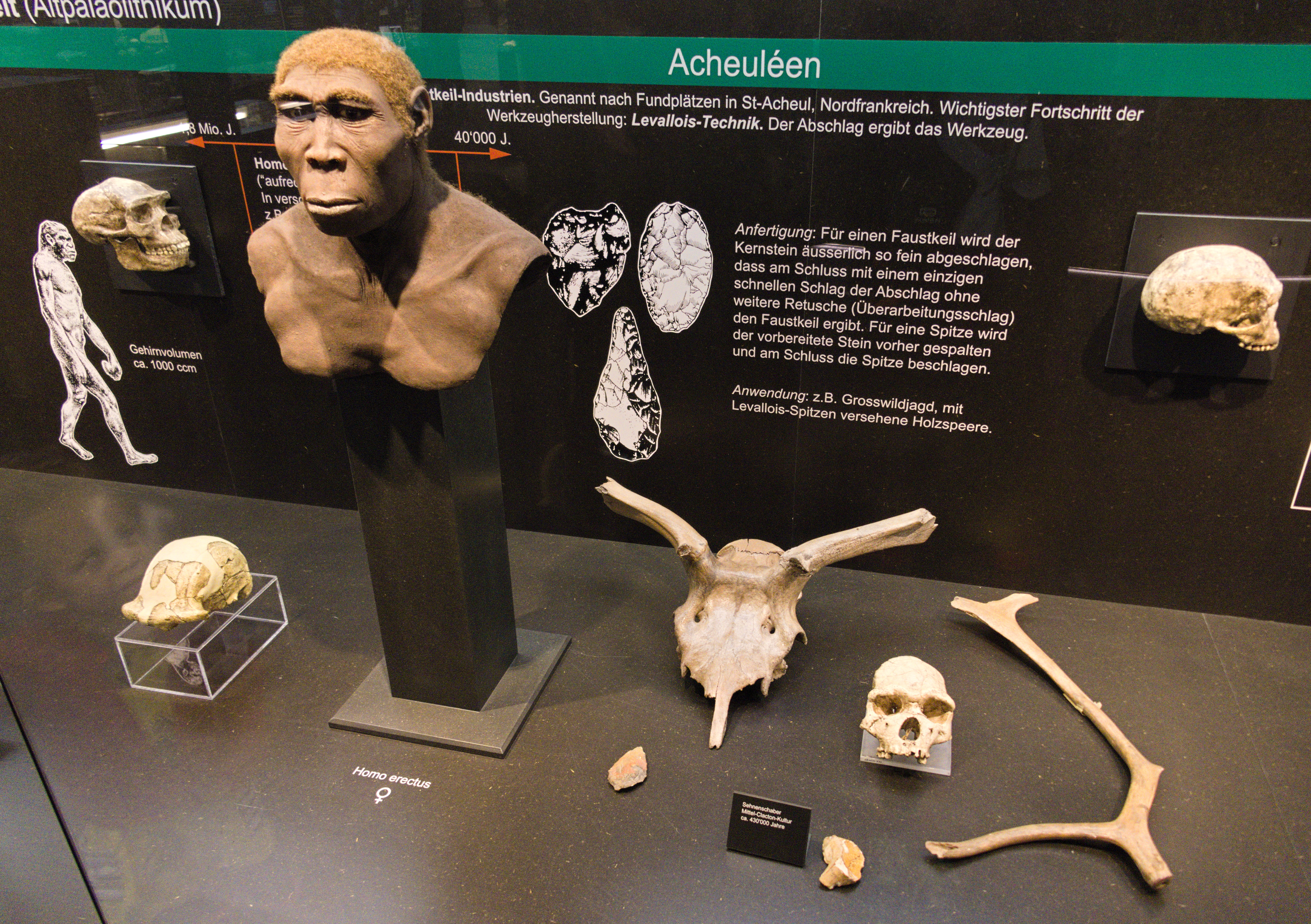
Reconstruction of Homo erectus.
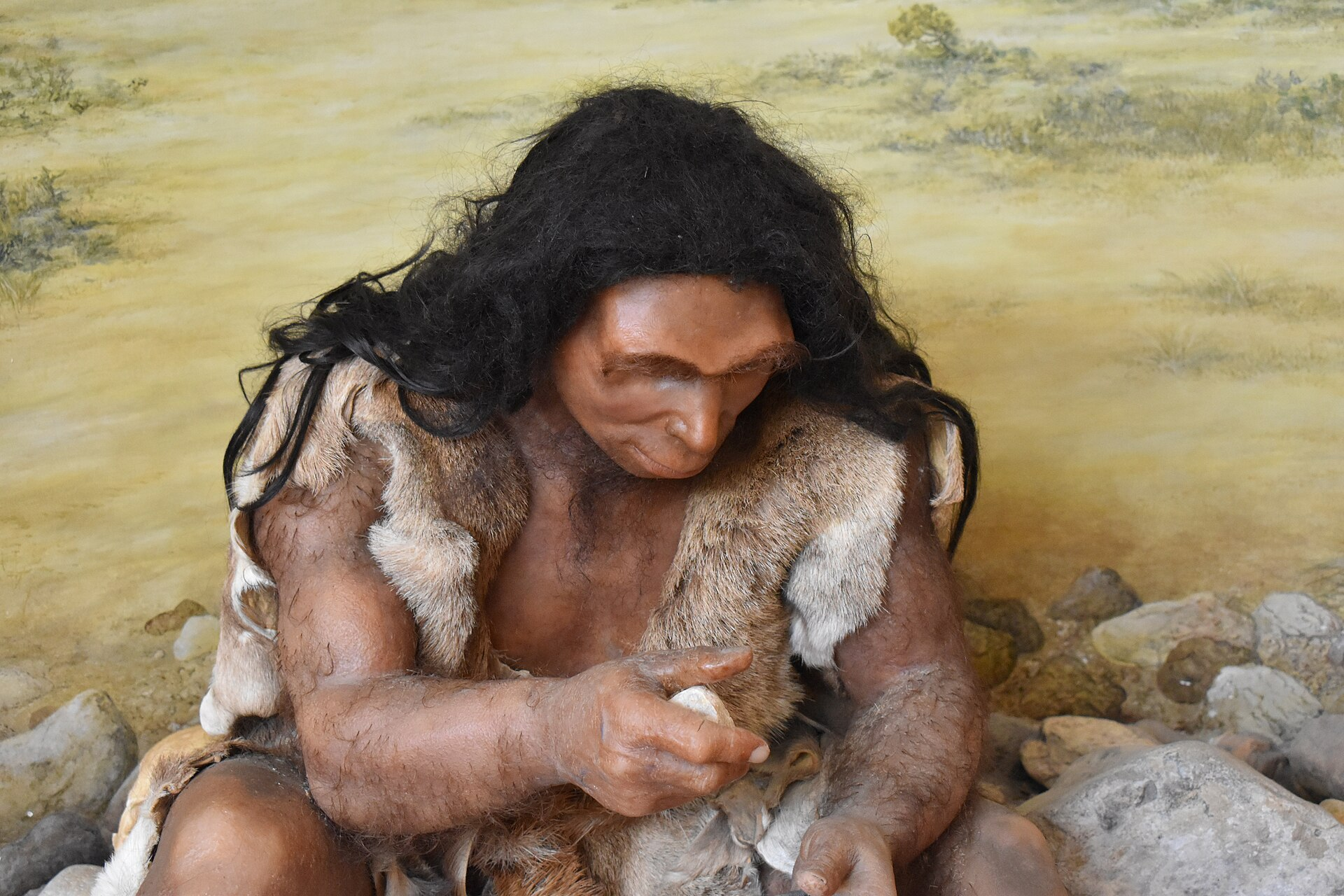
Reconstruction of Homo heidelbergensis.
These humans did not arrive in a single migration.
Their presence in France is the result of slow migrations, spread over tens of thousands of years, generation after generation.
They followed:
- animal herds,
- rivers,
- resource-rich areas.
👣 A life in constant movement
These early human groups were strictly nomadic.
They had no permanent settlements.
They temporarily settled:
- in caves,
- under rock shelters,
- or in the open, near rivers.
When an area became less favorable (cold, lack of food), the group moved on.
Each generation passed on to the next:
- routes,
- safe locations,
- survival techniques.
🪨 The emergence of the first tools
To survive, these humans made stone tools.
The oldest tools found in France include:
- sharp stone flakes,
- hand axes, shaped on both sides.

Stone hand axe used by early humans.
These tools were used to:
- cut meat,
- break bones,
- work wood and hides.
Tool-making relied on know-how passed down orally from one generation to the next.
🧊 A dangerous environment
Prehistory was a time of great dangers:
- extreme cold,
- predators (cave lions, bears),
- diseases,
- often fatal injuries.
_-_Mauricio_Ant%C3%B3n.jpg)
The cave lion, one of the most formidable predators of the time.

The cave bear, a solitary giant of mountainous regions.
Humans shared their environment with a megafauna that has now disappeared:
- mammoths,
- woolly rhinoceroses,
- giant bison.
_-_Mauricio_Ant%C3%B3n.jpg)
The woolly mammoth, an emblem of the Ice Age.

The woolly rhinoceros, adapted to cold steppes.

The steppe bison, ancestor of modern bison.
Survival depended on:
- group solidarity,
- cooperation,
- the experience of elders.
🔥 A very slow but continuous evolution
For most of Prehistory, progress was extremely slow.
A technique could remain unchanged for tens of thousands of years.
But every improvement, even small, increased the group’s chances of survival.
These early human generations laid the foundations of all human history:
- social organization,
- transmission of knowledge,
- adaptation to the environment.
🧠 Key takeaways
- Humans have lived in France for about 1 million years
- The first inhabitants were Homo erectus and Homo heidelbergensis
- They were nomadic
- They made stone tools
- Progress was slow but steady
📸 Image credits
- Saint-Acheul hand axe — Muséum de Toulouse, CC BY-SA 4.0, via Wikimedia Commons
- Cave lion — Mauricio Antón, CC BY 2.5, via Wikimedia Commons
- Cave bear — Sergiodlarosa, CC BY-SA 3.0, via Wikimedia Commons
- Woolly mammoth — Mauricio Antón, CC BY 2.5, via Wikimedia Commons
- Woolly rhinoceros — ДиБгд, CC BY-SA 4.0, via Wikimedia Commons
- Steppe bison — Robert Pawlicki, CC BY-SA 4.0, via Wikimedia Commons
- Homo erectus reconstruction — Tiia Monto, CC BY-SA 3.0, via Wikimedia Commons
- Homo heidelbergensis reconstruction — local asset
📚 Sources
- INRAP – Prehistory in France
https://www.inrap.fr - National Museum of Natural History (MNHN)
https://www.mnhn.fr - CNRS – Origins of Humanity
https://www.cnrs.fr - French Ministry of Culture – Archaeology
https://www.culture.gouv.fr - Encyclopædia Britannica – Prehistoric Europe
https://www.britannica.com