

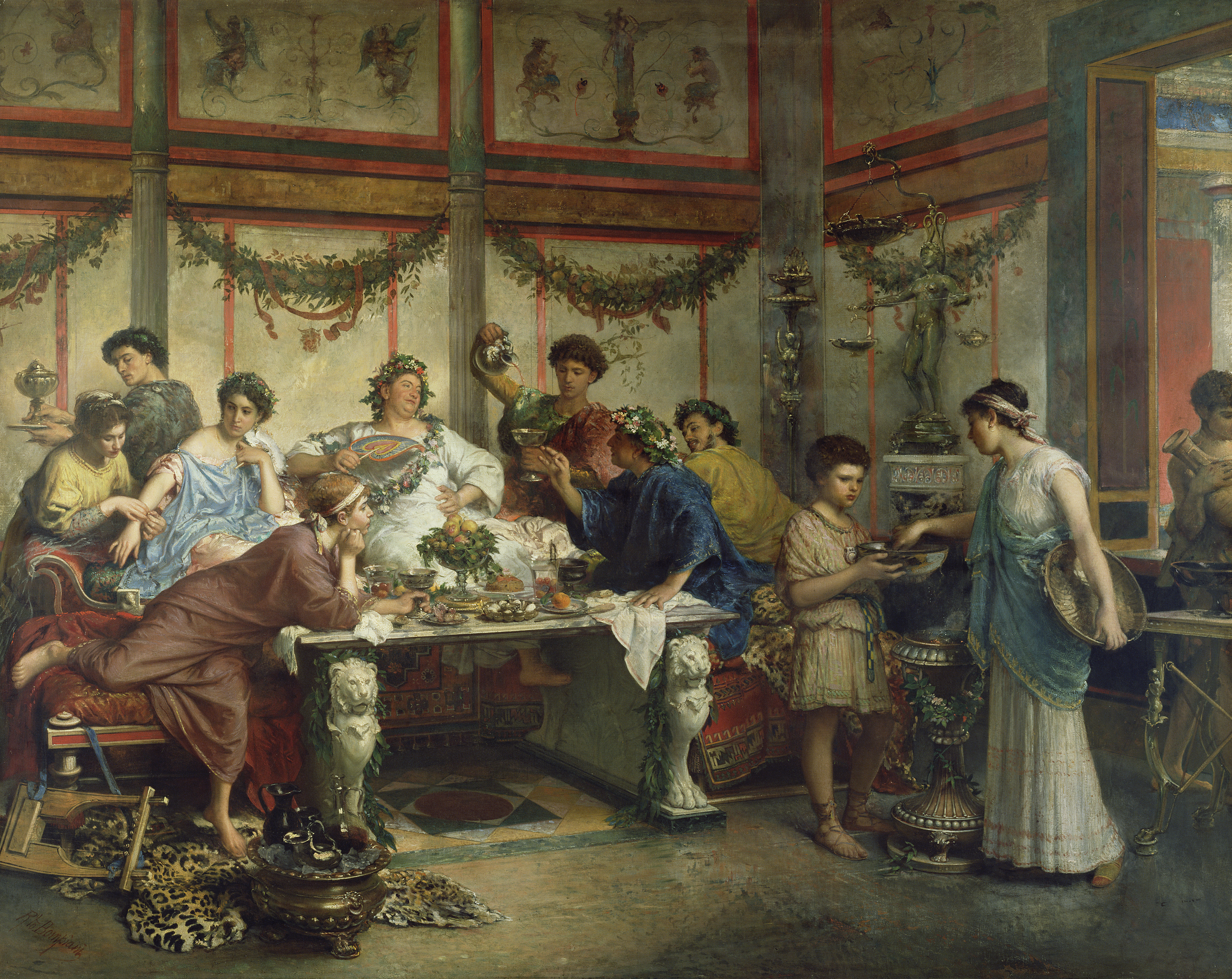
Peak and Crises of Roman Gaul
p3100 à 300
Between the 2nd and 3rd centuries, Gaul follows a contrasted trajectory. After a phase of prosperity and stability, it is gradually confronted with political, military, and social crises. This era marks both the high point of Gallo‑Roman civilisation and the first signs of fragility within the Empire.
🏛️ The peak of Roman Gaul
In the 2nd century, Gaul benefits fully from the Pax Romana. Political stability encourages economic growth, the development of cities, and the enrichment of local elites.
Rural life is structured around large agricultural estates, while cities fill with public monuments. Gaul becomes a prosperous region, fully integrated into the Empire and connected to major commercial networks.
🧑🤝🧑 A stabilised and integrated society
In the 2nd century, Gallo‑Roman society reaches a high level of organisation and cohesion. The framework of city‑states now structures political and administrative life, and local elites occupy a central place in the territory’s functioning. Emerging from former Gallic aristocracies, they are fully integrated into the Roman system: they administer cities, dispense justice, and finance public construction, while adopting Roman cultural codes (Latin language, institutions, lifestyles).
This integration is strengthened by a major legal development. In 212, Emperor Caracalla grants Roman citizenship to almost all free men of the Empire. This measure reduces distinctions between provincial and Italian populations, and further unifies the imperial whole on legal and political grounds.
In cities, society appears stable and structured. Notables dominate civic life, while artisans, merchants, and workers participate in a dynamic economy. In the countryside, the population is organised around agricultural estates, contributing to supplying urban centres.
However, this stability remains relative. Social and military tensions persist in the background. In 186, a revolt led by the deserter Maternus breaks out and crosses Gaul before spreading as far as Spain and Italy. Quickly repressed, this movement reveals the existence of marginalised groups and the fragility of imperial control in certain regions.
Thus, 2nd‑century Gallo‑Roman society appears both integrated and hierarchical, yet crossed by occasional tensions that foreshadow the difficulties of the following century.
✝️ The first Christian communities
In the 2nd century, Christianity spreads slowly in Gaul, mainly in large cities such as Lyon (Lugdunum) or Vienne. This diffusion relies on commercial networks and mobility within the Empire, but communities remain few in number and often discreet.
The new religion differs from traditional cults by rejecting polytheism and the imperial cult. This position sets it apart from dominant religious practices and arouses mistrust and hostility. Christians are sometimes accused of subversive behaviour, such as refusing to participate in public rites.
In 177, in Lyon, a persecution breaks out during the festivals of the imperial cult. Several Christians are arrested, tried, and executed in the amphitheatre. Among them, Blandina becomes an emblematic figure of Christian martyrdom. Bishop Pothinus dies in prison after ill‑treatment, and Irenaeus succeeds him as head of the community.
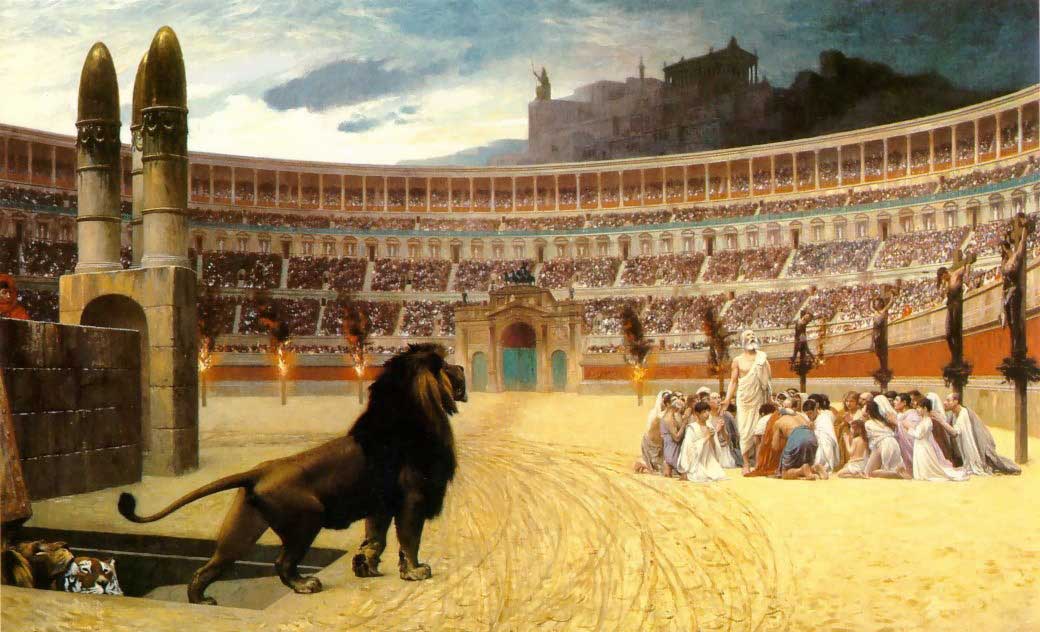 Christian martyrs — Source: Wikimedia Commons
This well‑documented episode is one of the earliest precise testimonies of Christianity’s presence in Gaul. It illustrates both the gradual establishment of the religion and the tensions it provokes in a society still largely attached to Roman religious traditions.
Despite these occasional persecutions, Christianity continues to grow gradually, laying the foundations for a major religious transformation in the centuries that follow.
⚔️ Gaul in imperial power struggles
At the end of the 2nd century, Gaul becomes directly involved in Roman civil wars. Far from being a peripheral province, it becomes a strategic space, controlled by powerful legions and located on the routes leading to Rome.
In 195, the general Clodius Albinus, governor of Britain, is proclaimed emperor by his troops. He crosses Gaul, establishes his headquarters in Lugdunum (Lyon), and rallies part of the local forces. His position enables him to control a vast territory and assemble a significant army with the aim of marching on Rome.
Emperor Septimius Severus reacts quickly. After securing his position in the East, he marches toward Gaul to confront his rival. The decisive confrontation takes place in 197 at the Battle of Lugdunum, one of the largest civil‑war battles in Roman history.
 Septimius Severus — Source: Wikimedia Commons
Clodius Albinus’s defeat is total. He commits suicide after the battle, ending his bid for power. The consequences for Gaul are severe: Lyon, which supported Albinus, is harshly punished and sacked. This episode illustrates the violence of Rome’s internal conflicts and their direct impact on the provinces.
Thus, Gaul appears as a major stake in imperial power struggles. Control of its resources, cities, and legions can determine the outcome of conflicts for the Roman throne.
🛡️ Border pressure and early invasions
From the end of the 2nd century onward, Gaul faces increasing pressure on its frontiers, especially along the Rhine. Although this boundary is heavily militarised, it remains a contact zone with Germanic peoples.
Between 172 and 174, groups such as the Chatti and the Chauci launch incursions into Belgic Gaul. These attacks are repelled, but they reveal the frontier’s vulnerability and the need for a constant military system.
In the 3rd century, the situation deteriorates sharply. Incursions become more frequent and penetrate deeper inland. The Franks and the Alamanni cross the Rhine repeatedly and push into the interior:
- in 253, groups reach the region of Lutetia
- in 259, some raids descend as far as the Pyrenees
- around 275, new waves of plundering strike Gaul
These attacks are no longer mere isolated raids: they durably disrupt certain regions, cause destruction, and weaken the local economy.
Faced with this threat, Roman authorities reinforce defences. Fortifications are built or strengthened, especially around cities, and legions are mobilised more intensively to monitor the frontier.
Thus, Gaul—long protected by the Pax Romana—gradually becomes an exposed region. These external pressures foreshadow the Empire’s growing difficulties in controlling its borders in the 3rd century.
👑 The Gallic Empire (260–274)
 The Gallic Empire — Source: Wikimedia Commons
In the context of the 3rd‑century crises, a major rupture occurs in 260. The general Postumus, commander of forces in Gaul, seizes power after eliminating Emperor Gallienus’s representative. Proclaimed emperor by his troops, he founds an independent state known as the Gallic Empire.
This new entity brings together Gaul, Britain, and, temporarily, part of Spain. Postumus sets up a full organisation inspired by the Roman model: administration, army, coinage, and its own institutions. Above all, he manages to defend the territory against Germanic invasions, which earns him support from part of the local population.
After Postumus’s death in 269, the Gallic Empire enters a period of instability. Several emperors succeed one another quickly, such as Marius, Victorinus, and then Tetricus. Internal revolts break out, notably at Autun, and certain regions defect back to Rome.
Despite these difficulties, this parallel empire lasts for more than a decade, evidence of the central Roman government’s fragility at the time.
In 274, Emperor Aurelian launches a decisive campaign against Tetricus. The confrontation ends with Aurelian’s victory at the Battle of the Catalaunian Plains. The Gallic Empire is reintegrated into the Roman Empire, bringing this experiment in independence to an end.
This episode illustrates both the provinces’ capacity to organise in times of crisis and the limits of imperial control. It marks a unique moment when Gaul temporarily becomes an autonomous centre of power again.
⚔️ A time of deep crises
The 3rd century represents a clear break with the prosperity of the previous century. The Roman Empire undergoes a lasting crisis, characterised by chronic political instability, power struggles, and economic difficulties.
Emperors succeed one another rapidly, often elevated by the army and then overthrown in turn. This instability weakens central authority and directly affects the provinces, including Gaul.
Internal conflicts and invasions lead to major destruction. Some cities are attacked or plundered, such as Autun during revolts and prolonged sieges. To protect themselves, many city‑states reduce their area and build stronger walls. The countryside, for its part, is hit by insecurity and sometimes abandoned, disrupting agricultural production.
Economically, exchanges slow and the currency loses value, worsening hardships. Fiscal pressure increases to fund the army, weighing on populations.
In this context, social tensions appear. In 285, the revolt of the Bagaudae breaks out in northern Gaul. This movement brings together peasants, tenant farmers, and marginalised groups confronted with poverty and fiscal constraints. They rise up against the established order, forming armed groups difficult to control.
Emperor Maximian intervenes to restore order and manages to crush the revolt. However, the episode reveals the scale of social imbalances and the limits of imperial control.
Thus, the 3rd century appears as a period of deep crises in which the accumulation of political, military, and social unrest durably weakens Gaul and the Empire as a whole.
🏗️ Reorganisation and the end of the period
In response to the 3rd‑century crises, the Roman Empire undertakes a profound reorganisation to restore order and stability. These reforms affect the army, administration, and the exercise of power.
Military effort is strengthened. Frontiers, especially along the Rhine, are better defended, and the army is reorganised to react more quickly to invasions. Gaul, on the front line against Germanic peoples, becomes a major strategic space within this defensive system.
At the same time, the administration is reformed to improve territorial control. Provinces are reorganised, and imperial power moves closer to sensitive zones, notably the frontiers.
The most significant transformation occurs in 293 with the establishment of the Tetrarchy by Emperor Diocletian. Power is now shared between two Augusti and two Caesars, each governing a portion of the Empire.
 The first Tetrarchy of the Roman Empire — Source: Wikimedia Commons
Within this framework, Gaul is entrusted to Constantius Chlorus, who makes it an essential base of his power. Trier becomes a major imperial capital, close to the Rhine and the zones of tension. This organisation enables more effective crisis management and a stronger imperial presence in the provinces.
Thus, the end of the 3rd century marks a decisive transition. The Empire does not disappear, but transforms in depth to adapt to new challenges. Gaul, at the heart of these reforms, remains a key territory within this new balance.
Conclusion
Between 100 and 300, Gaul experiences a contrasted evolution, moving from an age of prosperity to a time of deep crises. The 2nd century represents the peak of Gallo‑Roman civilisation: flourishing cities, a dynamic economy, and advanced integration into the Empire.
In the 3rd century, this equilibrium deteriorates. Germanic invasions, civil wars, and social tensions durably weaken the territory. Located at the crossroads of frontiers and major military routes, Gaul becomes particularly exposed to these disruptions.
However, these crises do not lead to total collapse. On the contrary, they drive significant transformations. The military, administrative, and political reforms undertaken at the end of the century restore a measure of order and strengthen imperial control.
This period therefore marks a decisive transition. It ends the stability of the High Empire and prepares the emergence of a new balance—Late Antiquity—in which Gaul will continue to play an essential role.
Image credits
- Christian martyrs: Jean‑Léon Gérôme, Public domain, via Wikimedia Commons
- Septimius Severus: Edwin A. Morrow, Public domain, via Wikimedia Commons
- The Gallic Empire: Pomalee, Public domain, via Wikimedia Commons
- The first Tetrarchy of the Roman Empire: IvanBondarev, CC BY-SA 4.0 https://creativecommons.org/licenses/by-sa/4.0, via Wikimedia Commons