

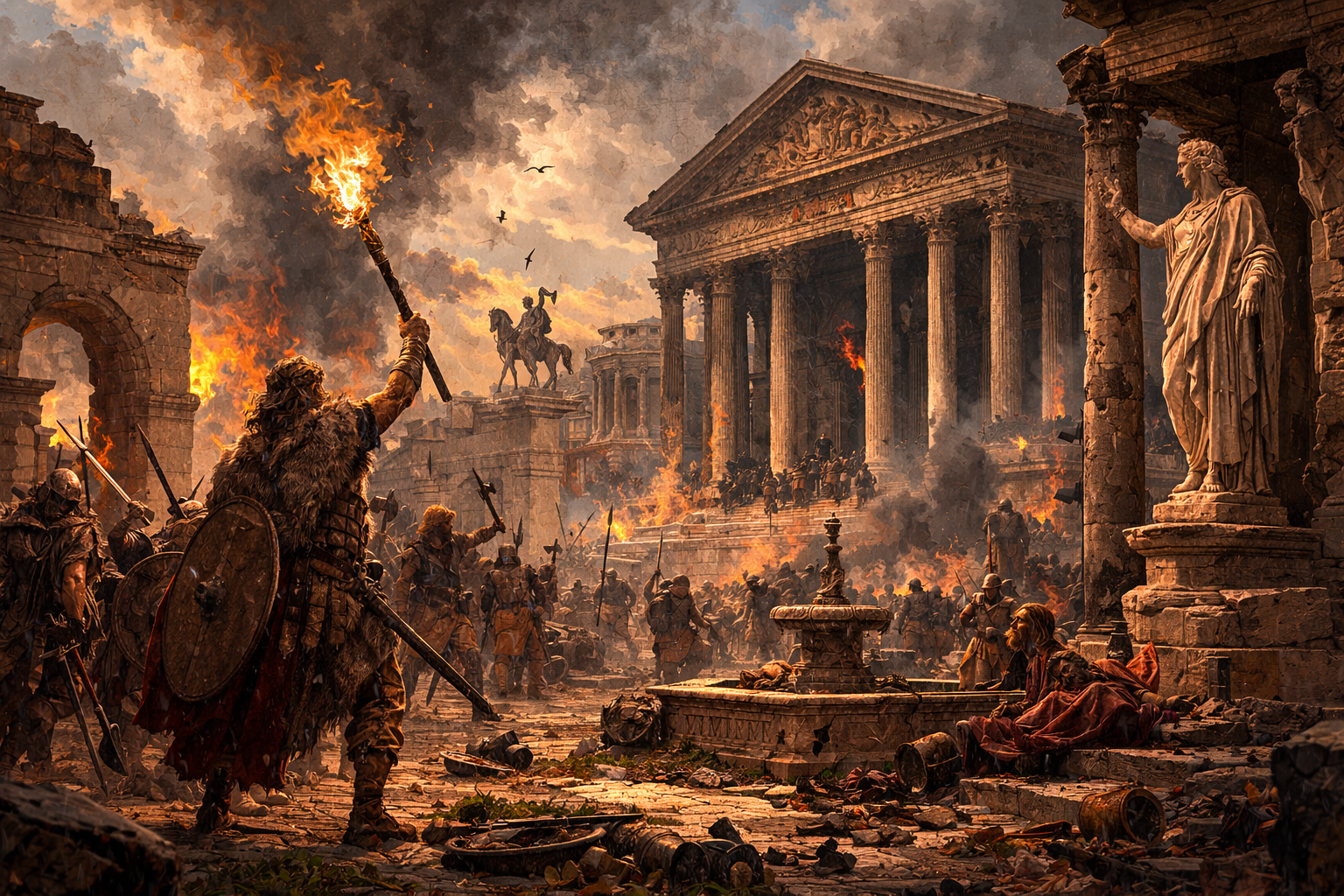
3rd Century: Crisis and the First Bishops
p3≈ 200 à 300 ap. J.-C.
⚔️ 3rd Century: The Empire Under Siege
The 3rd century marked a brutal turning point in the history of the Roman Empire.
After two centuries of prosperity, the Pax Romana collapsed. Between 235 and 284, the Empire went through a period known as the Crisis of the Third Century.
Emperors rose and fell at a frantic pace, civil wars multiplied, and the frontiers were no longer protected.
Gaul, once peaceful, became exposed to attacks from across the Rhine.
 Map of the Germanic limes, the fortified frontier of the Roman Empire — Source: Wikimedia Commons
🛡️ New enemies: Franks and Alamanni
In the 3rd century, new Germanic peoples appeared.
Unlike earlier tribes, these groups were powerful confederations capable of uniting multiple peoples.
The Franks
The Franks emerged north of the Rhine.
Their name probably meant “the free men” or “the brave”.
They stood out for:
- their warrior skills
- their fast raids
- maritime attacks on the coasts of Gaul and Britain
The Alamanni
The Alamanni appeared further south, along the Upper Rhine.
Their name means “all men”, suggesting a coalition of several Germanic tribes.
They regularly crossed the Roman limes and launched destructive raids as far as:
- Gaul
- Italy
- sometimes even Spain
 Depiction of a Germanic warrior in Late Antiquity — Source: Wikimedia Commons
🔍 Zoom — Franks and Alamanni: Warriors of the forest
🏚️ Rome’s powerlessness
Why could Rome no longer defend Gaul?
Military anarchy
Between 235 and 284, more than 20 emperors followed one another.
Most were proclaimed by legions and then assassinated a few years later.
Armies often left the frontiers to fight civil wars.
Economic crisis
The Empire also suffered a major economic crisis:
- massive inflation
- currency debasement
- decline of trade
People grew poorer and cities began to decline.
Cities fortify themselves
Faced with insecurity, many Gallo-Roman towns built new walls.
These fortifications often reduced the size of cities to make them easier to defend.
 Gallo-Roman walls in Le Mans (3rd-century enclosure) — Source: Wikimedia Commons
🌪️ The Gallic Empire (260–274)
Faced with Rome’s neglect, Gaul tried a unique political experiment.
In 260, a general named Postumus was proclaimed emperor by his troops.
He founded an independent state called the Gallic Empire.
 Coin bearing the effigy of Emperor Postumus — Source: Wikimedia Commons
This empire included:
- Gaul
- Britain
- sometimes Spain
Postumus organised:
- an effective army
- an administration
- a new currency
His goal was not to destroy Rome, but to protect the western provinces.
However, the Gallic Empire weakened because of internal rivalries.
In 274, Emperor Aurelian reunified the Roman Empire.
🔍 Zoom — The Gallic Empire: Why did independence fail?
🗡️ The great persecutions
In this time of crisis, emperors tried to restore the Empire’s unity.
Some accused Christians of abandoning the traditional gods.
Emperors Decius and Valerian launched the first systematic persecutions.
Christians had to:
- sacrifice to Roman gods
- recognise the emperor
- or face death
🔍 Zoom — The Great Persecutions: The Empire against the Cross
✝️ The first bishops of Gaul
Despite persecution, Christianity continued to spread.
Early communities were organised around the bishop, the city’s religious leader.
Bishops gradually became important figures in society.
They organised:
- mutual aid
- protection of believers
- the spread of the faith
Among the first famous bishops:
- Saint Denis, bishop of Lutetia (Paris)
- Saint Saturninus, bishop of Toulouse
 Saint Denis carrying his head after his martyrdom (medieval depiction) — Source: Wikimedia Commons
🔍 Zoom — Saint Denis: the legend of the cephalophore saint
🧠 Key takeaways
- The 3rd century was a period of major crisis for the Roman Empire.
- Germanic peoples (Franks, Alamanni) multiplied raids.
- Gaul experienced brief independence with the Gallic Empire.
- Cities fortified themselves and society transformed.
- Christianity continued to grow despite persecution.
📸 Image credits
- Map of the Germanic limes — ReMaps, CC BY-SA 4.0 https://creativecommons.org/licenses/by-sa/4.0, via Wikimedia Commons
- Germanic warrior — Silar, CC BY-SA 4.0 https://creativecommons.org/licenses/by-sa/4.0, via Wikimedia Commons
- Gallo-Roman walls of Le Mans — Fab5669, CC BY-SA 4.0 https://creativecommons.org/licenses/by-sa/4.0, via Wikimedia Commons
- Coin of Postumus — Bibliothèque nationale de France, Public domain, via Wikimedia Commons
- Saint Denis — Dobroš, CC BY-SA 4.0 https://creativecommons.org/licenses/by-sa/4.0, via Wikimedia Commons