


Odo: The Robertian King and the War of Prestige (888–898)
p4888 à 898
Odo is king of the West Franks from 888 to 898.
In 888, West Francia enters a new political phase. After the death of Charles the Fat, the kingdom’s great men elect Odo, count of Paris and hero of the capital’s defence during the Viking siege of 885–886.
For the first time in several generations, the crown is not given to a Carolingian.
This decision does not erase the dynasty of Charlemagne. On the contrary, it opens a decade of tensions, during which royal authority must constantly be rebuilt through military action, political negotiation, and the management of aristocratic alliances.
The immediate context explains the choice. Under Charles the Fat, the Carolingian Empire briefly seems reconstituted, but this unity does not prevent military crises. The Siege of Paris (885–886) deeply damages imperial prestige: the sovereign is blamed for intervening late and ultimately choosing to negotiate and pay the Vikings, letting them sail away to plunder other regions, especially Burgundy.
In this climate of distrust, Odo’s election appears pragmatic: the great choose a leader known for military effectiveness and the ability to defend the kingdom’s core.
 Coronation of Odo — Wikimedia Commons
Yet a non‑Carolingian king’s legitimacy remains fragile. To reinforce it, Odo organises a second anointing at Reims on 23 November 888. Before a large assembly gathering the main lords and bishops of the realm, he receives a crown sent by Emperor Arnulf of Carinthia, which he places on his own head. The gesture symbolically signals recognition by the ruler of East Francia and places Odo’s kingship within Carolingian political order.
This ceremony also has a special significance: it is the last great assembly gathering both lay great men and bishops from regions north and south of the Loire, still testifying to a certain political unity of the kingdom.
Despite these efforts, Odo rules a kingdom under constant pressure:
- recurring Viking raids,
- rivalries among princes,
- competition among major aristocratic families.
In this context, royal power rests on a simple equation: protect the kingdom, convince elites, and keep a political coalition together.
🔍 Zoom – 888: Compiègne and Reims, two anointings
🏛️ A less dynastic kingship
Odo’s reign illustrates a deep transformation of Frankish monarchy.
Like Boso of Provence in 879, Odo is not a direct descendant of Charlemagne. His election shows that high aristocracy now has decisive power in choosing the king.
Without completely rejecting Carolingian legitimacy, the kingdom’s great men reintroduce an older principle: aristocratic election and acclamation.
In this political system, dynasty is no longer enough: kingship depends on a leader’s ability to defend the kingdom and maintain balance among the great families.
The instruments of power reflect this new reality. Denarii minted in Odo’s name, notably at Toulouse, show that a non‑Carolingian kingship can now be inscribed in the administrative and symbolic practices of government.
⚔️ A contested monarch
From the start of his reign, Odo faces active opposition.
The archbishop of Reims, Fulk, remains loyal to dynastic Carolingian principle and supports several competitors. In this troubled context, an outside claimant, Guy III of Spoleto, is even anointed at Langres, a short‑lived attempt to redefine the kingdom’s balance.
At the same time, Ramnulf II, count of Poitiers, acts as protector of the young Charles the Simple, keeping open the possibility of a Carolingian return.
To stabilise his position, Odo seeks the support of the powerful king of East Francia, Arnulf of Carinthia. This backing helps reinforce the legitimacy of the Reims ceremony, accompanied by a more solemn ritual and royal insignia inspired by imperial tradition.
🌍 890–892: a kingdom at war and principalities in motion
Odo’s early years are marked by a chain of military and political crises. Viking raids continue, while great regional principalities assert autonomy. The kingdom appears fragmented, and royal authority must constantly impose itself against princes and invaders.
🐉 890: Viking raids and Breton assertion
Around 890, Vikings continue expeditions in the West. They besiege Saint‑Lô, massacre part of the population, and kill the bishop of Coutances. Exploiting divisions among Breton princes, they advance as far as the Blavet.
Bretons ultimately push them back in several fights. In the first clash, the Breton leader Judicaël is killed. Final victory belongs to Alan I, known as Alan the Great, who strengthens his prestige and adopts the title king of Brittany, affirming autonomy against neighbouring powers.
Meanwhile, political balance shifts in the South. On 6 June, an assembly meets at Valence, convened by Ermengard, widow of Boso of Provence. Her son Louis is proclaimed king of Provence with the support of his uncle Richard the Justiciar, who expands authority in Burgundy and is eventually recognised duke of Burgundy by King Odo.
The death of Count Ramnulf II of Poitiers on 5 August also opens a succession crisis in Aquitaine. Odo tries to impose his brother Robert as count of Poitiers, but local elites refuse. Power passes to Adémar of Angoulême, before Ebles Manzer, Ramnulf’s illegitimate son, imposes himself some years later.
In autumn, Vikings expelled from Brittany establish winter quarters near Noyon on the Oise. On 21 November, King Odo positions himself at Senlis to block their route to Paris, protecting the capital.
⚔️ 891: war against the Vikings
The year 891 is dominated by war against the Vikings.
On 2 May, they plunder the abbey of Saint‑Omer in Picardy, despite local resistance.
 Abbey of Saint‑Omer — Wikimedia Commons
In spring and summer, King Odo campaigns against the Northmen near Wallers, not far from Valenciennes. The Vikings escape. Soon after, Odo is surprised in Vermandois and suffers a setback in turn.
Vikings then push east. On 25 June, after crossing the Meuse near Liège and plundering the area around Aachen, they defeat an East Frankish army on the Gueule river.
Their advance is finally stopped by King Arnulf of Carinthia. On 1 September 891, at the battle of Leuven, Frankish forces repel the Vikings on the Dyle. The Viking leaders Sigfredhr and Godfredr are killed.
At the same time, a new threat appears in the South: Saracens land at Nice and begin ravaging Piedmont, before moving into the Alps to control strategic passes.
Taking advantage of unrest, Baldwin II of Flanders expands his power and seizes Artois up to the Canche.
🏛️ 892: princely revolts and new royal campaigns
In February 892, Vikings around Leuven launch another campaign. They ravage the left bank of the Rhine up to Bonn, then enter West Francia via Prüm and the Ardennes. The region between Reims and Cambrai is devastated.
On 17 April, an accidental fire destroys the abbey of Saint‑Vaast of Arras and the nearby castrum. In revolt against Odo, Baldwin II of Flanders seizes Arras and restores fortifications.
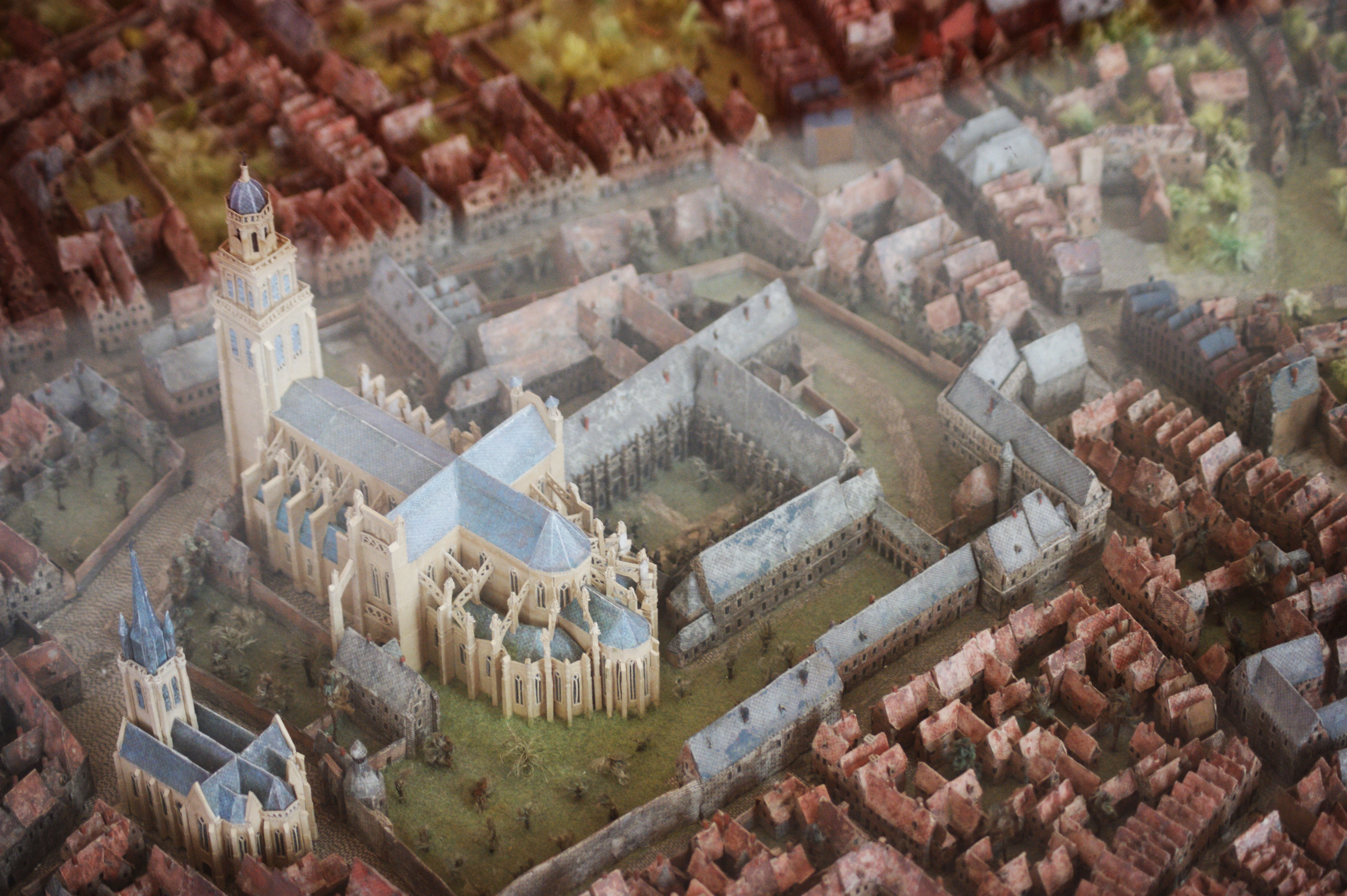 Abbey of Saint‑Vaast (Arras) — Wikimedia Commons
Odo intervenes in Flanders: he takes Laon and executes Count Walter. But instability continues and Baldwin withdraws to Bruges, mentioned for the first time in sources on this occasion.
On 13 June, Odo is at Tours with his brother Robert. He then campaigns in Aquitaine, supporting Aymar, who becomes count of Poitiers against Ebles Manzer. After staying at Limoges, Angoulême, and Périgueux, he marches against William the Pious and redistributes some benefices to his supporters.
The king is still attested at Cosne‑sur‑Loire on 22 September, a sign of constant travel to maintain authority.
In autumn, famine strikes West Francia. With local resources exhausted, Vikings leave the continent massively for England via Boulogne.
🔍 Zoom – 888 and 892: Montfaucon and Montpensier
⚔️ 893–896: war between Odo and Charles the Simple
In 893, dynastic rivalry breaks into the open in West Francia.
On 28 January 893, the young Charles III, called Charles the Simple, is anointed king at Reims by Archbishop Fulk. As legitimate Carolingian heir, he is supported by aristocrats attached to Charlemagne’s line: Baldwin II of Flanders, Pepin of Senlis (brother of Herbert of Vermandois), and several bishops.
This opens a period of double kingship: facing Odo, elected in 888, Carolingian partisans now have their own sovereign.
Odo reacts quickly. Supported by William of Aquitaine and Richard the Justiciar of Burgundy, he campaigns against his rival.
894: Odo’s counter‑offensive
In 894, Odo regains military advantage. Charles is beaten, retreats, and finds refuge in Burgundy under his supporters’ protection.
The victory strengthens Odo temporarily but does not end rivalry. West Francia remains deeply divided.
In practice, Odo’s authority is strongest between the Loire and the Seine, while Carolingian legitimacy remains strong between the Seine and the Meuse.
Princes between two kings
The rivalry also reflects aristocratic strategy. Charles is supported by Baldwin II of Flanders, worried about Odo’s attempt to regain control of honores and the royal fisc.
Princes often play one king against the other to increase autonomy and consolidate their territories.
895–896: campaigns
In 895, Odo campaigns from Corbie and marches on Arras, trying to assert authority in the North.
In 896, he seizes Péronne and Saint‑Quentin, two important strongholds of Vermandois.
These successes show the king’s real capacity for action, yet dynastic competition continues to weaken monarchy and maintain political instability.
🧬 897–898: political compromise and Carolingian return
Near the end of his reign, King Odo seeks to end the long rivalry with the Carolingian claimant Charles the Simple.
In 897, several events point toward appeasement. On 27 March, Easter day, the Norse leader Hundeus (Huncdée) is baptised at Denain, on the frontier between West Francia and Lotharingia. The young Charles the Simple, seeking alliances, acts as godfather. The conversion illustrates the complex relations between Frankish princes and Viking leaders, mixing diplomacy, religion, and political strategy.
Soon after Easter, negotiations resume between Odo and Charles’s supporters. After years of rivalry, the two camps reach a compromise.
Charles agrees to temporarily renounce the throne of West Francia. In exchange, he receives the stronghold of Laon, an important strategic position in the North. Odo, in return, officially recognises Charles as his successor, opening the way to a peaceful return of the Carolingian dynasty.
898: Odo’s death
King Odo dies on 3 January 898 at La Fère.
After his death, the great men apply the agreement concluded the year before and recognise Charles the Simple as king of the West Franks. Carolingian monarchy is restored.
But the decade that has passed has profoundly transformed the kingdom’s political balance. Odo’s election in 888 has shown that the crown can be granted by aristocratic choice, not only by dynastic succession.
🔍 Zoom – 898: succession and the Robertian legacy
Before his death, Odo takes care to preserve his family’s interests. Within the compromise with Charles, lands from the royal fisc are granted to his brother Robert, strengthening Robertian position.
Even if Carolingians return to the throne, the power of the Robertians is not broken. On the contrary, it takes deeper root in the kingdom’s politics — an ascent that will lead, a century later, to Hugh Capet.
🧠 Key takeaways
- 888: Odo’s election marks a less dynastic, more political kingship.
- Royal legitimacy rests on anointing, aristocratic alliances, and military victories.
- 893: Charles the Simple’s anointing reveals a deeply contested monarchy.
- 898: Carolingian return, but Robertian rise is now underway.
Image credits
- Portrait of Odo — Charles de Steuben, Public domain, via Wikimedia Commons
- Coronation of Odo — Grandes Chroniques de France, Public domain, via Wikimedia Commons
- Saint‑Omer abbey — Matthieu Debailleul, CC BY-SA 3.0 https://creativecommons.org/licenses/by-sa/3.0, via Wikimedia Commons
- Saint‑Vaast abbey (Arras) — Maxence Jeanjean, CC BY-SA 4.0 https://creativecommons.org/licenses/by-sa/4.0, via Wikimedia Commons