

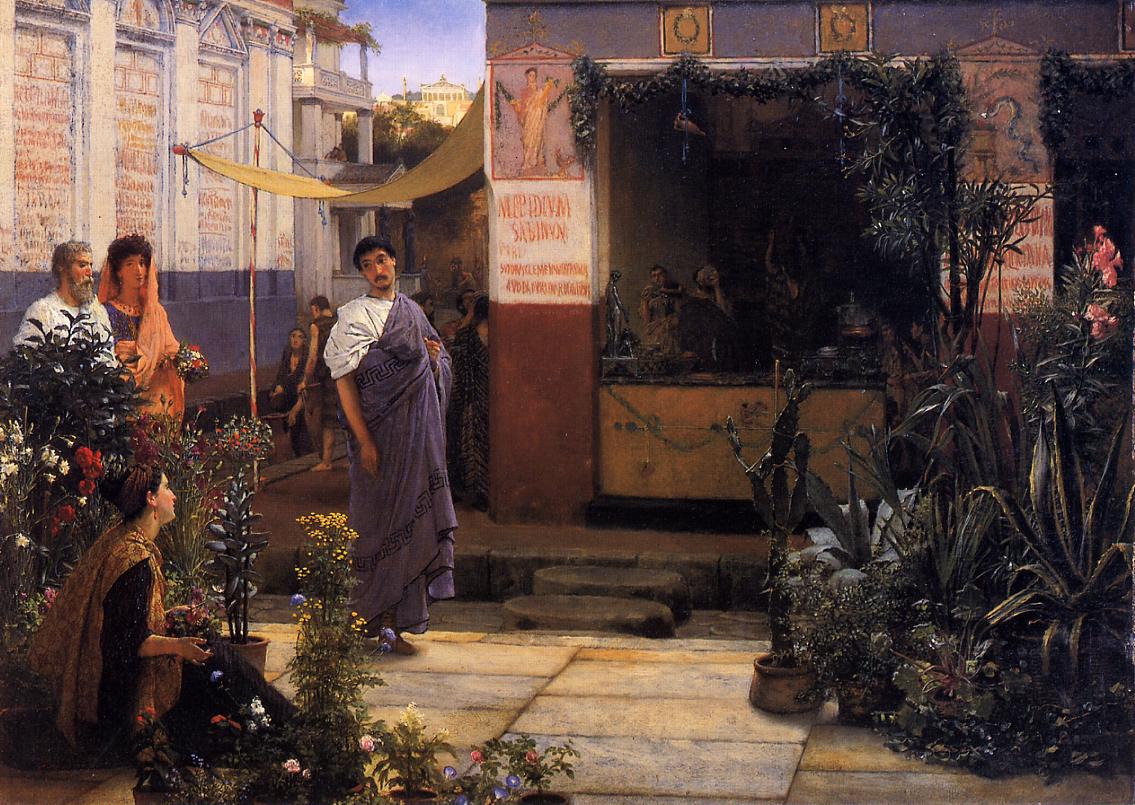
Living in Roman Gaul (AD 0 to 100)
p30 à 100
During the 1st century AD, Gaul enters a phase of relative stability and prosperity. After decades of conquest and transformation, it is no longer a territory in transition, but a region fully integrated into the Roman Empire.
This period marks the high point of Gallo‑Roman Gaul. The structures established under Augustus now function effectively, cities grow, and populations gradually adapt to a Roman way of life.
🏙️ An urban civilisation
In the 1st century, Gaul experiences significant urban growth. Without being fully urbanised, it sees its cities become the main centres of political, economic, and social life.
Lugdunum (Lyon) occupies a central place. Located at the confluence of the Rhône and the Saône, it becomes a major commercial hub and the administrative heart of the Gauls. It hosts the federal sanctuary, where representatives of the city‑states gather as part of the imperial cult.
 The Roman Empire during the 1st century — Source: Wikimedia Commons
Other cities also develop rapidly, such as Nîmes (Nemausus), Arles (Arelate), and Autun (Augustodunum). They are organised according to the Roman model, with a central forum, structured streets, and public buildings (temples, baths, amphitheatres).
Their inhabitants lead an active urban life: bathing, attending spectacles, commercial activities, and civic participation. Local elites play a key role in administration and gradually adopt Roman practices.
Thus, the city becomes a crucial driver of romanisation. It transforms lifestyles and helps integrate Gaul durably into the Roman Empire.
🧑🤝🧑 A Gallo‑Roman society
After the conquest, Gallic society does not disappear, but is reorganised in depth. Older tribal logics gradually fade in favour of a framework structured around the city‑states (civitates), each administering its territory and populations under Rome’s authority.
Elites play a decisive role in this transition. Coming from former Gallic aristocracies, they become relays of Roman power. They sit in local institutions, collect taxes, dispense justice, and finance public construction. This involvement allows them to keep status while gaining prestige. For them, adopting Latin, Roman law, and Mediterranean cultural models becomes a true social marker.
 Cicero denouncing Catiline in the Roman Senate — Source: Wikimedia Commons
The integration of these elites reaches an unprecedented level in the 1st century. In AD 48, Emperor Claudius allows certain Gallic notables to enter the Roman Senate. This measure confirms their place in the imperial system: they are no longer merely subjects, but full actors within Roman power.
Meanwhile, the broader population adopts Roman practices more slowly. In cities, inhabitants embrace urban lifestyles: attending baths, using coinage, participating in markets. In the countryside, changes are more gradual, but economic exchange and infrastructure promote the diffusion of Roman habits.
On the cultural and religious level, local traditions remain alive. Gallic cults persist, often associated with Roman gods, producing a blending of beliefs rather than a replacement. This adaptation allows a transition without brutal rupture and facilitates acceptance of the Roman model.
Thus, Gallo‑Roman society results not from simple domination, but from a process of integration. It combines continuity and transformation, giving rise to a stable, hierarchical society deeply shaped by Rome’s influence.
💰 An integrated economy
In the 1st century, Gaul becomes fully embedded in the Roman Empire’s economic circuits. This integration rests above all on an efficient communications network: roads, river routes, and ports enable rapid circulation of goods, information, and people across the territory.
Exchange intensifies between provinces. Gaul exports varied production: grain, wine, livestock, as well as crafted goods such as ceramics and worked metals. In return, it imports products from other regions of the Empire, notably oils, Italian wines, and luxury goods from the eastern Mediterranean. These commercial flows contribute to the Empire’s economic unification.
 Market scene in the Roman Empire — Source: Wikimedia Commons
Cities play a central role in this system. They concentrate markets, workshops, and places of exchange, while serving as redistribution points toward the countryside. Fairs and commercial spaces structure an increasingly monetised economy in which the use of coinage becomes widespread.
The countryside, meanwhile, remains the foundation of production. It is organised around agricultural estates, sometimes vast, which supply cities and armies. This complementarity between cities and countryside reinforces the system’s efficiency.
Thus, the Gallo‑Roman economy rests on a balance between local production and long‑distance exchange. It fosters the territory’s prosperity and anchors Gaul durably within a vast, interconnected economic space.
⚔️ A relative peace
From the beginning of the 1st century, Gaul enters a phase of relative stability often associated with the Pax Romana. Major revolts have ceased and imperial administration functions regularly. However, this peace remains closely tied to maintaining a strong military system, especially on the frontiers.
A major turning point comes in AD 9 with the Roman defeat at the Battle of Teutoburg Forest. Three legions are annihilated by Germanic peoples, ending Roman ambitions to expand beyond the Rhine. This event leads Rome to abandon, for the long term, the idea of conquering Germania.

The Rhine then emerges as a strategic frontier of the Empire. Far from being a simple natural boundary, it becomes an organised defensive line. Military camps and fortifications are built there, and several legions are stationed permanently to monitor and contain Germanic peoples.
In this system, Gaul plays an essential role. It serves as a logistical base for the army: providing resources, communication routes, and recruitment zones. Its position behind the front makes it a key space for supporting military operations and guaranteeing the frontier’s security.
Thus, the peace enjoyed by Gaul rests on a balance between political integration and military presence. Stable in appearance, it in fact depends on Rome’s ability to control and defend its borders.
🏛️ Gaul in the Empire: integration and tensions
In the 1st century, Gaul is fully integrated into the Empire, but it remains involved in its political crises.
⚔️ 68: the revolt of Vindex and the fall of Nero
In AD 68, Gaul becomes the starting point of a major political crisis in the Roman Empire. Caius Julius Vindex, governor of Gallia Lugdunensis and member of the Gallo‑Roman elite, rises against Emperor Nero, whose reign is increasingly contested.
Vindex does not seek power for himself. He calls for revolt in the name of restoring more legitimate government and supports Galba, governor of Hispania. His movement is part of broader discontent, linked in particular to heavy fiscal burdens and imperial authoritarianism.
However, the revolt quickly faces military opposition. The legions of Germania, still loyal to Nero, march against Vindex. The confrontation takes place near Vesontio (Besançon). Vindex’s army is defeated, and he takes his own life to avoid capture.
Despite this military failure, the political consequences are considerable. Vindex’s initiative triggers a chain reaction: Galba is proclaimed emperor by his troops, and other provinces rally to him. Isolated and abandoned by part of the army and the Senate, Nero is forced to commit suicide the same year.
 Emperor Nero watching Rome burn — Source: Wikimedia Commons
This episode marks an important turning point. For the first time, a movement initiated in Gaul plays a decisive role in the fall of an emperor. It also reveals the strategic importance of the provinces and the growing weight of local elites and armies in power struggles at the scale of the Empire.
⚔️ 69: Gaul at the heart of the year of the emperors
After Nero’s death in 68, the Roman Empire enters a period of great instability known as the “Year of the Four Emperors”. In AD 69, the legions stationed in Germania proclaim their commander Vitellius emperor, opening a new phase of civil war.
Gaul is immediately caught at the centre of these confrontations. Situated between the German provinces and Italy, it becomes a crucial corridor for armies marching on Rome. Vitellius’s troops cross the territory southward, followed by those of his rivals, notably supporters of Otho and then Vespasian.
These movements have direct consequences for local populations. Requisitions, looting, and fighting severely disrupt the regions crossed. Some cities, such as Divodurum (Metz), suffer major destruction as armies pass through.
 Vespasian’s triumphal entry into Rome — Source: Wikimedia Commons
Beyond the violence, this episode reveals Gaul’s strategic role in the Empire’s balance. As a crossroads between the militarised North and the Roman political core, it becomes a decisive space in power struggles. The legions stationed there or passing through it directly shape the choice of emperors.
Thus, in 69, Gaul is no longer merely an integrated province: it is a key territory whose control influences the fate of imperial power.
🔥 70: the attempted “Empire of the Gauls”
In AD 70, in the troubled context following the Year of the Four Emperors, a major revolt erupts in Gallia Belgica and along the Rhine. It is part of a broader movement known as the Batavian Revolt, which temporarily weakens Roman authority in the northern provinces.
Several local leaders, including Julius Sabinus, a member of the Gallo‑Roman elite, try to take advantage of this instability to challenge Rome’s power. Sabinus even proclaims himself emperor and seeks to establish a kind of “Empire of the Gauls”. The movement rallies some troops and mobilises parts of the local population, revealing tensions that persist despite romanisation.
However, the attempt remains limited and lacks lasting support. A significant portion of Gallic elites, now integrated into the Roman system, chooses to remain loyal to Rome. An assembly of Gallic city‑states comes out in favour of the Empire, gradually isolating the insurgents.
Rome’s response is swift. Imperial forces regain control and crush the revolts. Julius Sabinus, forced to hide for several years, is eventually captured and executed.
 Julius Sabinus bidding farewell to his family — Source: Wikimedia Commons
This episode highlights the limits of independence attempts. Despite occasional tensions, the majority of elites and city‑states remains attached to Roman order, which guarantees stability and prosperity. By the end of the 1st century, Gaul appears firmly integrated into the Empire, even if local resistance still exists.
✝️ The beginnings of Christianity in Gaul
In the 1st century, Christianity emerges within the Roman Empire and begins to spread slowly toward the West. In Gaul, this new religion remains very marginal, but it gradually takes root, mainly in major cities open to exchange.
 The calling of the Apostles — Source: Wikimedia Commons
The first Christian communities form in urban centres such as Lyon (Lugdunum) or Vienne. Their development is favoured by commercial networks and travel within the Empire, which facilitate the circulation of ideas and beliefs. These groups remain small and often discreet.
Christianity differs from traditional cults through its exclusive character: it rejects polytheism and the imperial cult, which can arouse distrust and misunderstanding. Christians therefore often live on the margins of dominant society, without official recognition.
Despite this minority position, the new religion gradually becomes established. It takes shape within a religious landscape already marked by a blending of Gallic and Roman traditions and begins to attract followers across different social environments.
Thus, in the 1st century, Christianity in Gaul is only at its beginnings. Still discreet, it nevertheless foreshadows major transformations that will profoundly shape the centuries to come.
🧠 Conclusion
In the 1st century, Gaul is fully integrated into the Roman Empire.
It experiences a period of stability and prosperity, marked by urban development, economic growth, and the integration of local elites.
However, this integration does not completely erase tensions. Political crises and certain revolts remind us that this balance remains fragile.
Gaul now appears as an essential province of the Empire, actively contributing to its functioning and evolution.
Image credits
- The Roman Empire during the 1st century: Cristiano64, CC BY-SA 3.0 http://creativecommons.org/licenses/by-sa/3.0/, via Wikimedia Commons
- Cicero denouncing Catiline in the Roman Senate: Cesare Maccari, Public domain, via Wikimedia Commons
- Emperor Nero watching Rome burn: Carl Theodor von Piloty (1826–1886), CC BY-SA 3.0 https://creativecommons.org/licenses/by-sa/3.0, via Wikimedia Commons
- Vespasian’s triumphal entry into Rome: Viviano Codazzi, Public domain, via Wikimedia Commons
- Julius Sabinus bidding farewell to his family: Josef Platzer, Public domain, via Wikimedia Commons
- Arminius at the Battle of Teutoburg Forest: Peter Janssen, Public domain, via Wikimedia Commons
- The calling of the Apostles: Domenico Ghirlandaio, Public domain, via Wikimedia Commons
- Flower market in ancient Rome: Lawrence Alma-Tadema, Public domain, via Wikimedia Commons